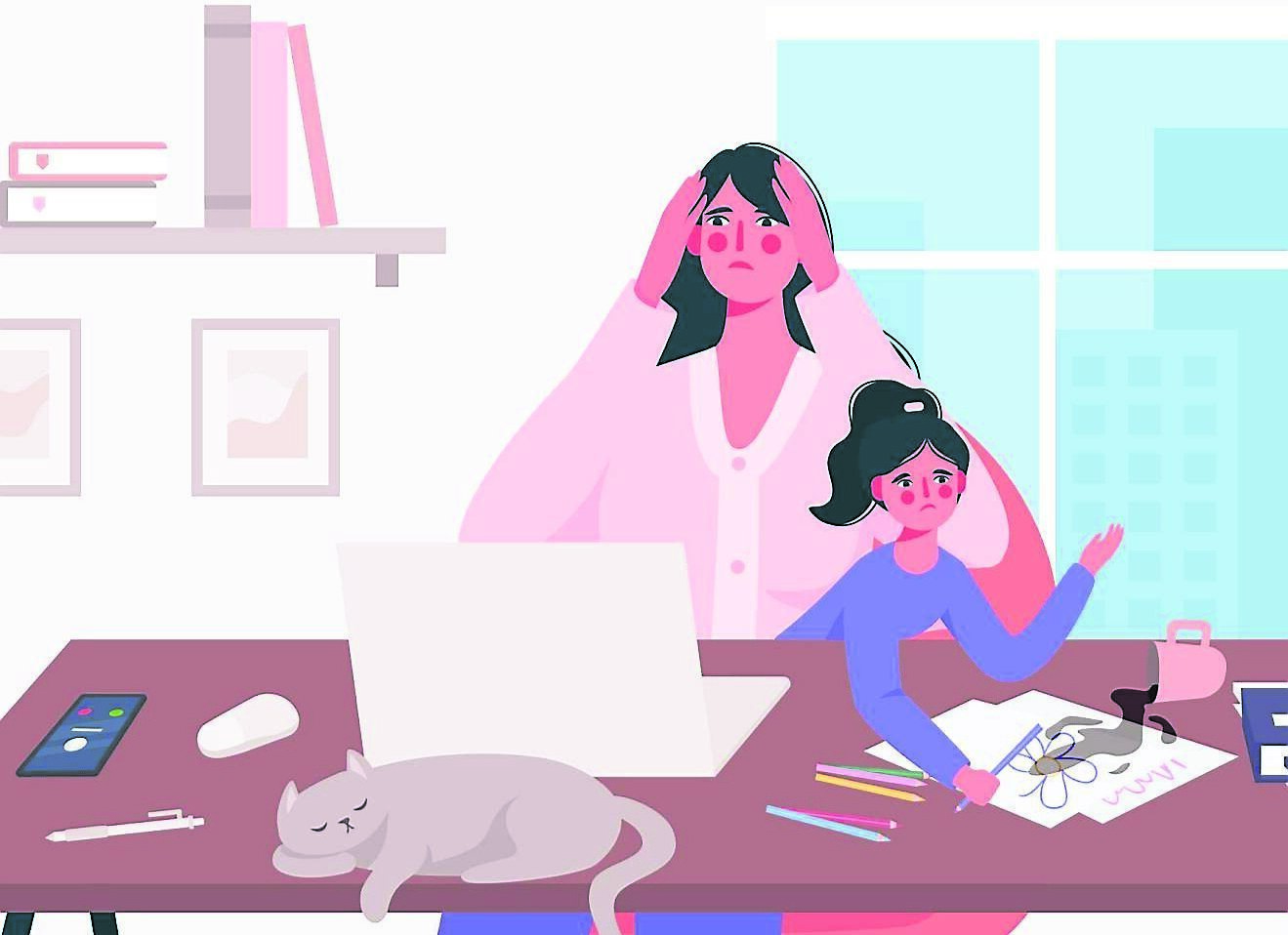
Mums need to be honest about the toll of school years — the 'Motherhood penalty' is real
Summer holidays mean additional strain for many women as they juggle work and childcare demands. Picture: iStock
Nine years into motherhood, and I assumed I’d be more career trailblazer than trad wife. But now that another summer is here, I can clearly see how balancing work and family life is such a stretch.
It’s a conversation I’m having with many mothers as we wrap up another school year.

One confesses that she thought it would get easier once the kids started school. That the grip would loosen, her autonomy and time would return. That she’d be able to properly focus on their career, health, and self again. But between Easter and midterms, half days, sports days, and surprise days, she now faces the three biggest annual tests of working parenting: June, July and August.
For mothers coming to the end of their first junior infant cycle, the admission is more like a confession of failure: “I didn’t expect to be stretched in so many directions.” And for the rest of us, who have a few seasons under our belts, there’s a quiet knowing that our shift as present caregiving mothers rolls on. And this isn’t a bad thing. It’s just not always an easy thing.
I’ve talked about this many times on my Stretch Marks podcast and the response is nearly always the same: Relief, recognition, and a kind of low-grade, resigned fury.
Because somehow we were made to assume that the early years of motherhood are the trenches and that once school begins, we will rise again. And perhaps this is true for some with the architecture of great childcare or family support, but for others this time of year brings the blunt realisation that we will be making compromises for the long term.
For context, I am self-employed, the flexible default parent, a choice I made willingly in 2021 after the birth of my second child, and one I will never ever regret.
I work at home during school hours, parent in the afternoons, and most evenings I slip back into my home office to complete a few more items on the list. I have attempted to create a balance that works around my children and, in turn, makes me feel like a good mother.

But professionally I am not the woman 28-year-old me assumed I’d be. Nor am I the woman 2026 needs me to be financially.
Because here’s what nobody prepares you for about school-age children: Their needs don’t diminish as they age — they get more complex.
The baby who needed me physically and emotionally for comfort is now the nine-year-old who needs me present mentally and empathetically to help her focus on homework, to listen to her little anxieties, to coordinate GAA or swimming, gymnastics, or drama. And please take a moment for all the mothers coming out of Communion and Confirmation season. Many of us are not OK. My children, by contrast, are having the time of their lives.
The data backs up the motherhood penalty. According to the CSO, 29% of women in employment worked part-time in the final quarter of 2025, compared with just 13% of men. When you look more closely at the shape of those statistics, it’s not random. The rate of part-time working among women in Ireland rises from 16.2% for those with no children, to 32.7% for mothers of one child, 37.2% for mothers of two, and nearly 47% for those with three or more. For fathers, meanwhile, the same progression barely registers — just 12.2% of men without children work part-time, a figure that falls only slightly as fatherhood increases. And this isn’t because men are uncommitted or disengaged, quite the opposite among the millennial dads, but work culture and systemic norms persist. It is what it is.
Part-time work is not inherently a problem either. Many women find it suits their lives. Me included.
A major international survey from 2020 found that 61% of mothers wished to work part-time, compared with 29% of fathers.
But there’s a difference between a genuine choice made freely and a choice made under structural duress, because the alternative of full-time work with inflexible hours, a culture of presenteeism, and a school that closes at 2.30pm is simply unworkable. When we talk about women “choosing” to step back, we need to be honest about the constraints within which that choice is made.
Those constraints have real, lasting consequences, which is my latest 3am concern as I sink further into this era of motherhood.
Research shows that when women reduce their working hours, the economic consequences can be significant: Lost earnings, stalled career trajectories, widened gender gaps, and future financial insecurity with a pension that may not meet her needs.
“The motherhood penalty” is real.
But here’s what I want every mother to know — if this feels hard, it’s because it is.
This is not a personal failing. This is a structural one. We have built an economy that requires two full-time earners to fund a family home, with a school calendar that still assumes that one of those earners is at home making memories.
For a single parent, it becomes impossible. One single mother put it simply to me: “I feel sad when I hear other parents say they’re looking forward to the summer holidays. For me it’s a time of survival.”
Another working parent I spoke to has called for the National Childcare Scheme to be extended to cover summer camps, and for workplaces to normalise options like shorter working hours during summer months, not as a concession, but just as a norm.
Until then, we do what Irish working parents have always done. We park our nervous breakdowns until September 1. We negotiate screentime and ice-cream for a minute to think while we Rosé our guilt away.
But at some point, without squashing the modern feminist dream, we need to get more honest about the toll the school years take.
We need employers to stop pretending that flexibility is a benefit graciously bestowed. We need working hours to reflect cultural realities.
We need partners to move past the stereotypical gender norms in workplaces and homes.
More than anything, we need to stop selling each other the story that says: Get through the baby years, and everything will be grand, because parenting is a series of different stretches, each with its own challenges, schedules, privileges and joy.
The school year doesn’t set you free. It just changes the shape of everything. And until we’re honest about that, we’ll keep hoping nobody thinks less of us for admitting that something isn’t working.
For many mothers, it isn’t working. Let’s start there.