Good vibrations: 'It's not just relaxing music — it reflects the human spirit'
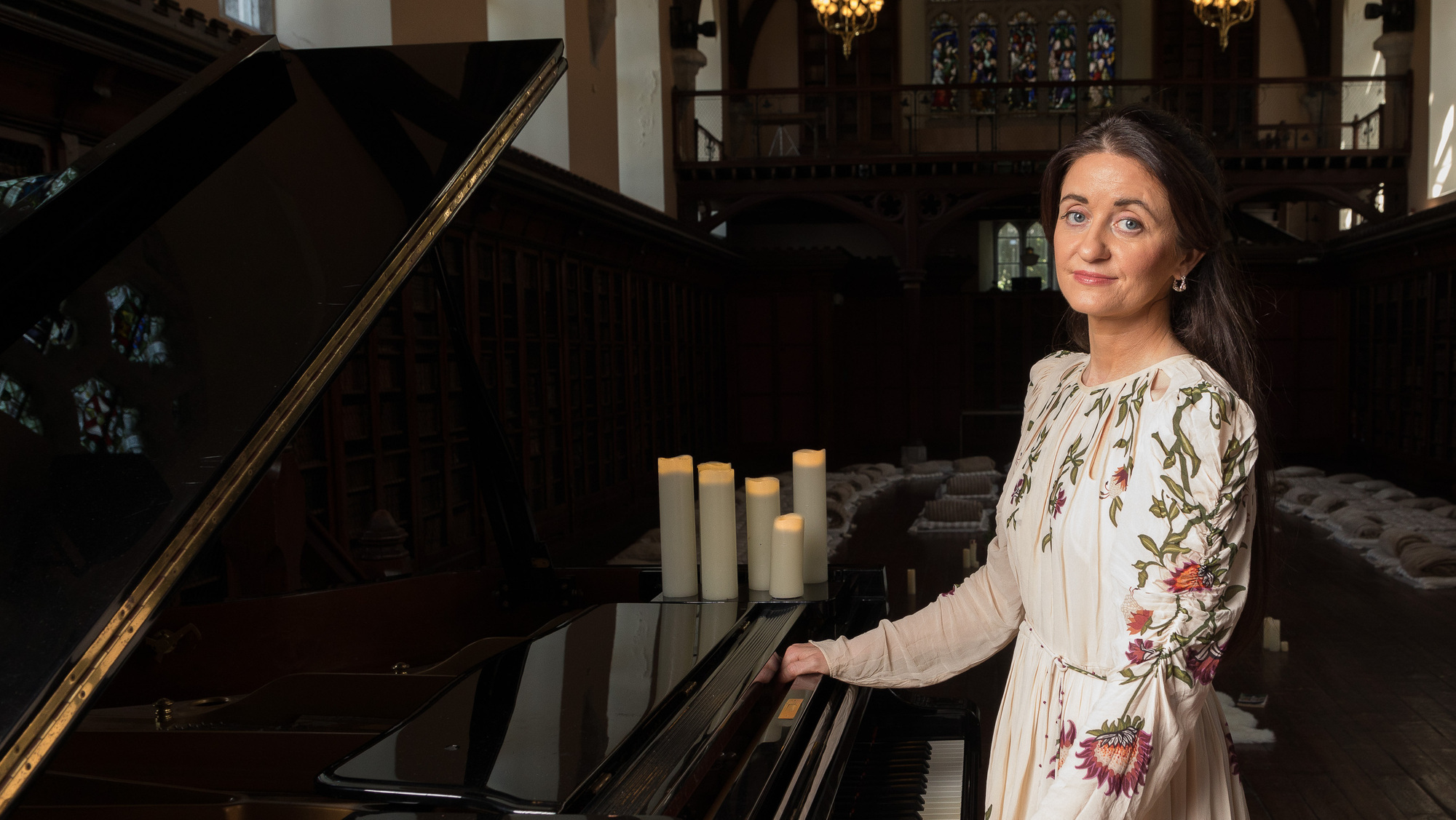
Composer Christina McMaster prior to her workshop Lie Down & Listen at the Aula Maxima in University College Cork. Picture: David Creedon
I step into the Aula Maxima in University College Cork (UCC). The last time I was in this room, I’d been sitting a modern poetry exam as part of my English degree. This is altogether different.
I’m here for Lie Down and Listen, created by Christina McMaster, a classically trained pianist and composer. It combines sound bath elements with a piano performance.
McMaster launched the experience in 2018 and has taken it around Britain, Ireland, and the US. The sessions typically take place in atmospheric venues, like re-purposed churches, heritage buildings and great halls, which McMaster believes add to the whole experience.
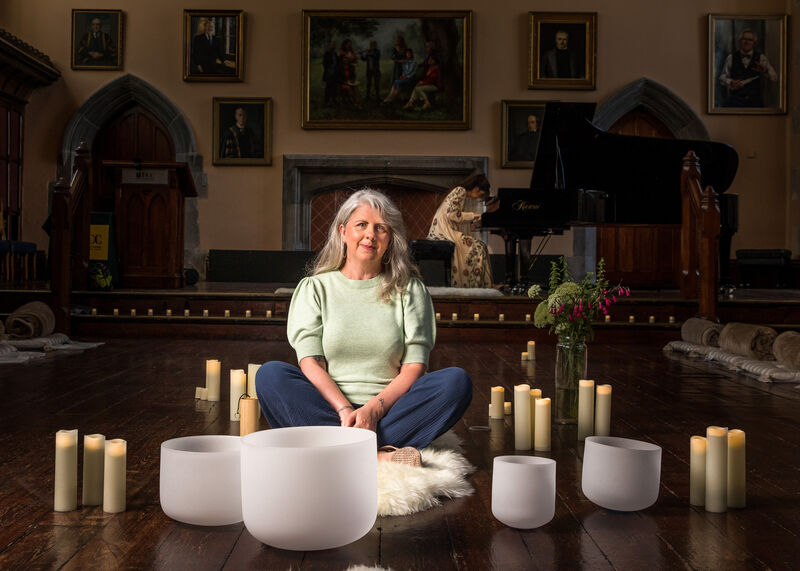
With its vaulted ceilings and book-lined walls, the cavernous Aula Maxima is an ideal setting for Lie Down and Listen. Steeped in history, the room was built in 1847 in the Gothic Revival style. It holds centuries of history, and that sense of gravity seeps into the space.
Dotted around the room are mattresses, with pillows and large cosy blankets. Sheepskin rugs and candles softened the dark wood of the room, and a large classical piano dominates on a raised area.
We are invited to sit down on our chosen mattress by McMaster. Accompanying her is Cork-based sound bath facilitator Sarah-Beth O’Mullane.
The idea that sound (its vibrations and frequencies) can calm the nervous system is an ancient one with roots in indigenous cultures and ancient Greek and Tibetan societies. We know that thousands of years ago, these cultures used chanting and metal bowls for therapeutic and spiritual purposes. The notion of the sound bath is more of a 20th-century concept, emerging alongside the growth of holistic health and wellness practices.
The Lie Down and Listen session combines the use of Tibetan and crystal bowls with classical music played on the piano. As we lie down, O’Mullane begins by rimming a large bowl, creating a deep, resonant sound that you can feel in your body. It has a hypnotic quality, stripping away the outside world and narrowing your focus to what you can hear and feel.
Separate lighter notes are created on smaller bowls, and in combination with the constant deep sound. I’m quickly immersed in sound.
That’s because sound works at a cellular level, explains sound therapist Nicola O’Sullivan of Anann Wellness, Cork, where she offers clinics and one-on-one sessions.
The unique element of Lie Down and Listen is the addition of classical music, and once McMaster sits at the piano and plays the first notes, the experience is what I can only describe as bliss.
The sounds hit me at an emotional level; I feel goosebumps and tears spring to my eyes. The music is at times joyful and uplifting, at other times sonorous and frenzied. In phases, it hits crescendos and slows down to single notes. It feels like McMaster is bringing us on a journey.
“I don’t simply play relaxing music — I choose specific music that reflects the human spirit and taps into specific emotions,” explains McMaster. “When people are lying down, particularly when they’re relaxed, they feel safe and can more readily feel emotions like joy and ecstasy. I’ll often play epic pieces of music that take people on a journey where they can feel their emotions reflected in the music.”
Feeling calm and relaxed from the sound bath, I find myself drifting off into an in-between sleep and awake zone. I’m still tethered to my surroundings, but it feels dreamlike.
That happens because your body is “slowing down and receiving the sound”, explains O’Sullivan. “The first thing [sound] does is help to calm and regulate our nervous system, and your body responds by softening, with tension starting to melt away.”
We have four major brain wave states: Beta, which is our alert state; alpha, a relaxed, meditative state; theta, a drowsy or light sleep state; and delta, a slow, restorative sleep state. Sound vibrations can slow brain waves from an active, alert state to calmer alpha or theta frequencies, which we associate with daydreaming or meditation.
If you’re open to the effects of sound instruments and the music, you might feel yourself drifting into that theta or sleep-like, meditative state, says O’Sullivan.
“Your body and your mind are completely slowing down. You’re not in your head anymore, which is beautiful because it’s not often in today’s busy world that we allow ourselves to feel present.”
Comparing it to a “massage for the senses”, O’Sullivan says that music can tap into a person’s emotional centre, and notes that certain keys are attuned to different chakras or energy centres in the body.
Hindu and Buddhist cultures believe we have seven main chakras in our bodies: the crown, third eye, throat, heart, solar plexus, sacral, and root chakra. While they are not scientifically proven, health professionals and scientists have argued that they may correspond to the body’s nervous system. Chakras form the basis for many holistic therapies, including yoga and sound baths.
According to O’Sullivan, in sound therapy, “Every chakra has a different note or key that it’s in alignment with. For example, your throat chakra is tuned to the key of G.”
That’s why, she says, when a certain bowl is played, you might feel it in a particular part of your body. “A bowl tuned to F may make you feel something in your heart, where your love and healing energy are stored.”
It’s the same with music. At one point during the experience, McMaster introduced a tune that she says begins and ends in the key of C, which she says is aligned to the body’s root chakra.
A 2025 study on the effects of music on the mental stress response in adults found that music, especially classical pieces, effectively reduced physiological stress markers, including cortisol levels, heart rate variability, and blood pressure.
Sound baths are also proving beneficial at alleviating tension and stress. A 2016 study showed sound baths, specifically using Tibetan singing bowls, relieved tension, feelings of anger, fatigue, and depressed mood.
Research continues into the effects of sound on the body. Binaural sound, where two different sound frequencies are played into each ear, is a relatively new area of study. Though research is limited, some evidence research suggests that listening to binaural beats can have a positive impact on stress or anxiety reduction.
We are wired to respond to sound from our time in the womb. “The first sound we ever heard is in our mother’s womb, the heartbeat,” says O’Sullivan. “Babies settle to the sound of a heartbeat, white noise, and other rhythmic sounds because their nervous systems recognise these as familiar and safe.”
That same wiring is what adults can tap into during a sound bath, she explains. “Your vagus nerve feels the slow, rhythmic sound, and signals to the body, ‘we are safe’, and then you can start to feel the calming, soothing benefits of the sound bath.”
As the classical music winds down in the Aula Maxima, and the final tinkling of the koshi bells echoes around the room, I return to my fully alert state again, but this time, the tension I usually hold in my neck and shoulders has eased. I was surprised to notice the session had lasted an hour and a half.
I look around the room, and everyone has a peaceful, slightly sleepy or dazed look about them. As we leave the room, I overhear people thanking McMaster and O’Mullane for the “wonderful experience”.
“I know I fell asleep,” laughs one woman. “I felt like I was on a journey,” says another.
As I wander out into the bright sunlight of UCC’s quadrangle, everything seems a little bit sharper, in focus. I feel refreshed and mentally revived, and later that night I experience one of the best night’s sleeps I’ve had in a long time.
- Lie Down and Listen will return to UCC on October 31 and November 1.
- liedownandlisten.com

CONNECT WITH US TODAY



Be the first to know the latest news and updates