Summer Economic Statement: Ministers won't have anything like €8.5bn for Budget 2027
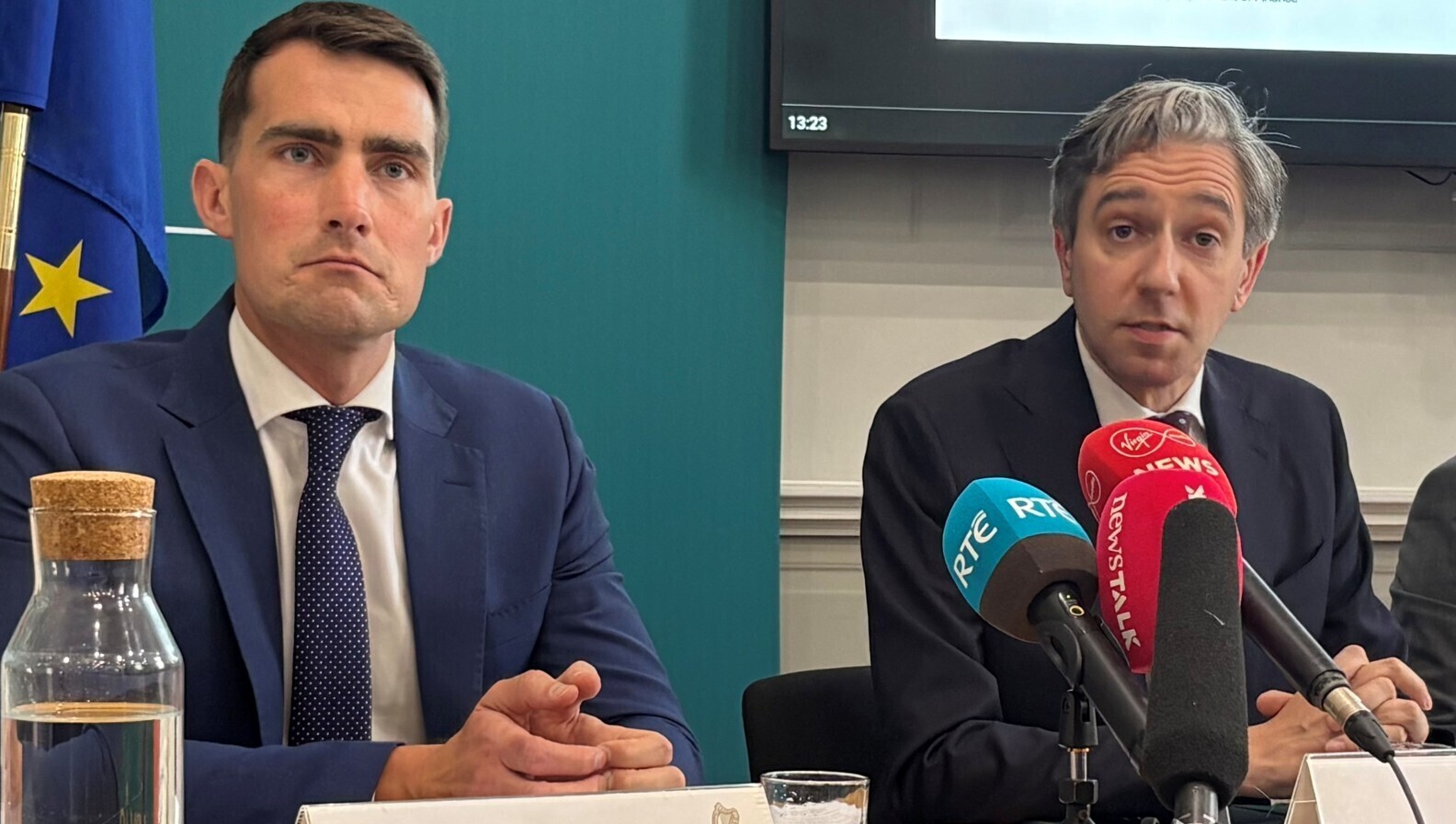
Public expenditure minister Jack Chambers and Tánaiste and finance minister Simon Harris announcing the Government's Summer Economic Statement this afternoon. Picture: David Young/PA
In just under 11 weeks, the Government will announce Budget 2027, but will be forced to grapple with the question of when is €7bn not really €7bn?
Today (Wednesday), as money ministers Jack Chambers and Simon Harris laid out the parameters of the budget, they revealed that they will have an additional €8.5bn to play with.
Some €1.5bn of that will be ringfenced to pay for tax measures — a cut in personal tax through an increase in the threshold for the higher tax rate is likely among other things — with the other €7bn assigned to spending.
Except that €7bn, while obviously really being €7bn, does not mean an additional amount purely to fund new measures in the likes of childcare, with much of the money already accounted for.
Read More
In total, €1.1bn is set aside for capital spending under the national development plan, around €2bn will be needed to cover inflationary pressures in services, and there will need to be around €2.5bn set aside for what is called existing levels of service or “standing still money”.
This is money which has been previously pledged or covers demographic growth and demand for services.
Very quickly, that €7bn has become €1.4bn, a healthy sum no doubt, but ignoring the elephant in the room.
As the Government prepares its budget, public sector unions will be balloting on industrial action in protest at the lack of a public sector pay deal. The prospect of hundreds of thousands of public and civil servants going on strike will send a chill down the spine of any government.
So it is unlikely that an agreement won’t be reached and will probably cost around €1bn at a minimum.
Now, the pot has shrunk to €400m.
Again, a very nice amount of money, but more limited in the scope of what it can be put towards.
Government leaders have openly indicated that a move will be made on the cost of childcare. There will be demands in education and health and housing and justice and any number of things you can envisage a minister and their team asking for.
Today, in the Department of Finance’s Whitaker Room, Mr Chambers made it clear that while there is additionality in the budget — government spending will climb to €125bn in 2027 — there will be no giveaways.
While being criticised on the opposition side as a neo-Charlie McCreevy, Mr Chambers was in fact preaching fiscal prudence, saying that some ministers who seek new initiatives will have to do so by finding efficiencies and savings. He made the point that many countries in which growth is flat are already doing such things.
Ireland has weathered the global shocks to the economy well in recent years, but more to spend creates more demand for that spending.
The coming months will see Mr Harris and Mr Chambers meeting with ministers who want part of that spending for their own projects.
They will spend the next 10 weeks or so batting back proposals, sometimes a more politically difficult position to be in than not having any money to spend in the first place.
- Paul Hosford, Deputy Political Editor

CONNECT WITH US TODAY



Be the first to know the latest news and updates