Ireland's long school holidays don't suit the modern family — but who's going to change them?
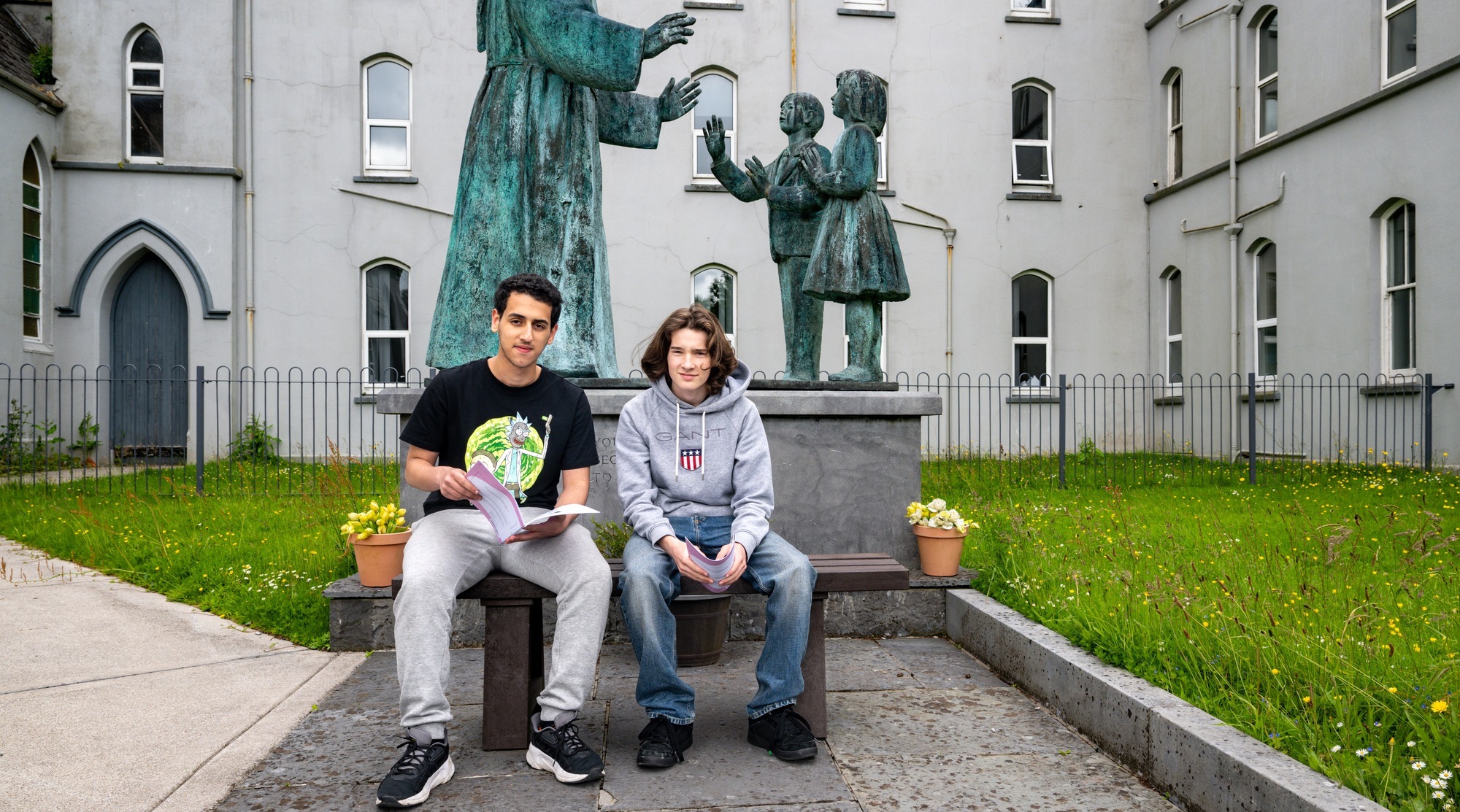
Aaser Shaaban (left) and Daniel McCarthy (right) outside Rochestown College holding their Leaving Certificate French exam papers on Tuesday. Parents around the country are quietly realising that they have just become responsible for an entire summer of life enrichment for their children. Picture: Chani Anderson
The Leaving Cert is finishing, school corridors are emptying, and parents around the country are quietly realising that they have just become responsible for an entire summer of life enrichment.
But at what point do we stop and check whether the systems we've inherited still make sense?
I'm talking specifically about summer holidays and daylight-saving time. I know, I know, these topics have been discussed to death. But perhaps that suggests something else entirely: either nobody is listening, or nobody knows who is supposed to be listening.
Who exactly decides these things? Where is their office? And why do most of us have no idea how to contact them?
The time is almost upon us: Summer Holidays. An event marked by the calendar as something to look forward to, something to get excited about and a reason to pull out all the holiday brochures we've been collecting.
Read More
But the reality is that many of us dread this time of year. Not because we don't love our children or want to spend time with our children, but because we simply do not have the capacity for extended holidays that only serve as holidays for children.
Honestly — we just gave them quite an incredible Christmas... are we not done?
My daughter has already started her summer holidays. So, for the foreseeable future, I am apparently responsible for her life enrichment, which feels unreasonable given that, as a millennial, I am still struggling to manage my own.
I grew up in Zimbabwe and Zambia, where the school year was divided into three terms of roughly equal length, each followed by a shorter holiday. The result was simple: no child disappeared from education for three months, no parent was suddenly expected to become Activities Director for an entire season, and holidays felt like breaks rather than endurance events.
I arrived in Ireland and found myself staring at what felt like a school calendar designed for a different century.
Contrary to popular belief, the long summer holiday was never solely about agriculture. It also reflected a world where wealthy families travelled for extended periods, classrooms became unbearably hot, and school attendance was far less consistent than it is today.

Few of those factors still influence attendance in the way they once did.
Most people do not travel extensively for the summer. Why? Because we have jobs. Homes now require two incomes, two consistent incomes. Modern employment does not have the capacity to absorb extended leave.
Our children cannot simply roam free all day while we work. Intensive summer camps are not only expensive but require their own set of administration requirements and, if you are lucky enough to be able to work remotely, you are still required to supervise your wonderfully weird children.
Admittedly, the thought of sending my 11-year-old to a farm for three months to pick potatoes sounds both exciting and wildly optimistic. The hosting farm may be required to upgrade its Wi-Fi first and ensure an endless supply of string cheese.
Governments increasingly encourage parents to limit screen time, and I have no objection to that. The difficulty is that the alternatives are not always straightforward.

They involve thousands of euro worth of Lego, elaborate summer camps, or allowing your kitchen to become a scientific research facility dedicated entirely to discovering new ways that slime can destroy a home.
Yet despite this, the structure remains largely untouched. If the modern school calendar no longer reflects the realities of modern family life, who exactly is responsible for reviewing it?
Is there a committee somewhere discussing whether a three-month summer break still makes sense? Is there a process for redesigning it? Or have we collectively inherited a system that simply continues because nobody knows how to stop it?
Summer holidays are not the only example. Daylight-saving time is another inherited system that seems to continue largely because it has always existed.
It is another one of those mysteries that feels like institutional inertia. I bet William Willett is looking down on us now and laughing at modern people desperately trying to figure out how to change the clock on their oven. My oven still lives in December.
Ironically, daylight-saving time is one inherited system that people have actually tried to change. In 2018, the European Commission consulted millions of citizens and found overwhelming support for ending the twice-yearly clock changes.
The European Parliament voted in favour of abolishing them in 2019, with the intention of stopping the practice from 2021.
And yet, here we are in 2026, still wandering around our kitchens trying to remember how to reset the oven.
It turns out that changing inherited systems is often far more difficult than recognising they no longer fit. Once a decision becomes woven into economies, transport systems, workplaces and national borders, even widespread agreement that something should change does not necessarily mean it will.

My son has a disability and never learned to read a clock. In the summer he wakes with the sun, which means that at approximately 4.48am he is fully prepared to begin his day.
I am not suggesting my son is being unreasonable. I am simply observing that when human beings attempt to negotiate with astronomy, there are occasionally unintended consequences.
This reminds me of a conversation I had with my husband on a particularly stressful Sunday in March when he casually remarked that the birds were up early. No darling. The birds did not wake up early.
They simply woke with the sun, as they always have. What actually happened was that the northern hemisphere decided to arrive at the meeting an hour later.
Equally, in the winter, sunshine on my face while having my morning coffee would be dramatically more effective than trying to convince my body that I'm not accidentally consuming caffeine at midnight.
So who exactly are these systems serving? And who is responsible for their management? We have elaborate processes for introducing new systems, yet remarkably few for reviewing old ones.
Once something survives long enough it quietly transforms from "a decision" into "the way things are". The question stops being whether it still works and becomes whether anyone remembers that it was a choice in the first place.
We regularly redesign phones, workplaces, technology and social expectations to match modern life. Yet some of the systems that shape family life remain largely unchanged.
If we were designing these systems from scratch today, would we choose them?
Or are we discovering that changing an inherited system can be far harder than creating one in the first place?
- Stephanie Park is a Dublin-based writer, author and self-proclaimed domestic anthropologist originally from Zambia.

CONNECT WITH US TODAY



Be the first to know the latest news and updates