Letters to the Editor: Dursey Island cable car congestion issue can be resolved
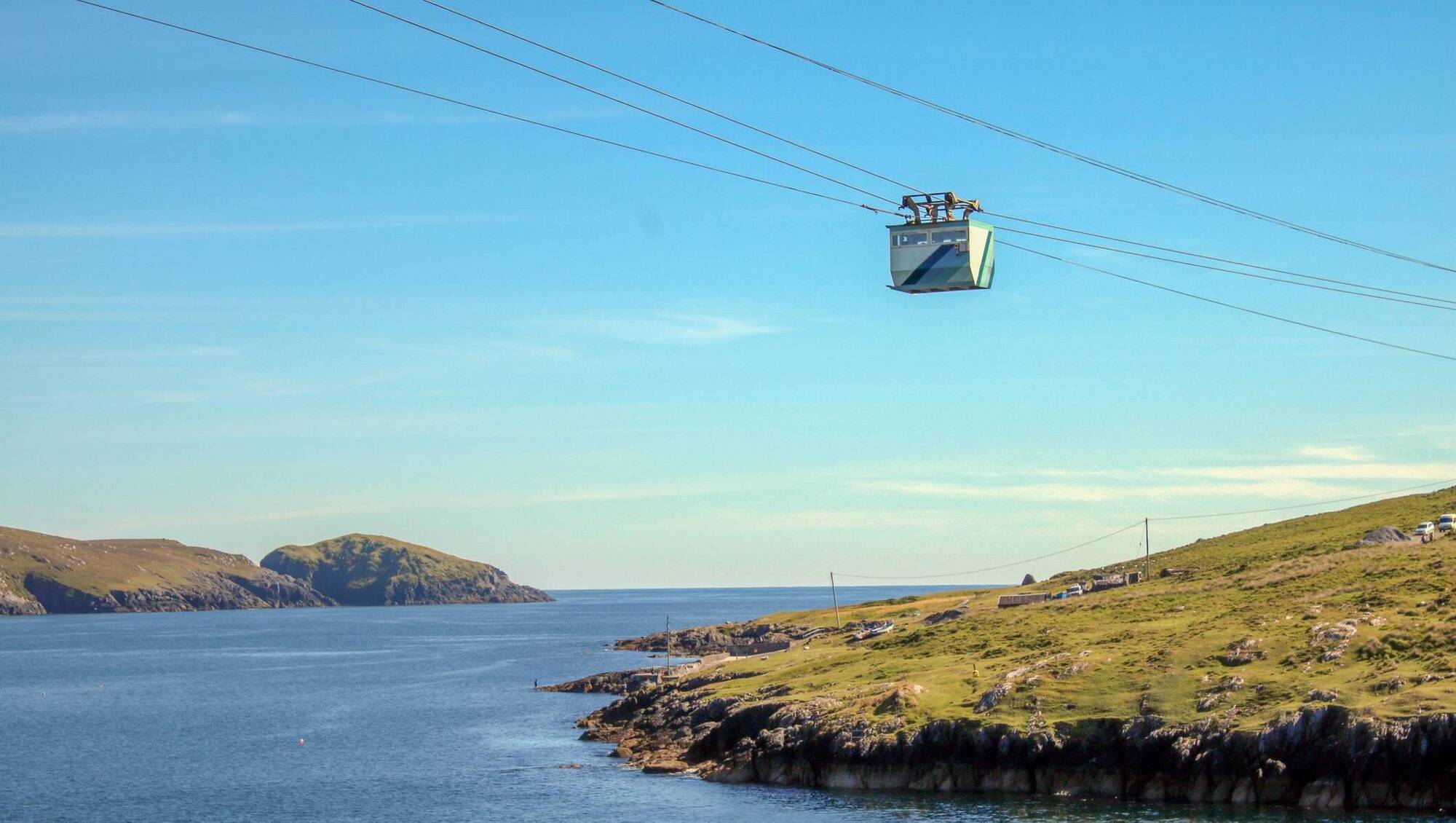
Tony Lownes of the Friends of the Irish Environment writes that traffic data signs on the main road and in Castletownbere, Eyeries, Glengarriff, and Bantry, would help avoid the frustrations of visitors arriving to find a long queue for Dursey Island cable car. File picture
Councillor Finbarr Harrington is quite right to raise safety concerns over the dangerously narrow and overgrown road leading to the Dursey Island cable car — ‘Road safety concerns at West Cork tourist hotspots’ (Irish Examiner, July 26).
The traffic problems on the access road were addressed as part of the September 2019 plan to raise the capacity of the cable car from the council’s estimate of the current 5,000 visitors to the island in the peak month of August (down to 300 per month in the winter) to between 3,400 and 6,600 persons per day, providing an interpretive exhibition space and an 84-seater cliff-top reflective glass café.
Our organisation was integral in the analysis of the proposal, which was ultimately quashed by the High Court in December 2022 because of the potential impact on the protected (and acrobatic) choughs. Studies showed tourists would displace the birds’ best habitat and end the isolation that has protected this rare, unspoiled, natural, and cultural heritage.
Read More
There were two plans to deal with the access road. Compulsory purchase orders were prepared for passing bays and improvements in sight lines.
But the other suggestion, which was inexpensive, ingenious, and good for our tourism experience, was variable message signs — electronic roadside signs linked to a real-time car-park occupancy monitor at the cable car.
These were to be placed on the main road — and in Castletownbere, Eyeries, Glengarriff, and Bantry — and would display the waiting time for a place on the cable car.
Tourism, no longer confined to conventional resorts and cities, reaches remote coasts, islands, mountains and rural communities, often precisely because they remain comparatively unspoiled. Where it reaches sensitive places, sensible limits and management are not anti-tourism: They are the condition of its survival.
Across Europe, protected sites are increasingly using conservation tools — real-time visitor caps, parking availability systems, timed entry information — and variable message signs.
Information is now one of the least intrusive tools available to conservation managers. Here, it would help avoid the frustrations of the visitor arriving to find a long queue for the cable car.
But it also shows visitors to the wider Beara area in the quiet season that the attraction is there — and that they will be welcome.
I was born in Bessborough. Unlike so many other babies born in that awful place, I went home — and with my own mother too at that.
The notion that we should build homes upon that land is absolutely repulsive to me.
We are not short of land for development — no matter how convenient Bessborough may be for access to City Gate, Mahon Point, and the N40 ring road.
We cannot and should not countenance even the possibility that one child is missed. No archaeological survey nor careful building plan offers enough surety of that to decide that trampling over the graves of children, and the crushed and broken dreams of their mothers is worth it. That land, those buildings, and the memories of those women brutalised by the system, would be far better served by a memorial park and a museum.
Read More
We must not forget the failure of our society in allowing the Church to dictate the morality of the Mass to the masses and to allow it be policed via cooperation with the State.
The State apologised, it has made tokenistic gestures, but it has done little to ensure not just adequate memorialisation but also an effort at educating as to what happened and why.
All the reports on institutional abuse in this country, are important and welcome, but they’ll never have the impact of a grave marker, a museum or the direct testimony heard first-hand or via an audio-visual presentation of the women who endured those places.
The State, and society as a whole, offered up our women, our children, and our poor, to the exploitative and abusive practices the Church turned a blind eye to at best and actively colluded in at worst.
There is plenty of land elsewhere in Cork City — build there. Memorialise those people still left devastated by the impact of what those places did to them.
It’s nearly 12 years since my mam died.
This is the first time I can say I’m glad she’s not alive to see something. Because as strong as she was, this is something no one who’s been through that ever needs to be dragged through again.
Forest Fest has earned a reputation as one of Ireland’s premier music festivals, but its treatment of GAA supporters on All-Ireland final day was disappointing.
The festival advertised that the football final would be shown on the big screen.
Instead, the only large screen was in the VIP area, effectively making the All-Ireland final a VIP-only experience. The irony of this is hard to ignore. Forest Fest is held at, and closely associated with, Emo GAA, yet the biggest occasion in the GAA calendar appeared to be reserved for those wearing VIP wristbands.
The match was shown on the big screen for general viewing for only about 20 minutes between two acts.
The rest of the game was unavailable to ordinary ticket holders, despite there being four or five large marquee arenas and several other suitable areas within the festival grounds where the match could easily have been shown. It was not a question of space or facilities — it was a question of priorities.
When I queried this decision, rather than receiving an explanation or any attempt to address a legitimate complaint from a paying customer, the response was to call security.
The GAA has always prided itself on community, inclusivity, and bringing people together. It is difficult to reconcile those values with the decision to make the country’s biggest sporting occasion effectively a privilege for VIP ticket holders.
I hope the organisers will reflect on what happened and ensure that, in future, an event of such national significance is made accessible to all patrons, not just a select few.
The main idea behind working from home was originally to give workers a better work-life balance and, at the same time, save on long commuting times, which in many cases meant a worker spending hours in their car, causing traffic congestion in all our major cities. This idea was first tried out by large companies during the covid lockdown.
It has since then become commonplace for many workers, with workers having the right to request the ability to work from home where feasible. Large companies have the technology to be able to monitor staff to ensure the work assigned is being carried out, with employers and employees finding the practice very successful.
Read More
However, one has to ask the question if the civil service and local authorities have the technology or the structures to be successful in monitoring staff working from home? Or have they evaluated the fact that, with staff working from home, it would reduce their ability to have face time with members of the public.
Many elderly people don’t use email and are not online; they are having difficulty getting through on phone lines that always seem to be busy and when they get through they don’t get to speak to the person relevant to their queries. They are totally disenfranchised. Their only chance to get answers on issues is to have face time with a relevant staff member. Also, how is a staff manager able to monitor staff from home, or is the status of staff manager just part of a career path?
The whole thing is a sad day for the public. While working from home works for highly digitised multinationals where even toilet breaks are monitored, it would be surprising if it works at all with government departments or local authorities, where the public are forced to spend weeks waiting for answers that should only take an hour or two if key staff were present in the workplace.
As screens, digital technology, and AI become ever more ubiquitous, their use in our education system deserves further discussion.
Included in the new primary curriculum framework being implemented in primary schools across Ireland are seven ‘key competencies’, one of which is ‘being a digital learner’. These competencies are not taught as separate subjects, but will underpin learning across all curriculum areas such as language and Stem subjects (science, technology, engineering, and maths). This surely means that much of a child’s learning will take place using digital technology as a medium. Is this high level of reliance on technology as a teaching tool warranted? Furthermore, is it really in the best interests of children in their formative years?
Succumbing to the lure of interactive whiteboards, apps, and AI in the classroom threatens to displace the teacher as a trusted source of information and knowledge, as well as contributing to children’s already significant and worrying exposure to screens. Increasing the use of digital technology in the classroom may ultimately create more problems than it will solve.
Parents, educators, and curriculum planners need to consider carefully how and why technology is used in schools. Just because digital technology can be used in all aspects of learning does not necessarily mean that it should.
Richard Jacob’s article — ‘The planet’s burning — so whatever happened to the latte levy?’ (Irish Examiner, July 27) showed how the environmental aspirations of government get waylaid by dubious over-consultation with vested interests.
Noel Dempsey, a former environment minister, introduced the plastic bag levy when he announced it. Now it’s the loudest lobbyists who scupper the simplest and obvious environmental actions.
The Government is now supporting a dirty addictive habit of dispensing coffee in disposable cups that will be very difficult to change. Killarney piloted a scheme to get rid of these cups a few years ago but gave up on it when there was no national scheme forthcoming.
The Government needs to do the right thing in regard to this needless waste and ignore the clamour of vested interests.