Letters to the Editor: Barack Obama is right about old men clinging to power causing chaos
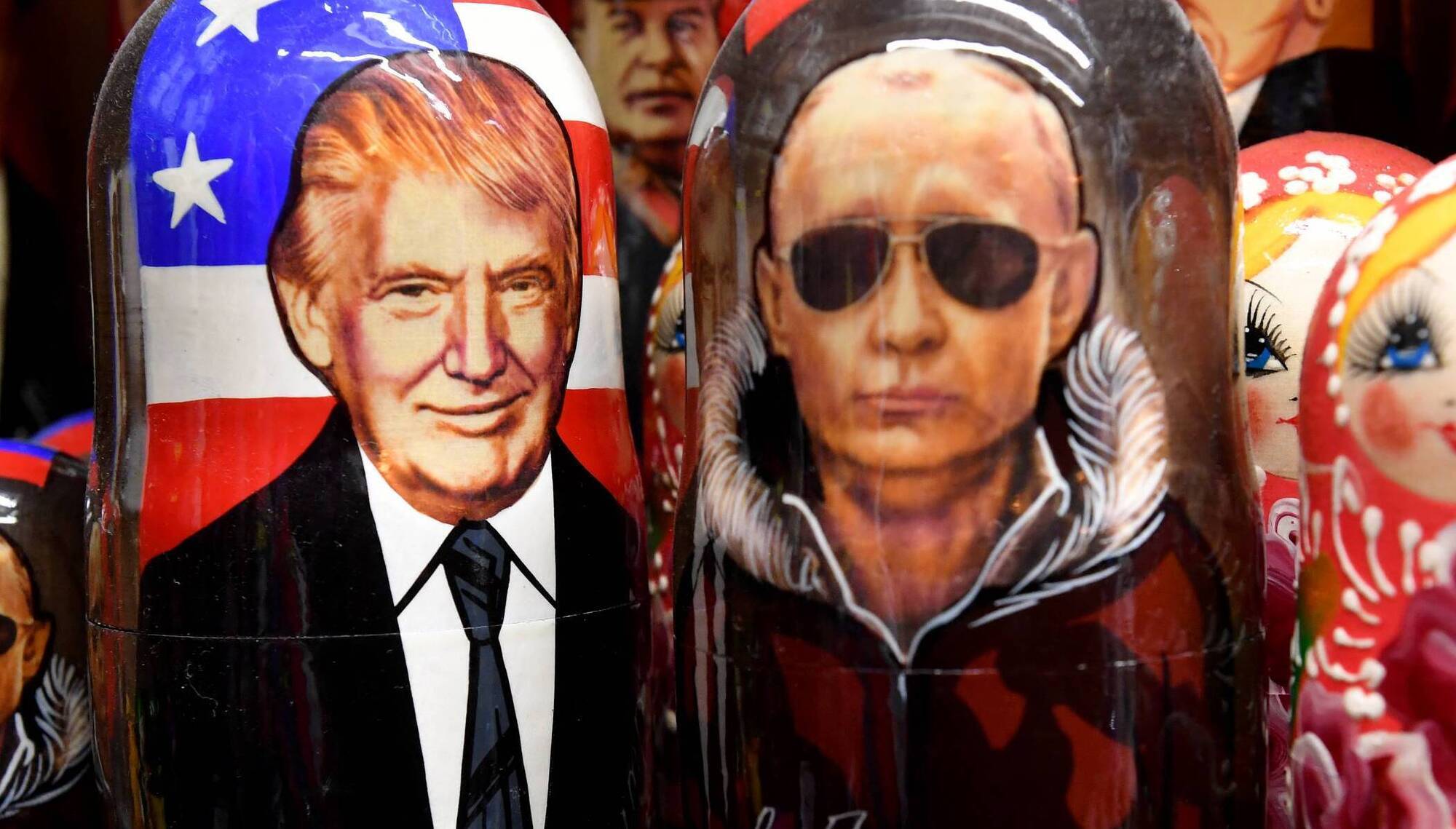
Russia's president Vladimir Putin and US president Donald Trump depicted in traditional Russian matryoshka nesting dolls. Picture: Olga Maltseva/AFP/Getty
Barack Obama was right when he said that roughly 80% of the world’s problems come from “old men hanging on”.
Vladimir Putin, 74, still redrawing maps in blood and devastating millions of lives to satisfy his imperial ego.
Benjamin Netanyahu, 76, cannot seem to distinguish national survival from personal survival. To dodge prison, he is sabotaging the international institutions built to keep the global order intact.
Donald Trump, 80, treats the US presidency less like public service than a lifetime-achievement award, and American democracy like a like a buffet for billionaires.
America’s upper chamber is starting to resemble a care home with a security detail. Mitch McConnell, 84, freezes at podiums, gets wheeled through committees like a museum piece, and needs prompting just to vote ‘aye'.
Oligarchs like Elon Musk funnel hundreds of millions into political campaign so the laws get written around their needs, hoarding wealth they couldn’t spend in 10 lifetimes.
These men could solve problems that have plagued humanity for centuries.
Instead, they’re using their fortunes to dismantle democracy, and stretch a wealth divide that is already obscene.
They just need one more year, one more term, one more war, one more tax cut for their pals. The rest of us get the bill: The climate, the body bags, the debt, the burned-out future.
At some point, the question must be asked: How much more are we supposed to sacrifice to keep these men feeling important?
Why is it that a person with a disability on reaching 66 years of age, is no longer recognised in the eyes of the State as a person with a disability but rather as an old-age pensioner?
This disingenuous oversight on the part of the Department of Social Protection means that a senior citizen with a disability does not receive extra payments which are awarded to disabled people but the disability does not simply disappear just because the person has reached the age of 66?
This situation is grossly unfair and needs to be addressed as a matter of urgency.
When did we stop mattering? That is the question I keep coming back to as I watch the Government push through the Defence (Amendment) Bill with barely a nod to the people it affects.
Neither Fianna Fáil nor Fine Gael mentioned removing the triple lock in their election manifestos. There was no debate, no consultation, no mandate. And yet here we are, with a bill that strips away the UN authorisation requirement passing its second stage in the Dáil after less than four hours of debate. Less than four hours to unpick something the public was explicitly promised would protect us. That promise was not made quietly.
During the Nice and Lisbon treaty referendums, the triple lock was held up as a guarantee of Irish neutrality. The Referendum Commission sent materials to every household in the country highlighting it as a safeguard. People voted on the basis of those assurances. To remove it now, without so much as asking us, treats that trust as disposable.
Polls consistently show that the majority of Irish people want neutrality kept. This is not a fringe view. And yet the Government is pressing ahead regardless.
Whatever your position on neutrality itself, this should trouble you.
A Government that changes the rules it used to win your vote, without going back to ask you, is not a Government that respects the people it serves.
Thank you for your well-balanced editorial (Irish Examiner, October 23) on the Government proposed removal of the triple lock.
The public are concerned over this change. You point out that the issue of the triple lock involves neutrality, international obligations, and the lives of serving soldiers. It also involves critical issues of democracy. The issue of neutrality is of vital importance. As a small country, Ireland will never have the capacity to defend its territory and its people by conventional military means. That is why active neutrality, combined with active support for the proper rules of international laws and the UN, are the only credible option towards defending the Irish people.
Removing the triple lock means abandoning the role of the UN and ending Irish neutrality. Ireland can best fulfil its international obligations by participating in genuine peacekeeping but not peace-enforcing. Peace-enforcing is what the US and its Nato and other allies did in Afghanistan, Iraq, Libya, and elsewhere, with disastrous consequences. The lives of serving Irish soldiers are of critical importance. Some 48 courageous Irish soldiers were killed in Lebanon, where often there was no peace to keep.
Our Government is considering sending Irish soldiers on an EU support mission to Lebanon where its mandate is likely to include disarming Hezbollah, which means intervening in a civil war, but it will have no mandate to deal with the Israeli occupation, destruction, and attempted annexation of southern Lebanon.
Our soldiers’ lives must not be squandered on such missions, undertaken without a UN mandate. Successive governments have been failing to support our soldiers adequately for decades.
The Government is ignoring the democratic wishes and interests of the Irish people. It is proposing to renege on its commitments, solemn declarations, and protocols on the triple lock, used to persuade the Irish electorate to change their minds on the second referendum for the Nice and Lisbon EU treaties.
Removing the triple lock endangers democracy and will end Irish neutrality.
Former president Michael D Higgins is reported in the 'Irish Examiner' as viewing the removal of the so-called triple lock as evidence we are “absolutely” sliding into military alliances.
What alliance he has in mind is not explicitly stated, but he goes on to suggest we might be “going to wait for the European Union to tell us where to go”. He is not giving ‘the full story’, something he decries in the interview. As a former president, he must be aware that Article 29.4.9 explicitly prohibits the State from joining an EU common defence alliance. Curiously, this critical constitutional provision is rarely mentioned in most debate on Irish engagement with EU security and defence.
If true, it is extremely worrying that he suggests that his dealings with ‘”senior army people” have ben instrumental in his coming to that conclusion. Such officers had no business discussing defence and security policy with him, nor he with them. Such policy matters are not within the remit of the president, although this did not prevent him from attempting to derail a series of public discussion on the issue some years ago by his unworthy disparaging of the chair.
Senior serving military people on their part, should confine their advice or observations on military alliances to the executive. In the interest of ‘the full story’. Mr Higgins might consider elaborating.