Irish Examiner view: Fáilte Ireland bids to bring tourists beyond the M50
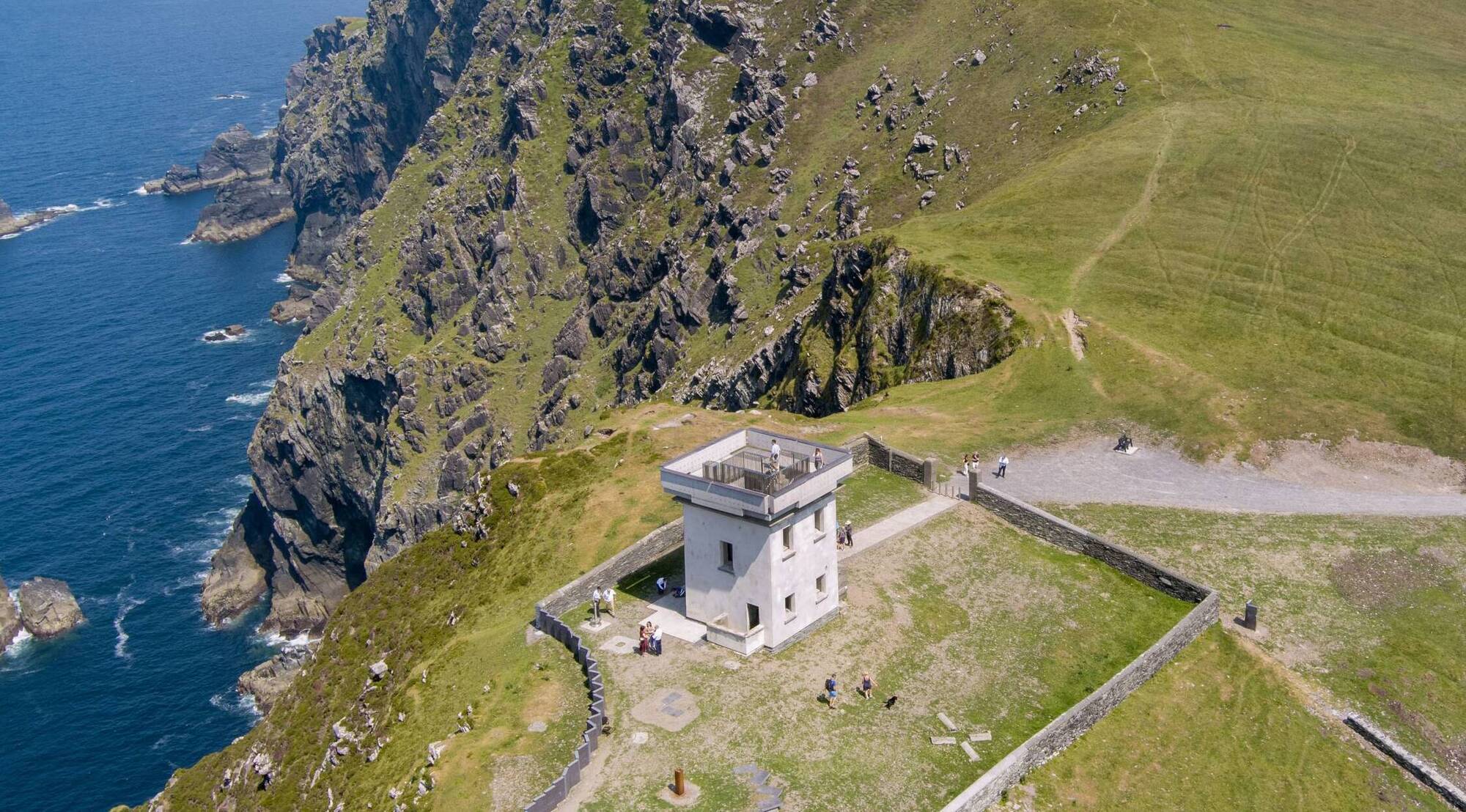
The Wild Atlantic Way Discovery Point at Bray Head, Valentia Island, Co Kerry, recently enhanced in a €2.1m investment by Fáilte Ireland in partnership with Kerry County Council. Picture: Valerie O'Sullivan
Given the time of year it seems appropriate to learn that Fáilte Ireland is to try to grow tourism in Ireland, with a particular focus on ensuring visitors are not wholly concentrated on Dublin.
This is a welcome development, given how significant an industry tourism is in terms of employment headcount — Fáilte Ireland stated that one in 10 people in Ireland is employed directly in tourism — but there appears to be a serious imbalance in the way many visitors experience Ireland.
The tourism body’s chief executive, Caroline Bocquel, pointed out that 75% of visitors spend a night in Dublin. That does not preclude visiting the rest of the country, and some of those visitors may use the capital as a launchpad for touring Ireland, but the statistic is a worrying one for those outside the M50.
Clearly, Fáilte Ireland sees this as an issue for the tourism industry across the country, as it is specifically trying to encourage visitors to experience the regions rather than remaining in Dublin.
It is notable that accommodation is one of the obstacles to spreading tourism throughout the country, as acknowledged by Ms Bocquel: “Certainly we have some accommodation shortages. The Government is working on a new accommodation strategy at the moment and we’re providing support to them through that, through analysis and data to see where that accommodation is needed.”
This view seems to run contrary to the general perception of the accommodation issue in many areas popular with tourists — that there is a stark shortage of long-term residential housing in those areas, something which is directly related to the number of short-term lets on the market for holidaymakers.
Other headline items may also have an impact on our tourism industry. The heatwaves ravaging Europe at present are likely to deter Irish people from visiting the continent for holidays, and may also foreground Ireland as a more temperate holiday destination for European tourists.
However, our tourism product, in terms of accommodation and regional access, must facilitate both foreign and domestic holidaymakers.
The news of Glen Hansard’s sudden death gave all of Ireland pause yesterday. The singer-songwriter died following a single-vehicle motorcycle collision near the Strawberry Beds, Lucan, Dublin, in the early hours of yesterday. He was 56.

In the course of a lengthy career, Hansard enjoyed several distinct phases of success. He first came to prominence in the 1991 movie The Commitments, where he played mystified guitarist Outspan Foster.
Though not one of the more prominent members of the eponymous band in the movie, he went on to carve out a successful career with his band, The Frames, which attracted a devoted following over the years.
However, the undoubted high point of his career came with a return to acting. He featured in John Carney’s film Once, and he and his co-star Markéta Irglová won the Academy Award in 2008 for Best Original Song for Falling Slowly.
Hansard was also a social activist: He was involved with the Home Sweet Home group, which occupied Apollo House in Dublin in 2016, and he helped to lead the annual Christmas Eve charity busking session near the Gaiety Theatre in Dublin which raises funds for the Dublin Simon Community.
That aspect of his life was cited in some of the many tributes paid to him since news of his passing broke yesterday, as musicians and politicians alike acknowledged his contributions to society.
Former president Michael D Higgins described Hansard as “a troubadour whose gift for storytelling brought so much joy to audiences across the world”, adding: “Glen also placed great emphasis throughout his life to the importance of talking the problems of society, including regular work in drawing attention to the problem of homelessness.”
It is an impressive legacy. Glen Hansard is survived by his wife Maire and son Christy. Ar dheis Dé go raibh a anam.
Public transport faces many challenges, including one of the most fundamental issues imaginable: Sourcing drivers. Last year, for instance, Dublin Bus admitted it was struggling so badly to find personnel that it was considering recruiting from as far away as South Africa.
Credit the same organisation, then, for innovating to access a particular segment of the workforce: Women who are looking for flexible or part-time work.
Dublin Bus is offering part-time roles — which require a commitment of just two days a week — to increase the number of female drivers. It is to hold recruitment open days in the coming weeks at which women can get behind the wheel of a bus, and talk to female bus drivers about working for the company.
This a very positive move. It recognises the reality of women’s lives — as Vivienne Kavanagh of Dublin Bus said: “We know that women still have the majority of the care and responsibilities in society. This hopefully offers women more flexibility to be able to work around their childcare or other responsibilities that they have.”
Increasing the number of women drivers will reflect the society served by Dublin Bus, which is showing commendable imagination with its employment practices: The company has pointed out that part-time drivers can become full-time drivers later if they wish.
There are other sectors of our economy where workers are at a premium. While the Dublin Bus initiative might not work across the board, the flexibility on show here could be copied to good effect everywhere.