Letters to the Editor: We don't need these badly-written amendments in our Constitution 
One reader says both referendums are at best unnecessary, while others write about topics including conflict in the Middle East, RTÉ's travails, and sustainable shopping
Letter-writer Christy Galligan says Ireland doesn't need the amendments we'll be voting on on March 8 when our courts have already decided on the substantive issues. Stock picture: PA

Letter-writer Christy Galligan says Ireland doesn't need the amendments we'll be voting on on March 8 when our courts have already decided on the substantive issues. Stock picture: PA

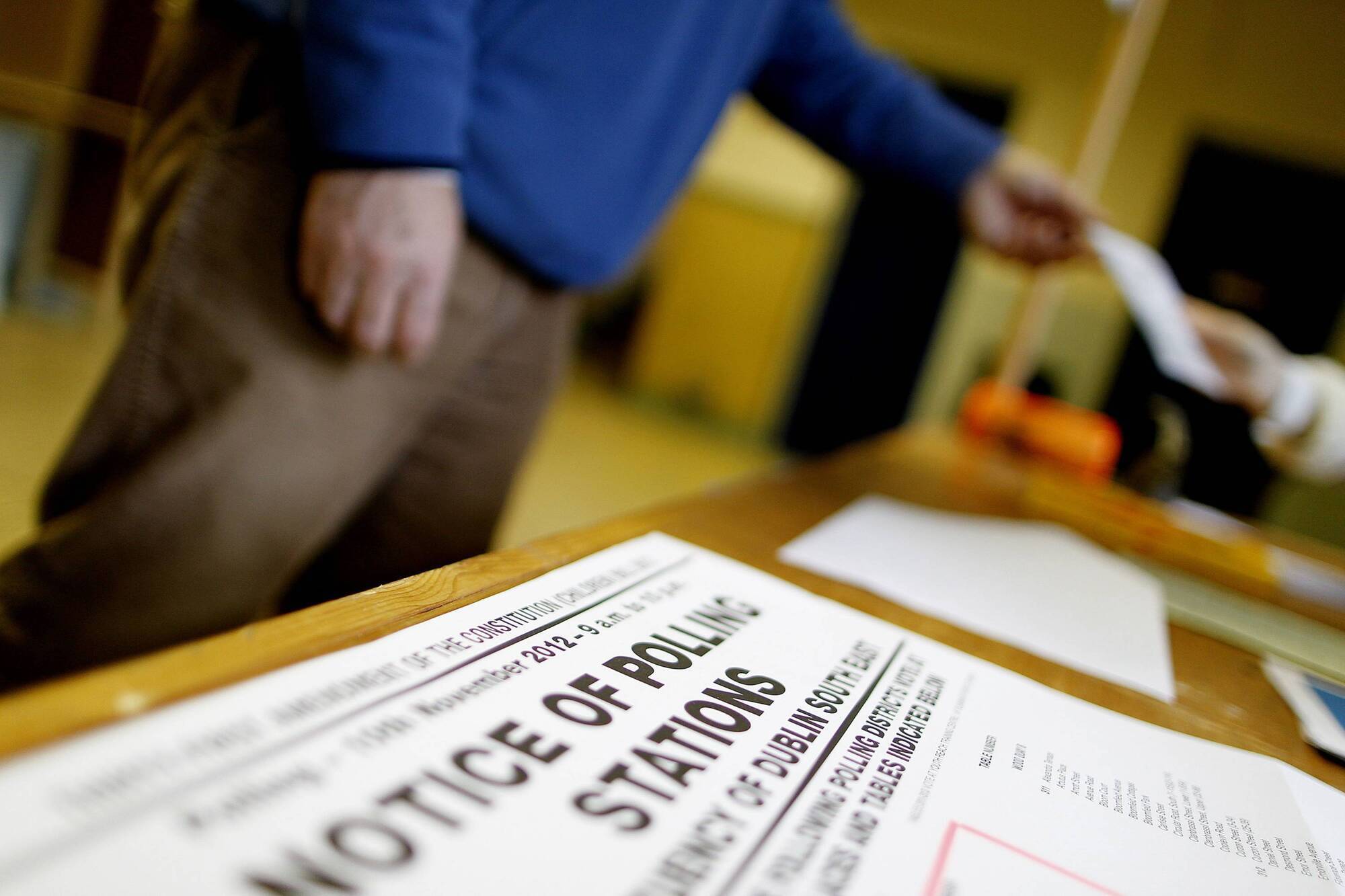
I have listened to the many debates and read copious articles for and against the Government’s proposal to amend the Constitution by way of a referendum on March 8.

The sticking point for me is that the State wishes to include the wording “other durable relationships” in article 41.3.1 while deleting “on which the family is founded”. This amendment is rather opaque and doesn’t define what “other durable relations” means. Why not insert “cohabiting relationships” instead of “durable relationships”?


What the Government is asking us to vote on is a change in the Constitution which, to all intents and purposes, renders a family founded on marriage no longer sacrosanct, while at the same time leaving it to our courts to define what “ other durable relations” means. This renders the whole of the amendment as absolutely meaningless.

There is ample precedent and cases stated before our courts that give cohabiting couples, etc, rights that are also conferred on married couples. So why change what’s not broken?

With regards to the proposed insertion of the new Article 42B, the Government’s ham-fisted approach by excluding carers and persons with disabilities’ legal rights, by inserting, “shall strive to support”, in fact means striving not to be supported by the State, should fail on these exclusions and the wording alone.

CLIMATE & SUSTAINABILITY HUB

The exclusion of the State’s obligation to women in the home in Article 41.2 negates the women’s contribution to family and the home even where the courts have already decided that women are not assigned to a domestic role.

As legal expert and political analyst Micheal McDowell refers to, in the Supreme Court case of Sinnott v Minister for Education 2001, and in DT v CT 2002, the courts found the duties and obligations of spouses are mutual and recognised a man’s contribution in the home.

The recent Supreme Court case — in which a father, John O’Meara, sought a widowers pension when his partner died — recognised his right in a non-marital cohabitating relationship, and found part of the social welfare legislation that excluded him from a widowers pension unconstitutional, one that could be rectified by amending Government legislation.

We are all for equality and equal rights but we don’t need badly-worded and opaque amendments to our Constitution to prove it when our courts have already decided on the substantive issues.

Christy Galligan, Letterkenny, Co Donegal

Palestine must have its own state

The other morning on CNN I watched a Palestinian doctor cry at the carnage and death around him, and with frustration of not being able to save lives, particularly those of the children.

No one with a soul could not but be touched by the daily slaughter of the innocents in Gaza. The sheer scale of the destruction of homes, hospitals, and relief centres is mind-boggling, and such destruction ensures that Gazans will most likely have to re-locate as refugees to God knows where.

Israel must roll with the wishes of the vast majority of the world and accede to a two-state solution. In fact most, if not all of the ‘new’ Palestinian state would merely echo the return of stolen Palestinian and Arab lands.

Many years ago we lived, as a family, as did many other UN families, among the Arabs in East Jerusalem. In fact many were our landlords, and wonderfully caring people.

Israel must stand accused of extraordinary brutality in its most recent attacks in Gaza.

Israel deserves a right to live in its own land, yet one should ponder that the lands that Israel now occupies is at least twice the size of the lands given to them by the United Nations League of Nations in 1947, and accepted by Israel. Palestine must have its own state. It is the wish of the free world.

Ray Cawley, Douglas, Cork

Sustainable factors in buying habits

Research shows that when habits form early in young people, they are then difficult to change. 

Promoting sustainable food purchasing needs to start young. Education on how to recognise sustainable food on packaging is crucial. For example, promoting sustainable symbols on food packaging, and getting rid of the misinformation and lack of clarity.

Or using acronyms like ‘FACTORS’ to help people purchase sustainably, F – form new habits; A – Awareness; C – Carbon Neutral; T – try new brands; O – organic; R – recyclable packaging, S – sourced locally. Our young people can be impactors by considering sustainable food factors.

Emily Drinan and Robyn Whelton, Eco-Unesco Young Environmentalist project, Schull Community College, Co Cork

Was Israel ever a ‘normal’ state?

Leo Varadkar said last week that he no longer believes Israel to be “a normal, liberal, western democracy” and he concluded that it “hasn’t been for a long time”.

Leaving aside Mr Varadkar’s exaltation of “liberal, western democracy” — as if “western” military power, for example, has never been oppressively deployed — can we really say that Israel has ever been a “normal” democratic state?

The state of Israel got off to an inauspicious start with the Absentee Property Law, a draconian instrument that allowed the government to confiscate land, property, and other assets left behind by Palestinian Arab refugees in 1948. Allied to other measures, this made the return of the many former Arab residents impossible; in fact, the Israeli state does not recognise a “right of return” at all for Palestinian refugees, some of whom were displaced into Gaza.

On the other hand, the Law of Return, passed in July 1950, conferred on Jewish people worldwide, regardless of their country of origin, the right to enter Israel and obtain Israeli citizenship. Large numbers have availed of this opportunity.

The purpose was patently to change the social demographic composition of the Israeli state.

Undeniably, this institutionalised ethnic and religious discrimination has shaped Israel as we see it today. None of this is the behaviour of a “normal” democratic state.

There are plenty of other examples of Israeli exceptionalism, but Benjamin Netanyahu, at a cabinet meeting in early 2019, probably summed up the fundamental difficulty when he succinctly defined Israeli democracy: “Israel is a Jewish, democratic state. This means that it is the national state of the Jewish people alone.”

Fintan Lane, Lucan, Co Dublin

Make sure Kevin Bakhurst stays on

Kevin Bakhurst is in a tight spot.His utterances last July on RTÉ exit payments left something to be desired and these are being parsed by some of the most respected and forensic journalists in the country. That is their job and it is an important job.

But things said are said in an instant. When those things are written down they can then be anatomised in excruciating detail in slow motion on the vivisectionist’s table.

No one in their right mind can doubt Kevin Bakhurst’s bona fides. He is an expert on RTÉ and when he took the job he knew it would be difficult. This rumbling never-ending “upstairs downstairs” omnishambles within RTÉ management needs to be dealt with as transparently and constructively as possible. This is difficult to do when lawyers and commentators are watching every move.

RTÉ is one of the most important public bodies in the country. It delivers superb programming (especially in the realm of news and current affairs) and Irish people are rightly proud of it.

I reckon the Government and Oireachtas committee members are getting it right. Straighten things out. Don’t take the Mickey. Get on with the job. That seems to be their message to RTÉ. RTÉ management would be wise to co-operate as far as possible.

One thing’s for sure. Everyone would be wise to keep Kevin Bakhurst in the post.

He didn’t take the job to do it badly. He has the experience and it is an extraordinarily difficult and responsible job at present.

Michael Deasy, Bandon, Co Cork


More in this section

Revoiced

Newsletter

Had a busy week? Sign up for some of the best reads from the week gone by. Selected just for you.

Cookie Policy Privacy Policy Brand Safety FAQ Help Contact Us Terms and Conditions

© Examiner Echo Group Limited