Letters to the Editor: Racist abuse ignores our long history
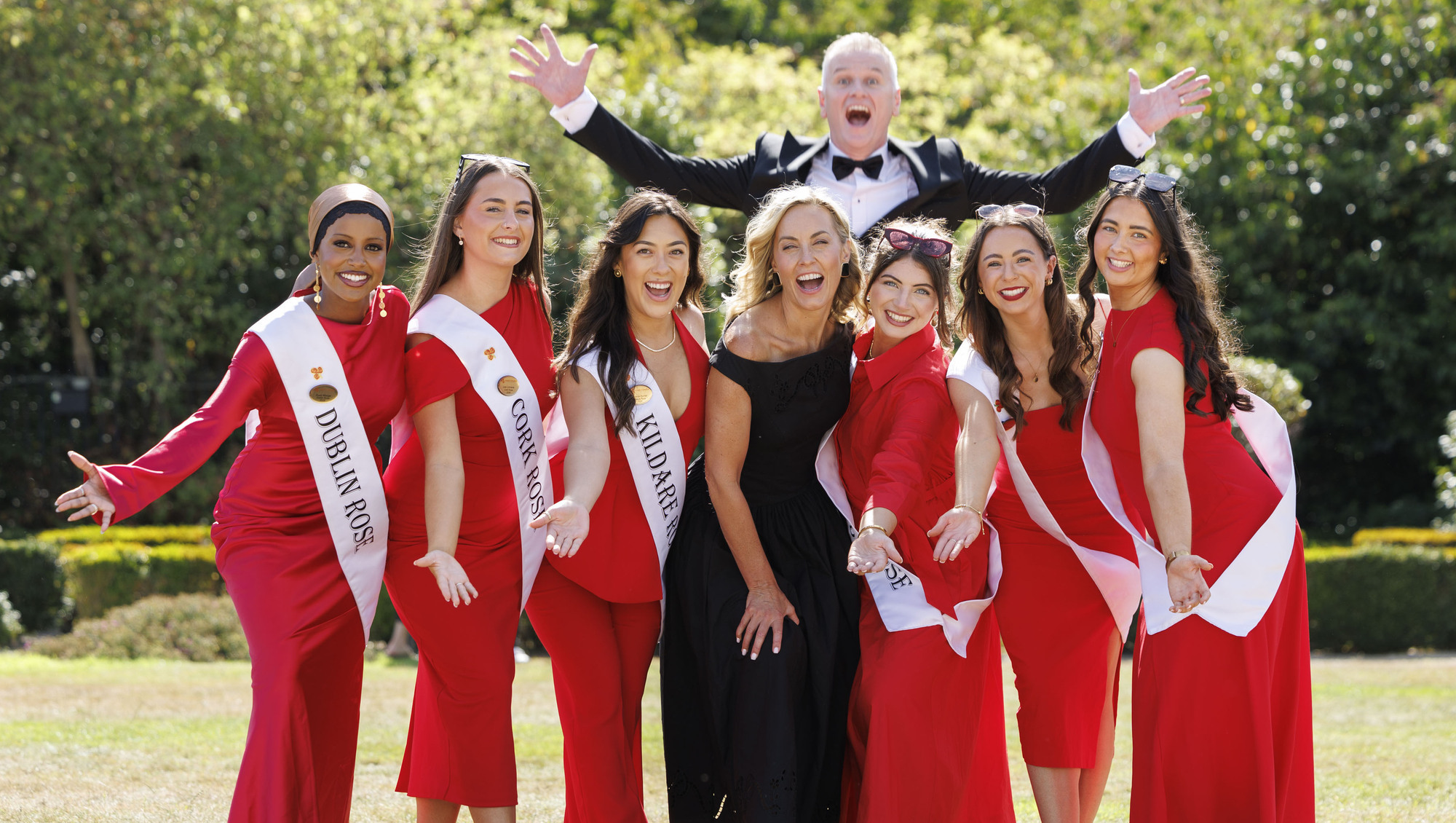
Hosts Kathryn Thomas and Dáithí Ó Sé with six of this year's finalists: Suad Mooge (Dublin), Lexi Linnane (Cork), Jessica Hunter (Kildare), Rachel Keane (New Zealand), Bethany McLoughlin (Sligo), and Méabh Holland (Clare). Picture: Andres Poveda
Rose of Tralee contestants from outside Ireland have been a feature of the festival from its early days. Some, it appeared, had rather tenuous Irish roots.
However few, if any, were subjected to the type of racist abuse recently directed at the Irish-born Suad Mooge, this year’s Dublin Rose entry. One wonders why?
The acclaimed 2021 RTÉ documentary, , revealed some interesting facts about Ireland’s deep history (or prehistory, as it used to be called) and its early peoples. According to the anthropologists and archaeologists, who featured on the programme, recent DNA findings suggest that the Mesolithic peoples who began to arrive in Ireland around 8,000BCE were dark skinned with blue eyes (an unusual combination). So, it seems the “first Irish” were black.
Modern genetic studies also suggested that their successor immigrant group, the Neolithic peoples, originated in the region later known as Asia Minor/Palestine and were also dark skinned. These were the great megalithic tomb builders, whose extraordinary creations continue to dominate much of Ireland’s landscape.
DNA suggests that the next wave of migrants, the Bronze Age people (the first whites), originated in the eastern parts of today’s Russian Federation. It appears the later dominant group, the Iron Age or Celtic-speaking people, did not arrive till as recently as around the fifth century BCE.
Perhaps we should place more emphasis on Ireland’s deep history? After all, it represents some 80% of Ireland’s story and the research tools at our disposal are improving all the time. This may, in the process, help to dispel some of the uninformed prejudice and deep ignorance concerning Ireland’s long and diverse migratory heritage.
Brittany Ferries’ decision to end the live transportation of farm animals on their Rosslare to mainland Europe service is a victory for animal welfare over commercial interest.
Following their arrival on the continent, the young animals endure long road journeys to their final destination. Gallows humour is the inspiration to say these calves are the lucky ones.
Their removal from Irish dairy and beef farms operates within EU animal welfare regulations, a legal patina to a trade based on the exploitation of the young.
Spare a thought for Irish cattle with a one-way tickets as they set sail for countries like Algeria, Turkey, Libya, and Egypt.
For Irish farm animals their path to hell is only starting once they are herded into the moribund embrace of a non-EU country bound livestock ship. The sea journeys involved are too long to be able to guarantee a satisfactory level of animal welfare and conditions for animals in destination countries are often far below the minimum legal standards required in Ireland or the EU.
A snapshot of what our cattle will endure can be found in the fact that most animals in the Middle East are not stunned — rendered unconscious — before slaughter. Their throats are cut while they are fully conscious and are left to bleed to death.
The live farm animal export trade, in which profit is systematically being placed above animal welfare and respect for the law, should be consigned to farm animal trade history.
Brittany Ferries’ decision to end livestock transport from Ireland to France reflects a corporate surrender to public relations pressure rather than a balanced assessment of animal welfare or market realities.
Furthermore, by refusing to carry Irish livestock to France, the operator is actively disrupting the movement of agricultural goods between EU member states, raising serious questions about interference with the core principles of the EU single market.
The policy’s internal logic is equally flawed. Brittany Ferries continues to carry horses, dogs, and cats under identical sea-transit conditions. If ferry travel is safe for pets and equine transport, claiming it poses an unacceptable welfare risk to cattle and sheep simply does not hold water. Commercial livestock transport in the EU operates under stringent regulations governing ventilation, stocking densities, temperature monitoring, and veterinary oversight.
Additionally, the transport industry is heavily regulated and it is mandatory that all trucks have tamperproof electronic trackers installed, which record all movement times, location and duration of all stops that the vehicles make. The actual risk to animal health in compliant shipments is minimal. Yet Brittany Ferries has chosen to disregard these high standards and accept false claims to appease a vocal activist campaign against our only indigenous farming sector.
Live shipping remains a vital lifeline for Irish farmers by fostering essential market competition against the near-monopoly of domestic meat processors. By choking off export logistics, the company directly undermines farmgate prices and leaves primary producers at the mercy of factory buyers. This decision capitulates to single-issue groups whose ultimate objective is to force livestock farmers out of business and end meat consumption entirely. These organisations, which struggle to garner genuine public backing, rely heavily on State funding rather than a broad membership base to push their agenda.
It is deeply regrettable to see a major logistics line sacrifice legitimate, legal agricultural trade and the livelihoods of Irish farming families to placate targeted pressure groups.
I dream of a time when public EV chargers will be as plentiful and accessible as current petrol stations.
I dream of a time when all public EV chargers will have roofs overhead so that customers don’t need to don the raincoat when charging in wet weather.
I dream of a time when policy makers will stop talking about and instead take urgent action on making home charging an option for EV owners who live in apartments or who don’t have driveways.
As a senior senior, I fear that this too may become yet another broken dream!
To ease my stress during next year’s hurling season could the relevant authorities now set about introducing the clock/hooter system (as currently in football) into hurling.
It would eliminate my angst as to exactly how much time is left in a game and my bias as to why some referees seem to add further minutes to the already declared added time. And as for the referees, surely having a “hooter system” relieves them of the considerable burden of tracking and mentally calculating lost time thus allowing them to concentrate on fouls, playing advantage, and general player behaviour.
The illegal throw ball has spread like wildfire. There were numerous throw balls in this year’s https://www.irishexaminer.com/sport/gaa/arid-41893351.html senior camogie final. Referees officiating at top level games seem to have opted out of their responsibility to blow it. Commentators and reporters are turning a blind eye to it too.
Yet at an U14 club camogie game I’ve seem throw balls been blown. These young girls playing in a low division game, see that a rule that applies to them doesn’t apply to players in a senior All-Ireland. One rule for us but not for them.