Irish Examiner view: Defence is about people, not hardware
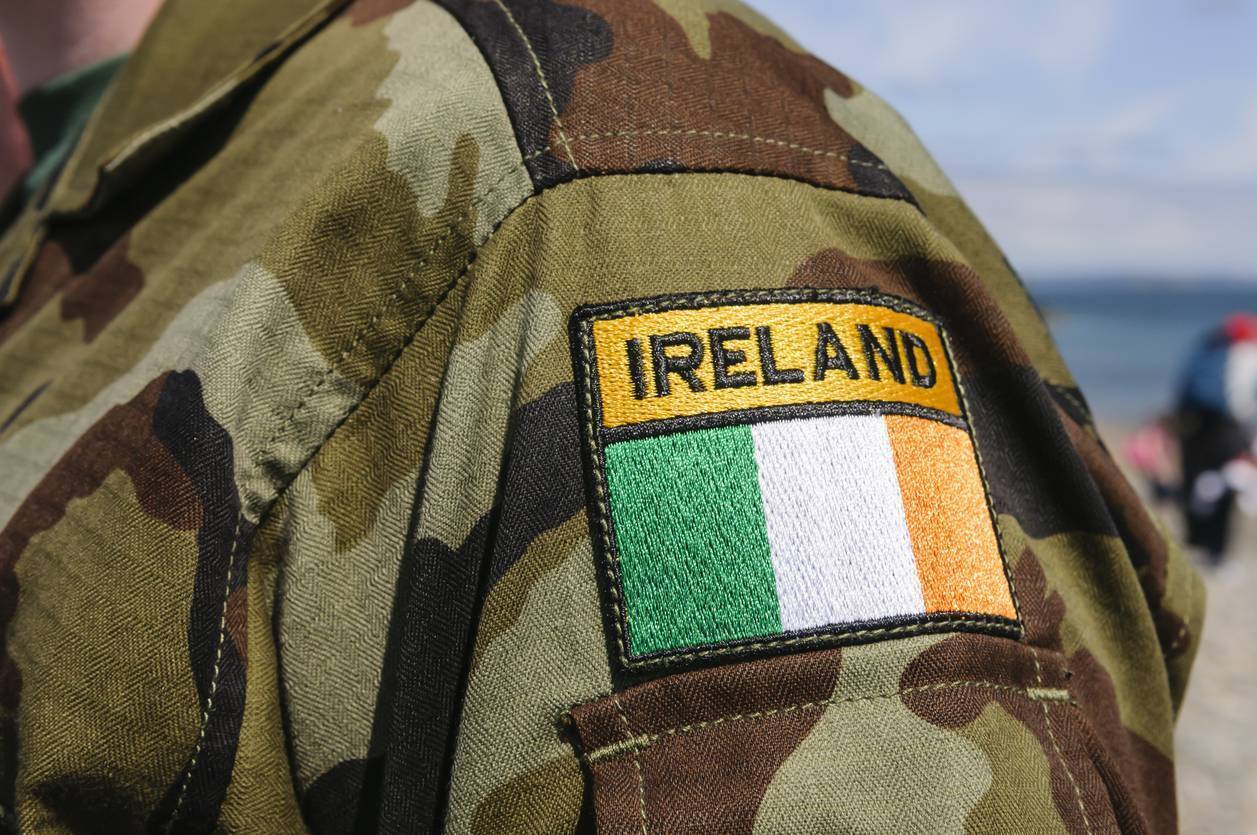
As political leaders gather at international forums to discuss a more hostile global security environment, the pressure on Dublin to increase its defence outlay is tangible. File picture
The ongoing debate over Irish military spending and the creeping shadow of European militarisation has reached fever pitch this week.
As political leaders gather at international forums to discuss a more hostile global security environment, the pressure on Dublin to increase its defence outlay is tangible.
We are repeatedly told that Ireland must get serious about its security, that we cannot afford to sit on the sidelines, and that our airspace and territorial waters are dangerously exposed.
Yet, as the State moves to inject record allocations into the defence sector — reaching nearly €1.5bn — the entire conversation is fundamentally misaligned.
The current debate focuses overwhelmingly on hardware: Radar networks, naval vessels, drones, and sophisticated weapon systems.
But this rush to up-arm ignores a glaring, systemic reality.
Hardware is meaningless without human software. You can purchase the most technologically advanced radar system in the world, but it cannot operate itself.
You can commission state-of-the-art ships, but they will sit idle at the docks if there are no crews to sail them.
The most fundamental capability problem facing the Defence Forces is not an absence of weaponry; it is a catastrophic failure of recruitment and retention.
While the Government sets ambitious personnel targets, the reality on the ground is stark.
The Defence Forces remain thousands of personnel below their agreed establishment strength.
The naval service has previously seen vessels forced to patrol without functioning main weapons systems as there was a shortage of qualified technicians to service them.
No amount of capital investment can fix a culture where those who serve feel undervalued, underpaid, and overworked.
Fixing the retention crisis must come before any rush to buy more arms. This crisis of identity is compounded by a looming operational vacuum.
For decades, conventional peacekeeping under the UN umbrella has been the cornerstone and main effort of Irish foreign policy.
Read More
The upcoming wind-down of the Unifil mission in Lebanon — which has consumed vast amounts of training, bandwidth, and personnel recovery — begs a vital question: What next?
The political establishment seems increasingly eager to pivot toward EU military alliances and the EU’s common security and defence policy.
Yet the legal basis for such a shift remains highly contentious.
Critics rightly point out that the historic triple lock mechanism — requiring a UN mandate, government approval, and Dáil authorisation before deploying more than a dozen troops abroad — is actively being dismantled by legislative reforms.
The same critics claim that by removing the UN authorisation requirement under the guise of stopping foreign vetoes, the Government is fundamentally eroding the legal and ethical safeguards that define our military neutrality.
Bunreacht na hÉireann explicitly forbids Ireland from joining an EU common defence without a referendum.
Ireland stands at a crossroads. Throwing millions at shiny hardware is not the answer while our barracks sit empty.
If we wish to remain a credible, neutral voice on the global stage, we must invest in our people first.
Without them, any new military apparatus is just an expensive, hollow shell.
As reports confirm that the El Niño phenomenon is once again strengthening in the tropical Pacific, the natural inclination for many in Ireland is detachment.
The event occurs thousands of kilometres away, across vast oceans, easily dismissed as a distant meteorological curiosity.
Yet our atmosphere does not observe national borders.
Through global atmospheric teleconnections, swings in tropical sea surface temperatures disrupt planetary jet streams, fundamentally altering weather patterns worldwide.
For Ireland, an active El Niño typically manifests in late winter and spring, frequently nudging the North Atlantic storm track southwards.
This can bring colder, drier conditions in winter, followed by unseasonably wet, stormy springs, and erratic summer precipitation.
For a country reliant on agriculture and vulnerable to flash flooding, these subtle shifts carry severe economic and infrastructural costs.
More broadly, this points to a glaring imbalance in our public priorities.
Amid relentless debate over conventional defence, naval capacity, and regional military alliances, we remain fixated on traditional concepts of security while overlooking the most existential threat at our doorstep.
Read More
National security in the 21st century cannot simply be about monitoring airspace or tracking radar; it must encompass ecological resilience, food security, and climate adaptation.
Understanding global phenomena such as El Niño and their ripple effects across the Atlantic should not be the exclusive remit of academic specialists.
It must become foundational literacy for the generation tasked with living through their escalating consequences.
An educated citizenry needs to understand the basic mechanics governing the air we breathe and the land we farm just as readily as it debates public spending or foreign policy.
Ignoring planetary dynamics will not shield us from their fallout. It is time our national conversation caught up with planetary reality.
This week, a Las Vegas courtroom victory finally delivered a legal resolution to the 1996 drive-by shooting of hip-hop icon Tupac Shakur.
Yet it raises a compelling psychological question: Can a jury’s verdict truly kill a multi-million-dollar conspiracy industry?
For three decades, Tupac’s death existed as modern folklore, spawning endless documentaries, books, and internet rabbit holes.

The actual trial, however, was surprisingly pedestrian.
It relied heavily on the defendant’s own public boasts and media interviews rather than grand cinematic twists.
But legal finality rarely translates into cultural closure.
Conspiracies thrive in the gaps left by institutional delay.
When the state takes 30 years to provide an answer, the truth often feels too mundane for a public conditioned on myth.
A verdict can sentence a person, but it cannot reshape a subculture.
The legal file may be closed, but the mythology ensures the mystery will never feel entirely over.
Check out the Irish Examiner's WEATHER CENTRE for regularly updated short and long range forecasts wherever you are.
CONNECT WITH US TODAY



Be the first to know the latest news and updates