Irish Examiner view: A test of democratic freedom

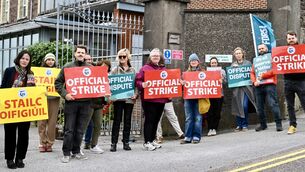
Sally Rooney's publisher has withdrawn supply of her books in Britain, with her agreement, after she said she would use her earnings to support Palestine Action. File picture
A democracy should be troubled when its anti-terrorism laws intrude on the relationship between a novelist, her publisher, and her readers.
That is where Britain now finds itself, with Faber announcing it can no longer supply Sally Rooney’s work in the UK because it cannot pass on her earnings.
Rooney’s novels have not themselves been declared illegal.
Her publisher has withdrawn supply, with her agreement, after she said she would use her earnings to support Palestine Action.
Existing bookshop stock can still be sold.
The practical restriction on her work arises from the consequences of proscription rather than an order banning its contents.
Palestine Action, founded in 2020, campaigns through direct action against businesses connected to supplying military equipment to Israel.
Britain proscribed it under the Terrorism Act 2000 in July 2025.
The government cited serious damage at defence-industry premises, including Thales in Glasgow, Instro Precision in Kent, and Elbit Systems UK in Bristol, and alleged an escalating willingness to use violence.
The decision followed the group’s incursion at RAF Brize Norton, where military aircraft were damaged.
Those actions should neither be airbrushed nor embroidered.
Criminal damage can be serious, dangerous, and punishable. Workers have rights to safety.
Supporting Palestinian freedom does not place anyone beyond the law.
Equally, describing an organisation as terrorist should never relieve a government of explaining why ordinary criminal law is insufficient.
Here lies the central controversy.
Britain’s statutory definition of terrorism extends beyond violence against people: Serious property damage can qualify when the other requirements, including a political purpose and an intention to influence government or intimidate the public, are met.
A designation can therefore be legally grounded in conduct very different from what many people understand by terrorism.
That breadth demands restraint.
Read More
Proscription carries consequences extending far beyond those responsible for particular offences.
It draws supporters, speech, and financial arrangements into the reach of counter-terrorism law.
Rooney’s pledge has now made the ordinary business of publishing her books legally fraught.
Faber says it cannot pay her; it has consequently stopped supplying her work.
Rooney is a hugely successful author. She has financial protection unavailable to most writers, and accepting this loss will not mean destitution.
Her willingness to bear it is nevertheless meaningful.
More troubling is the pressure the same machinery could exert on someone whose next royalty payment pays the rent.
Readers need not share Rooney’s politics, endorse Palestine Action’s methods or admire her novels to recognise the danger.
A chilling effect does not require a censor with a red pencil.
It can operate through contracts, payments and the fear of prosecution.
Britain should prosecute provable offences and protect public safety.
It should also reconsider a measure whose consequences now obstruct the circulation of literature.
Rooney’s determination to accept those consequences does not absolve the government of responsibility for creating them.
The test of democratic freedom is how much room remains for people who refuse to retreat.
Europe needs to triple its data centre capacity within five to seven years, according to European Commission vice-president Henna Virkkunen.
The ambition is clear. Where the electricity will come from, and what competing demands must give way, requires a considerably clearer answer.
For Ireland, this is an immediate question.
Data centres consumed 23% of metered electricity in 2025, according to the CSO, compared with 5% a decade earlier.
Almost a quarter of our measured electricity consumption now serves an industry whose appetite is expected to grow further.
The European target does not mean Ireland must triple its own capacity.
Decisions about where facilities are built should reflect available power, grid infrastructure and environmental limits.
Hosting more servers is not, by itself, evidence of sound economic planning.
There are benefits to digital investment.
Europe needs computing infrastructure, and dependence on overseas providers carries risks.
But technological ambition cannot excuse avoiding the physical constraints on delivering it.
The Climate Change Advisory Council has warned that data-centre demand is absorbing increases in Irish renewable capacity.
Electricity that might otherwise help displace fossil fuels is being matched by additional consumption.
Read More
Building more wind farms while adding demand does not automatically deliver the emissions reductions the public has been promised.
Government must explain how new connections will be matched by additional generation, adequate networks, and credible climate accounting.
Promises about future renewable supply need enforceable conditions and transparent monitoring.
Households should not be left carrying costs that properly belong to commercial expansion.
The same scrutiny must apply to water use and any reliance on fossil-fuel generation.
Efficiency improvements are welcome, but cannot settle the question of how much growth the system can sustain.
Something has to give when commitments exceed resources.
Ministers must identify the trade-offs before approving expansion, and demonstrate that the public interest determines which demands take priority.
We routinely look to Scandinavia for practical ideas that improve everyday life.
On giving people greater control of social media, Australia deserves recognition.
Its proposed “My Feed, My Way” rules would require platforms to offer users a feed containing only accounts they follow, giving them a choice about whether to receive algorithmic recommendations.
The proposal remains subject to legislation and consultation.
The principle is straightforward: People should have a meaningful say in what competes for their attention.
There is a European precedent.
A Dutch court ordered Meta to make feeds without profiling easily accessible and preserve users’ choices, rather than repeatedly returning them to personalised recommendations.
Ireland should ask why such basic control requires determined campaigning and litigation.

A setting buried in menus, or forgotten whenever an app reopens, is an inadequate concession.
Australia’s proposal deserves scrutiny and support.
Choosing what we read should be an ordinary right online, rather than a privilege platforms reluctantly grant.

CLIMATE & SUSTAINABILITY HUB
CONNECT WITH US TODAY



Be the first to know the latest news and updates