Rosaleen McDonagh: Traveller identity cannot be in the dock for M9 crash
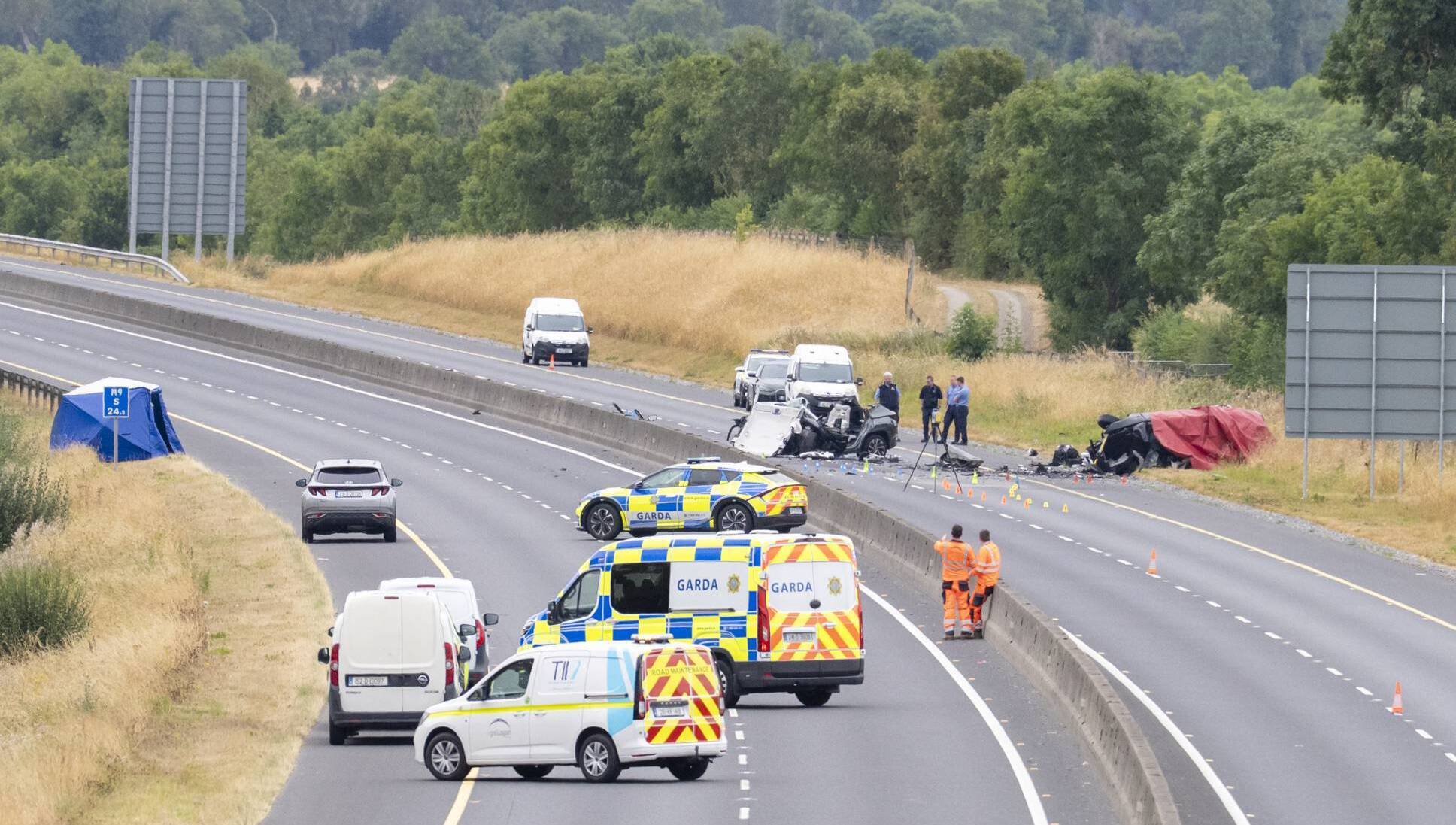
In the early hours of Sunday, August 16, a journey to Dublin Airport became the setting for a catastrophic collision on the M9 in County Kildare.
Three sisters — Ella Hendricken, Niamh Kinsella and Alma Kinsella — and Alma’s seven-year-old son, Yemi, were travelling in a Hyundai when it was struck head-on by a BMW driving the wrong way along the motorway.
In the early hours of Sunday, August 16, a journey to Dublin Airport became the setting for a catastrophic collision on the M9 in County Kildare. By Sunday evening, racist commentary had already begun to gather around the crash online. The five teenage boys in the stolen BMW died.
Any discussion of what followed must begin with the innocent people driving safely along a motorway, the terror inflicted on a family, and the consequences that will extend far beyond the few seconds when two cars collided. It must also begin with a position that the public often abandons after a catastrophe: the refusal to let individual responsibility become an indictment of the wider Traveller community.
The young men in the BMW were not abstractions; neither were they exempt from moral agency because of their youth, marginalisation, or, in three cases, Traveller status. But destructive behaviour cannot serve as an alibi for racism.
Once responsibility is shifted from individuals to a community, justice begins to mutate into collective blame. The burden of representation then becomes personal, political and unequal.
Read More
Three of the five boys were Travellers, and almost immediately that fact acquired explanatory weight it could not reasonably bear. Their ethnicity was no longer simply part of who they were; it was made to signify why they behaved as they did.
This is one of racism’s quieter intellectual masks. Racism does not always announce itself with an explicit slur. Sometimes it works through apparently ordinary questions: What are they like? Where do they come from? Why do those people behave this way?
The individual is slowly evacuated from the story, and the racial category takes his place. A Settled teenager can be reckless, violent, selfish or criminal and remain an individual. They rarely bear the burden of collective representation. A Traveller teenager is more easily turned into evidence.
That distinction matters because there is a peculiar privilege in being permitted to be individually disgraceful. The question is no longer simply what these young men did, but what their behaviour supposedly reveals about Traveller identity.
This is how racism acquires the appearance of evidence. The stereotype existed before the event; the event is then recruited to prove it.
The response to the crash exposed this process. Pavee Point described some of the online commentary as “vile and racist”. Its co-director, Martin Collins, condemned the reckless and dangerous behaviour while urging that there remain “some level of mercy and humanity” for the young people and their families. These are not contradictory propositions.
TikTok and other social media platforms sit uncomfortably on both sides of this story. The content creators curate their own circus.
Before tragedy, the phone can turn danger into theatre, including material that glorifies dangerous driving: the camera produces an audience; the audience confers status; the platform rewards attention. For young men whose sense of recognition is precarious, being watched can be mistaken for being valued.
After tragedy, however, the same architecture can serve a different function. The show that once platformed danger can quickly become the show that platforms collective retribution. TikTok becomes not only a place where dangerous masculinity is displayed, but also a frictionless arena where racist anti-Traveller sentiment is vented and proliferated.
Popular outrage swells into moral panic; analysis gives way to contempt. The darker pleasure of belonging to a crowd that believes its contempt has been authorised increases.
Watching this unfold reveals another, more intimate dimension. Collective shame is one of the oldest forms of punishment imposed on minority ethnic groups. It asks our community to condemn quickly and publicly, to keep their heads down, and to wait for the wave of collective blame to pass.
Silence can feel safer when Traveller identity is dragged into the dock. Yet there is another response, one that holds respect, compassion, courage, humanity and cultural integrity together.
It refuses the false choice between defending indefensible conduct and accepting collective humiliation. It insists that the behaviour was appalling, while giving no one licence to turn Traveller ethnicity itself into an accusation, a causal factor.
Anti-racism is strongest when it holds two truths together: Our community continues to face racism, exclusion and structural neglect, and painful questions about risk, masculinity, gender expectations, sexism, misogyny, status, exploitation, violence and belonging.
Such conversations take young Traveller men seriously as full human beings, shaped by circumstance but not stripped of responsibility. Poverty, racism, educational exclusion, poor accommodation and hopelessness do not make any one person drive the wrong way down a motorway.
That is why prevention must be understood as more than a retrospective explanation. Ireland already knows the severe inequalities experienced by young Traveller men, including profound mental health disparities, educational exclusion and barriers to employment and services.
Intervention belongs in youth work, schools, primary healthcare projects, Traveller organisations, family networks, sports clubs and mental health services. Cultural competence is not ornamental; it determines whether a young person recognises the service as somewhere he can enter without humiliation.
Traveller organisations possess knowledge that mainstream institutions commonly lack, but that knowledge needs sustained resourcing, investment and engagement through meaningful, reciprocal partnerships.
There is an ethical difference between reporting that helps the public understand how a catastrophe occurred and assembling biographical fragments so that dead adolescents can be vilified. Complexity disappears precisely when it is most needed.
After the M9 collision, the task is to keep these ideas separate, ensuring that anger, algorithms, and racism do not collapse into one another.
Explanation helps us understand the conditions in which harm becomes possible; vacuous commentary denies the seriousness of the harm itself. Grief for the dead does not endorse what they did, and criticism of appalling conduct does not require contempt for who they were.
CONNECT WITH US TODAY



Be the first to know the latest news and updates