Colin Sheridan: Streaming has brought us endless entertainment. So what the hell is going on at Netflix?
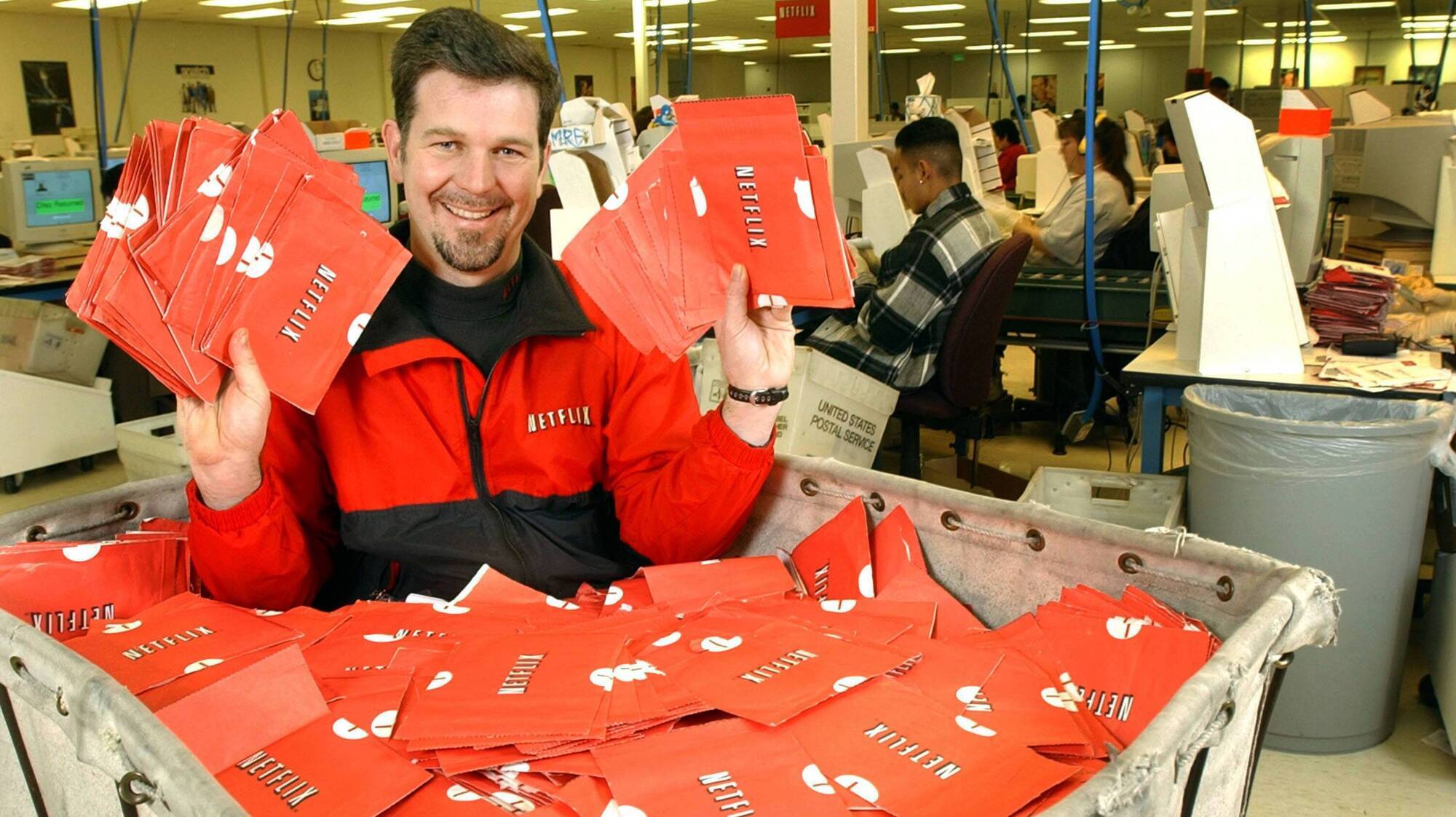
Netflix.com CEO Reed Hastings sits in a cart full of ready-to-be-shipped DVDs in 2002. Before Netflix could deliver a film to your television, it had to deliver one to your letterbox. File photo: Justin Sullivan/Getty Images
Before Netflix could deliver a film to your television, it had to deliver one to your letterbox.
Founded in 1997 by Reed Hastings and Marc Randolph, the company began renting DVDs through its website the following year. Customers chose a film online and waited for the post. The early price was $4 a rental, plus $2 postage.
In 1999 came the more consequential innovation: a monthly subscription. For $15.95, customers could rent four DVDs a month without due dates or late fees. The proposition was beautifully ordinary.
Netflix would remove an irritation from your life. You could watch a film without driving to a shop, negotiating its shelves, or being penalised for forgetting to bring it back.
Almost three decades later, the company that liberated us from the video shop faces a different question. Having become part of the furniture, how does it keep growing? What worlds remain for Netflix to conquer?
That question has acquired urgency. This month, Netflix cut approximately 1,000 jobs, about 6% of its workforce.
Chief content officer Bela Bajaria departed after nearly a decade. Film chief Dan Lin was also dismissed. Peter Rice, the former Fox and Disney executive, took over Bajaria’s role on October 26, with responsibility for films, series and live programming worldwide.
These are significant changes in the people deciding what much of the world watches. They also represent an uncomfortable moment for a company whose identity was built on knowing where entertainment was going before everyone else.
There is having something on, and there is having something you cannot wait to watch. Netflix’s first great transformation arrived in 2007, when it introduced streaming. The envelope became unnecessary.
Its second was becoming a commissioner of entertainment rather than simply its distributor. and , both launched in 2013, proving that a streaming service could compete for attention and prestige with television’s most powerful incumbents.
The whole series could arrive together. The viewer controlled the timetable. Television no longer required us to turn up at its appointed hour.
When Netflix launched in Ireland in January 2012, its cost €6.99 a month. There was a free trial, no lengthy commitment, and a library available whenever you wanted it. Against the expense and rigidity of established television packages, it felt like an escape route.
September’s price increases brought the Irish standard plan to €18.99 monthly, or €227.88 annually. Premium rose to €25.99, while the cheapest plan increased to €11.99.
The standard subscription now costs roughly 172% more than the original Irish offering, although the packages and service have changed considerably.
That is still potentially good value for a household using it every day. It is also a long way from an inexpensive extra you barely noticed leaving your account. The competition helped change the bargain.
Disney+, Amazon Prime Video, Apple’s television service, and other platforms, offered their own reasons to subscribe. The studios supplying entertainment could also become competitors for the customer relationship.
For audiences, abundance came with administrative duties. Which platform had the series? Which subscription had expired? How many were we paying for? The liberation of television produced another collection of monthly bills.
Netflix also tightened the definition of a customer. Its Irish crackdown on sharing accounts outside a household began in May 2023.
People who had watched through someone else’s subscription were encouraged to take their own or become a paid extra member. Existing popularity could be converted into additional revenue.
Ireland illustrates both the scale of the achievement and its limits. Deloitte’s research, published in February 2025, found 59% of respondents had access to Netflix in 2024, comfortably ahead of Disney+ on 32%.
But Netflix’s figure had declined from 65% in 2021. Access is not the same as a separately paid subscription; these are survey findings, not Netflix’s national account ledger.
The same research found 27% had cancelled a video streaming service during the preceding year. Cost was the leading reason. Sometimes, people simply were not using it enough.
There is a danger, however, in confusing Netflix’s search for growth with a business in collapse. Its latest quarterly revenue was $12.9bn, up 12% year on year. Operating profit was approximately $4.5bn.
Netflix is enormously successful.
The difficulty is satisfying an economic model in which enormous success must become more enormous. Its plans are increasingly recognisable: more advertising, more live events, and more programming licensed from other providers.
Its partnership with French broadcaster TF1 brings that broadcaster’s channels and on-demand entertainment inside Netflix. A service that helped prise viewers away from conventional television can also become its front door.
Irish subscribers will encounter another part of this evolution next spring. Netflix has announced an advertising-supported tier here from March 1, 2027. Its Irish price has yet to be announced.
The attraction is obvious: a cheaper subscription for the viewer, another income stream for the company.
Yet there is something wonderfully circular about paying for television that contains advertising, while live entertainment gives us reasons to watch at a particular time. The future keeps finding useful things in the past.
The competitive landscape has changed, too.
As observed this month, YouTube is an increasingly formidable presence on television screens.
Netflix must compete for attention with entertainment that does not require the same expensive machinery of scripts, stars, and production.
A rival no longer needs to make the next . It can occupy the hour in which you might otherwise have watched it.
This is where the corporate story becomes a story about us.
We have more freedom over our viewing than any previous audience. We can also spend an extraordinary amount of that freedom deciding what to watch.
A vast catalogue is not the same thing as curiosity satisfied. Personalisation cannot guarantee surprise. There are evenings when the apparently limitless menu becomes its own reason to give up.

None of this diminishes what Netflix has achieved.
It has made international storytelling part of ordinary viewing and helped loosen the assumption that English is entertainment’s default language.
Nor does an executive reshuffle establish that its best work is behind it.
But the next phase raises a less glamorous question than the one that animated the original business.
Netflix once asked how it could make watching easier. Increasingly, the question is how much more money, time, and attention it can secure from people already watching.
There are still audiences to reach and wonderful stories to tell. There are only so many hours in an evening.
Perhaps the last unconquered territory is the viewer’s right to decide that they have had enough.

CONNECT WITH US TODAY



Be the first to know the latest news and updates