Elaine Loughlin: The budget numbers look good — until the corporation tax luck runs out
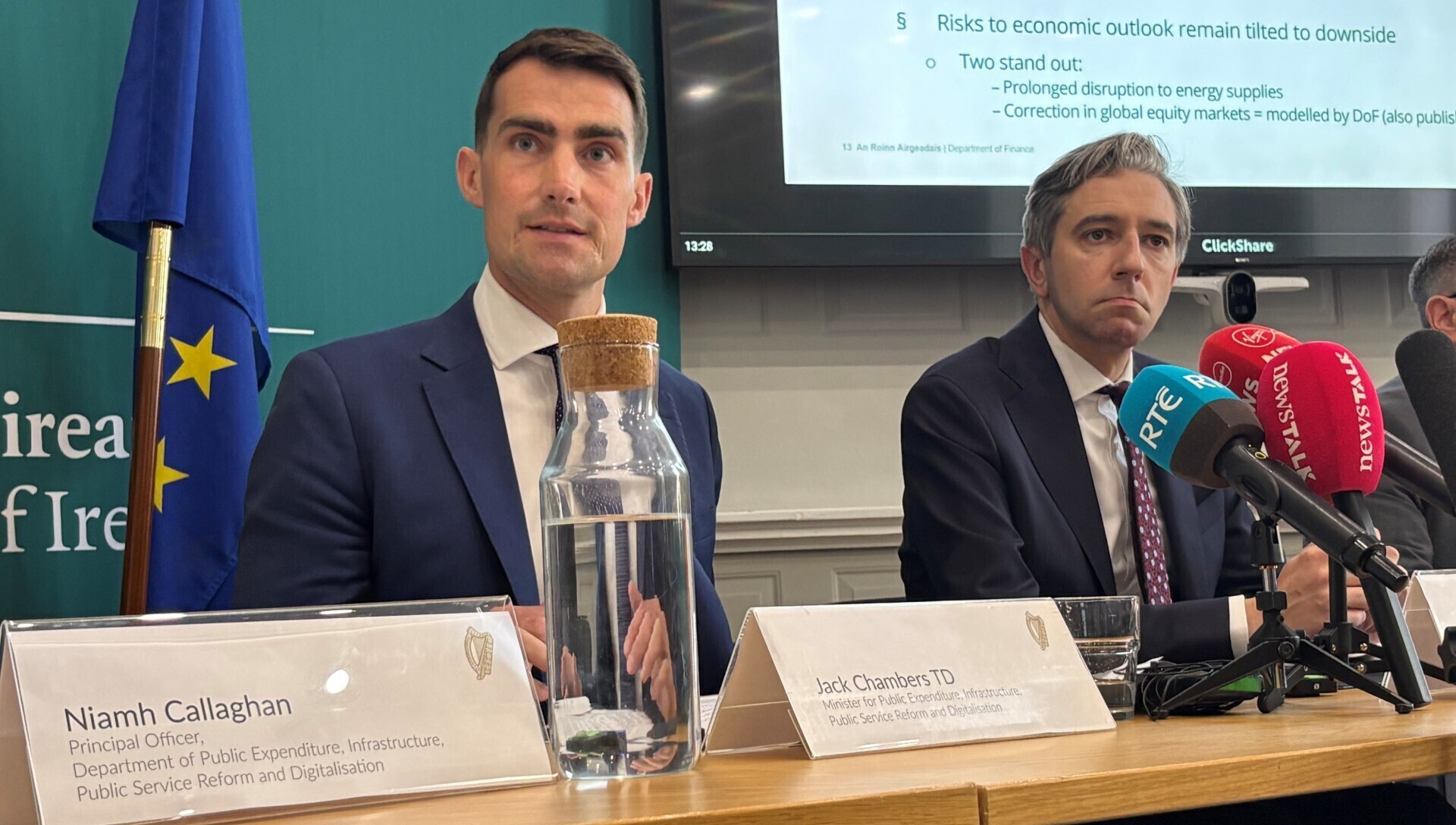
Public expenditure minister Jack Chambers and Tánaiste Simon Harris. If a department knows it is going to receive additional funding, where is the incentive to take a serious look at expenditure and find efficiencies? Picture: PA

It's a well-rehearsed pre-budget dance at this stage; the State's financial watchdog sounds alarm before the Government scoffs and promptly bins the advice.
The Irish Fiscal Advisory Council (Ifac) is, as its name suggests, a body which feeds in information for consideration by the Government before tax and spending decisions are ultimately taken by the political leaders at budget time.
This year in its pre-budget submission, Ifac has criticised the Government's persistent overspending, it has sounded caution around the threat of overheating the economy and has also hit out at the coalition for not saving more of the corporation tax receipts it is generating, especially since by the end of the decade it may need to borrow money to properly invest in its two wealth funds.
Tánaiste and finance minister Simon Harris was quick to put any Ifac economist attempting to stray above their station back in their place this week.
"They're not the government,” he said, when asked about the spending advice.
But is there any point in having a financial watchdog, which costs the State around €700,000 each year, if it is repeatedly ignored to the point of belittlement?
Instead of heeding the warnings over many years now, the Government has been splurging on measures using the uncertain but extremely lucrative income generated through corporation taxes.
The State has been spending its lotto winnings to pay for the daily essentials, but no one has figured out how we will put bread on the table if our corporation tax luck runs out in the years ahead.
Not only that, successive governments have also been overspending by billions of euro each year.
Ifac's pred-budget submission notes that "over the past decade, spending overruns have averaged more than €2 billion per year in today's terms. The last time spending was at, or below, budgeted levels was in 2013".
Despite global geopolitical uncertainly and fluctuating oil prices, Ireland's domestic economy is forecast to grow by 3.5% this year.
Income tax receipts are up on last year, the number of people in employment has also increased by 0.8% in the second quarter of this year, and of course the corporation tax cow continues to deliver.
Ifac has argued that pumping more money into the pockets of consumers will simply fuel inflation and has repeatedly hit out at the Government’s “everything now” approach , which it believes is adding needless pressure to the economy.
Indeed last year, Ifac found that the breach of the Government's own spending rules every year since 2022 has added an extra €1,000 to a typical household’s yearly outgoings making it harder for people to afford everyday essentials.
Economists have warned that continuing with similar spending policies will add another €1,000 to family bills.
"Putting a sticking plaster on a bullet wound," was how Emma Howard, an economist and lecturer at TU Dublin, described cost-of-living subsidies and other short-term spending.
She told RTÉ radio that cutting excise on petrol and diesel, as was extended during a special Dáil sitting on Friday, provides immediate relief, but ultimately people will pay down the line. Investing in renewables to provide households with cheaper, cleaner energy would make better economic sense, but would not be fully delivered within one electoral cycle.
Prudent economics is not politically popular.
Government ministers will stress that Ifac has the luxury of not having to worry about voters.
But Ifac is particularly exercised about the spend, spend, spend approach taken by their elected counterparts in Government.
Supplementary estimates, the mechanism used to provide a department with extra mid-year funds when it has ran out of allocated cash, have become a baked in assumption.
By November of last year, various departments had requested billions of euro in extra funding to cover overruns.
This included social protection which got €265m extra, while transport received €279m on top of its initial funding.
The department of foreign affairs, which has hired a significant number of additional staff as part of Ireland's EU presidency, needed an additional €155m to get to the end of the year.
Other supplementary estimates requested included €34.6m from the office of public works; €98m from the department of agriculture and €157m from the justice department.
A €646m overrun in the department of education, which came to light in March of this year, has caused much frustration among other departments that have been asked to make up the savings to cover the bill.
But the previous autumn as the overall budget parameters were being defined, department of education officials were assured that more funding would be issued beyond the budget day allocation.
At an Oireachtas Committee hearing Tom Whelen, the department’s head of finance and accounting, explained that ahead of last October's announcement, a €416m deficit had been outlined to the department of public expenditure.
"It may be the case that the department of public expenditure did not accept the quantum but it accepted that extra funding would be required for an existing level of services," he said under questioning from Social Democrats TD Cian O'Callaghan.
In effect the budget allocation was not the real budget and officials knew this.
Public expenditure minister Jack Chambers adopted a new approach in making it clear that the Government must take a collective, rather than departmental, view of overspends. This is sensible, but whether it is achievable remains to be seen.
While a spending overrun is justified when responding to unforeseen or emergency circumstances, such as the covid emergency or energy price shocks that require a rapid response from the State, persistently spending significantly more than what has been allocated is bad financial management.
The department of health, which appears to have now factored supplementary estimates into its accounting, got €302m additional funding last year.
If a department knows it is going to receive additional funding, where is the incentive to take a serious look at expenditure and find efficiencies?
Niall Conroy, Ifac's acting chief economist, pointed to the knee-jerk decisions that are sometimes made in a bid to limit the overrun, but which fail to address the underlying issue.
"You do see when overruns are building in certain government departments, for example, health. Emergency measures are introduced mid-year to try and stem some of those overruns, we often see moratoriums in the health services introduced mid-year and then hiring resumes early in the following year. That doesn't seem like the most efficient way to organise providing public services."
To date, the Government has got away with topping up and bailing out departments as corporation taxes have continued to rise.
"In a sense you could say that the money is there to pay for it but it does point to poor planning," Conroy said.
But a drop in corporation tax receipts would almost immediately turn budget surpluses into sudden deficits.
Using this precarious form of income for day-to-day spending not only shows a failure to get a handle on the annual budget but also a lack of ambition.
At this stage money diverted into supplementary estimates over the past decade would have almost covered the astronomical cost of building the Metrolink, which now has an estimated price tag of between €14bn and €19bn.
CONNECT WITH US TODAY



Be the first to know the latest news and updates