Shona Murray: Mark Carney and Canada has shown Europe how to say no to Donald Trump
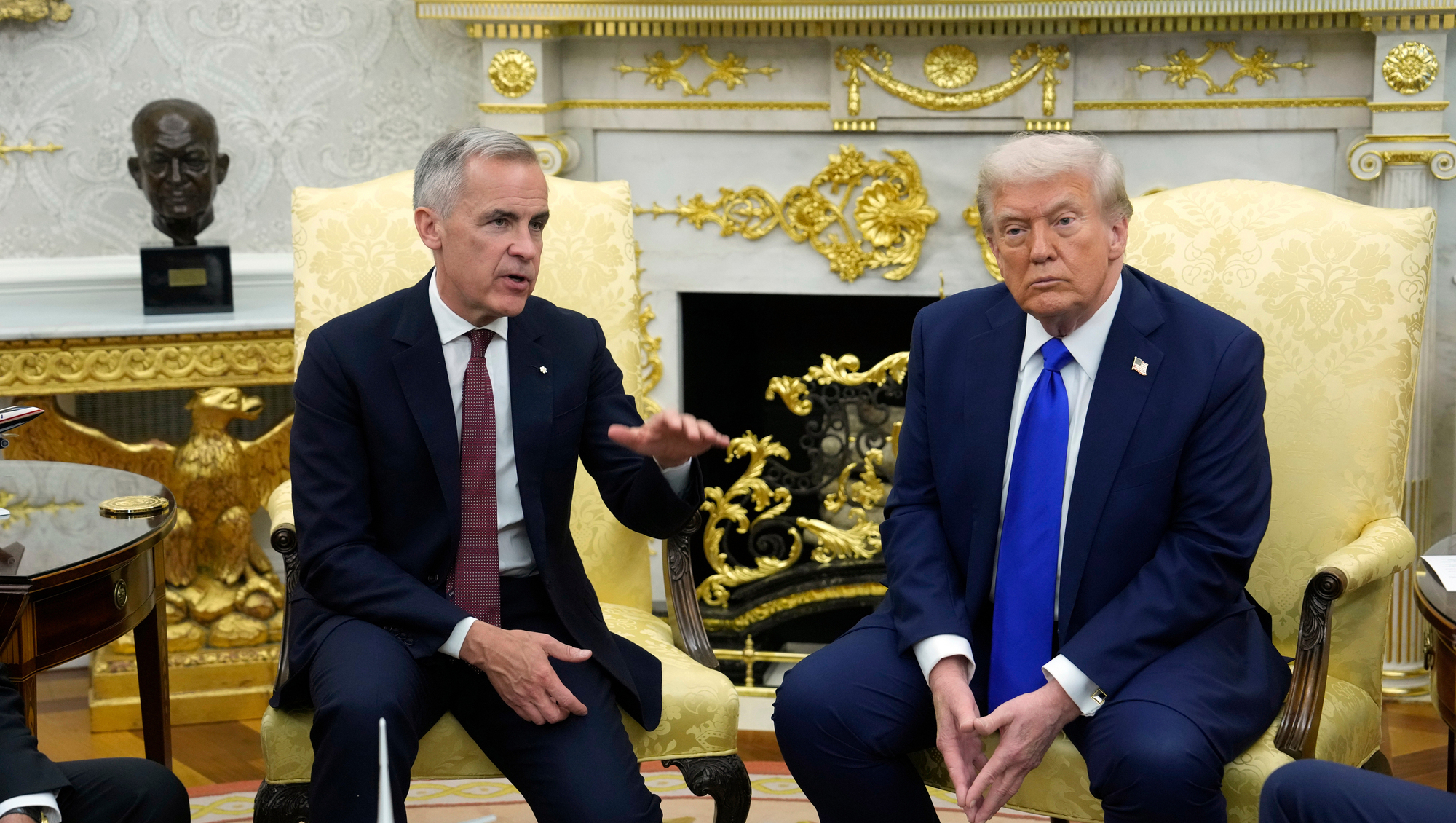
Canada's prime minister Mark Carney has withdrawn from trade talks with the US because of president Donald Trump's unreasonable demands. Picture: Adrian Wyld/The Canadian Press via AP, File

Canadian prime minister Mark Carney will be a guest of honour at the European Parliament in Strasbourg on September 16, amid Ottawa's ever-deepening rupture with the US administration.
Mr Carney has been invited by European Commission president Ursula von der Leyen to attend her annual state-of-the-union address, where she will outline her priorities for the EU for the year ahead. The address is the most political date in the commission's calendar.
The invitation is a statement of solidarity by Ms von der Leyen. Mr Carney's decision to confront, rather than accept, unreasonable treatment by Washington contrasts with the supine approach the EU has taken to the Trump administration.
The EU accepted a humiliating 15% tariff on most goods during its bruising trade negotiations with Mr Trump's team last year, though Brussels did resist Washington's demand that it dismantle regulations governing digital markets that keep in check big-tech giants (companies that are close to the US president).
Europe has been closely monitoring developments across the Atlantic since Mr Carney did the unthinkable by pulling the trigger on a full-on trade war with the Trump administration.
Canada had been locked in talks to resolve trade levies imposed by the US as part of the Trump administration's 'America First' policy.
Despite a few weeks of progress, the deal fell apart after several last-minute demands by the US, which Ottawa said were "unacceptable"; demands that would turn Canada in to a vassal state. Or, indeed, the 51st state.
Among several impositions, the US wanted a guarantee that Washington would have a say in any future trade agreements Canada negotiated with other countries.
In addition, there were to be new rules around Quebec’s French-language legislation, such as the requirement for French to be included on consumer devices, like electronics or household appliances and user manuals.
The US also required Ottawa to drop domestic rules for American streaming giants, like Netflix, that prioritise Canadian and French-language content. This despite the fact that all countries promote more nationally relevant content.
Canada is bilingual and the demands struck at the heart of Canada's sovereignty. Mr Carney could not countenance that. Such an agreement — or capitulation — might temporarily stave off some tariffs, but would bring Canada under the control of Washington. This at a time when Ottawa and Brussels are trying to wean themselves off dependency on the US, both in trade and to a limited extent defence and security.
Mr Carney has long-realised that the US is not messing around when it comes to its imperialistic, might-is-right approach to dealing with allies.
"We recognised from the start that America has changed," Mr Carney told journalists after he recalled his trade team, putting an end to the talks.
He said: "Early last year, I observed that the decades-long process of steadily increasing integration between our economies was over. Our government understood, before many, that America would transform all its commercial relationships."
US vice-president JD Vance responded to Canada's move with the usual superciliousness.
Canada, "quite literally, would get invaded by a foreign country were it not for the umbrella of protection provided by the United States of America", he said at a rally in Maine.
While many people in Europe would have liked Brussels to take a similarly defiant approach to Mr Trump, about the same amount — including the Irish Government — were willing the EU to cut a deal to maintain some level of predictability.
Moreover, Europe still counts on the US for a vast amount of its security architecture, while war rages in Ukraine. And its states — particularly in the Baltics, and including Germany — are dealing with increasing Russian aggression. Sabotage, arson, hybrid war — involving airspace violations — and drone incursions are occurring more frequently.
Europe's guiding priority at the time was the US's supposed effort to bring Russia to the table to end the war in Ukraine, as well as to continue to sell key weapons and provide intelligence to Kyiv.
The talks have amounted to nothing, and Europe is now the overwhelming provider to Ukraine for its defence, so this argument doesn't hold much water.
Yet, due to obvious geographic reasons, Europe is less reliant on the US for trade. The US makes up around 23% of the EU's trade. That's the biggest trade relationship in the world, worth around €1.5tn. Canada's dependence is proportionally larger, making Mr Carney's play even riskier.
Mr Trump has spent most of his presidency berating the EU, including providing political cover to anti-European, far-right forces within member states, such as the AfD in Germany.
The opportunity for Europe and Canada to merge ever closer in a bid to save themselves from a rapacious and untrustworthy America is here. Mr Carney has indicated this is his part of the plan. Let's hope Europe grasps it.


CONNECT WITH US TODAY



Be the first to know the latest news and updates