Are brain training exercises the solution to cognitive decline?
Research suggests that up to 45% of dementia cases are preventable, and with that in mind Jonathan deBurca Butler sets out to see if he can train his grey matter with some simple exercises
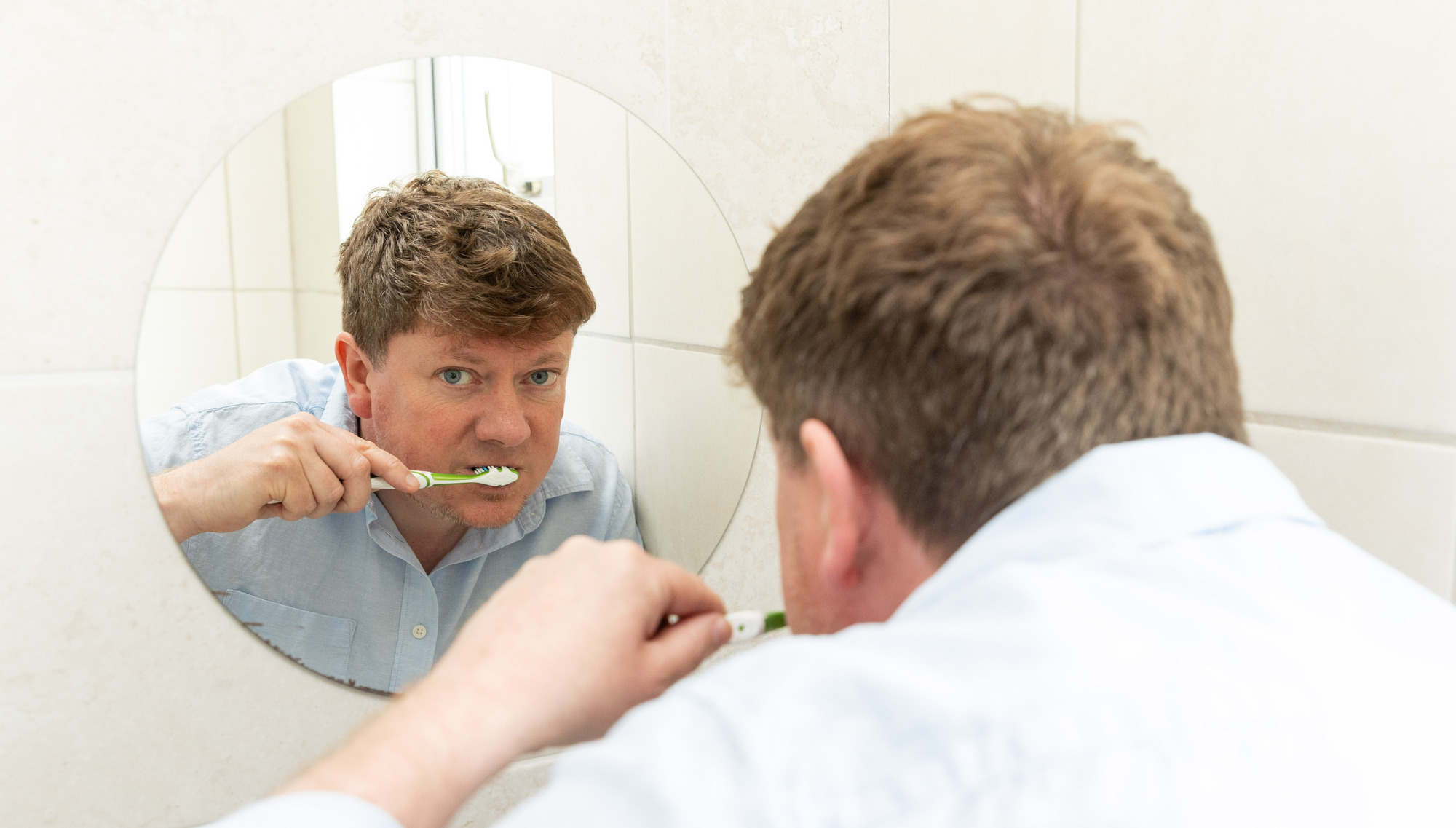
Jonathan deBurca Butler brushing his teeth with his non-dominant hand. Pictures: Gareth Chaney

Jonathan deBurca Butler brushing his teeth with his non-dominant hand. Pictures: Gareth Chaney

A Sunday morning, the night after a 50th birthday party, is probably not the best day to start any sort of gym routine, let alone a brain gym, but such was my determination to start stretching my grey matter that I opened up the laptop and went through several online tests to determine the status of my current cognitive powers. A part of me also knew that if I did them in what was something of a sleepy and cognitively impaired state the only way was up, and in four weeks, when I was due to face the tests again, I would be a little closer to Homer than Homer Simpson.

In the space of about 30 minutes, I conducted three simple tests through humanbenchmark.com, a fun and popular online platform that offers a suite of free, interactive tests to measure cognitive abilities.

Each test maps to a validated cognitive construct from neuropsychological literature. First up was a verbal memory test that assesses your ability to keep as many words in your short-term memory. Given the good/above average score is 40 to 60 words, I was rather chuffed with myself that I scored 94, particularly after a night of low-alcohol beers, dancing, and poor sleep.

For my next challenge, I took on the sequence memory test, which asks you to memorise a sequence of buttons that light up in a square, then press them in order. As you get to the next level, the sequence gets longer. On this test, I got to level eight, which landed me in the 50th-60th percentile and was therefore average. On test three, the visual memory test, I reached level nine, which pushed me just into the top 25% and the above-average bracket.

Finally, I decide to add a fourth test. For this one, I go offline with a classic: Naming as many animals as I can in 60 seconds. I’m rather disappointed with my score of just 27, but again it turns out to be just above average and demonstrates “highly efficient semantic memory mapping” according to the US-based National Institute of Health.

Though my brain cells seem to be holding up, I’m determined to improve my performance, so for the next four weeks, I take my brain to the gym and add to my daily routine three minutes of finger sequencing; some cross-body movements, specifically lifting one knee and touching it with the opposite elbow; and a range of non-dominant-hand tasks such as brushing my teeth, combing my luscious locks, and opening doors.

Jonathan deBurca Butler doing brain training excericses to to improve his cognitive function at his home in Kimmage, Dublin. Picture: Gareth Chaney

Many of these so-called neurobics are recommended by groups such as the Enable Centre in Britain and the Alzheimer Dementia Resource Center in Florida, USA. Robert Baden-Powell, the founder of the Scout Movement, was a historic proponent of ambidextral culture and promoted two-handed training among his scouts. If it’s good enough for them, it’s good enough for me.

I will come back to the tests I completed before and see if I can match, or hopefully, better my scores (without going out the night before). But then again, perhaps I should. According to Garrett McDermott, clinical neuropsychologist at the Institute of Memory and Cognition at Tallaght Hospital, socialising is one of the best things you can do for your brain.

Garrett McDermott, clinical neuropsychologist at the Institute of Memory and Cognition at Tallaght Hospital

“Any social engagement, whether it’s banter with your mates over the phone or watching a game together, puts us into a stimulating and activating environment,” says McDermott.

“This is what the brain needs. We hear a lot about a loneliness epidemic among older adults, so things like local dance groups, singing groups, and golf clubs can be so important for people in later years.”

Brain pillars

McDermott points to the 80-plus Dementia Cafes around Ireland where cognitive stimulation therapy or CST is practised. The group-based intervention involves bringing people together in a social context to stimulate their brains through conversation. Groups might read a newspaper for instance and then discuss current affairs, thereby stimulating short-term memory.

Reading and discussing articles in newspapers stimulates your short term memory. Picture: Gareth Chaney

“CST has been found to improve quality of life and activity levels,” McDermott says. “In some cases, it also improves cognition. It doesn’t treat dementia, but it really impacts how people are on a day-to-day basis.”

While socialising is what McDermott calls one of “the pillars of the brain”, there is much more to keeping the noodle in good shape.

“It’s about eating well, a balanced, nutritious diet with lots of hydration. We emphasise the importance of sleep and its importance for brain function, particularly cognitive function and memory function.

“Then there’s exercise and managing stress. In the middle age years, we’re talking about managing your cholesterol, your blood pressure, obesity, and diabetes, and ceasing smoking, reducing or ceasing alcohol consumption, combating a sedentary lifestyle, and looking after any new hearing impairment.”

Much of McDermott’s work involves assessing signs of dementia in people with atypical presentations or unusual symptoms. Most people with dementia have Alzheimer’s disease, which involves the buildup of two abnormal brain proteins, amyloid and tau, that together destroy brain cell communication and drive cognitive decline. While most of us are aware of the memory loss associated with Alzheimer’s, there are many variants.

“Some people present with changes in their behaviour and personality rather than in their memory, or they might have changes in their visuospatial functioning and reading ability rather than their memory,” McDermott says.

“Usually, the buildup of amyloid and tau affects the part of the brain that’s involved in new learning and memory — the medial temporal lobes — but sometimes that pathology might strike somewhere else. If, for example, it strikes towards the back of the brain, it’s likely to affect your visuospatial functioning rather than your memory. That will still be Alzheimer’s disease. It just won’t look like a memory problem. So people might miss those signs early on.

“There’s also a range of other conditions where people might lose the ability to speak or to find words. There’s Lewy body dementia, which often involves losing a motor component, visual hallucinations, sleep problems, as well as memory and language problems as well.”

Early intervention

According to the Alzheimer Society of Ireland, roughly 64,000 people nationwide live with dementia. More than 4,000 are diagnosed before the age of 65. Just over 60% of those living with dementia are women. Due to an ageing population, overall cases are expected to rise to 150,000 by 2045. This is a significant increase and makes prevention and early intervention even more critical.

While the thought of developing diseases associated with cognitive decline can be frightening, they are not inevitable. In 2024, The Lancet Commission on Dementia updated its findings, revealing that about 45% of dementia cases are potentially preventable by addressing 14 specific, modifiable risk factors across a person’s life course. These include many of the lifestyle factors mentioned previously but also involve laying good foundations from the day we are born, such as a good education, which McDermott says “builds up the cognitive reserve”, helping to protect us in the later years.

Novel tasks bring about neural connections says Neuropsychologist Garrett McDermott. Picture: Gareth Chaney

So will my brain gym activities improve my brain health?

“If they’re novel tasks, they’re going to bring about new neural connections, and that’s all good for the brain,” says McDermott.

“The problem is that these don’t have any transferability into other parts of your life. For example, I can teach you to remember a really long list, but when does one ever need to remember a really long list?

“So we work one-to-one with people to find out the kinds of goals they have,” he says. “They might want to remember their grandchildren’s names or want to be able to use that digital display on the telly or get to the shops without getting lost. So we focus on how we can impact something meaningful for the person and look at the techniques and strategies we think will actually help this person in this scenario.”

While they are unlikely to involve finger sequencing or weaker hand exercises, it is comforting to know that there are steps that can be taken to fight the onset of dementia.

With that in mind, I return to my tests. This time, I’m on my holidays staring into the distance at the Atlantic Ocean. The night before, I was the designated driver, so there’s little to no alcohol slithering its way around my noggin. I’m expecting great things.

When I score 104 on the verbal memory test (10 points better than three weeks ago) I am positively over the moon, and I do a celebratory finger dance, which I’ve become quite good at now. This doesn’t last long, however, and though I go into both the sequence memory and visual memory tests with great confidence, I score the same on the former and, at level 7, worse on the latter.

I give the table a small frustrated thump, but find that I have done so with my left hand and give a satisfied harrumph. I’m sure that my analogue animal test will deliver.

Alas, I make something of a monkey of myself, scoring the same 27 as before. Never mind, I can always blame the beauty of West Cork that distracted me. Still plenty to work on.

x

More in this section

Lifestyle

Newsletter

Eat better, live well and stay inspired with the Irish Examiner’s food, health, entertainment, travel and lifestyle coverage. Delivered to your inbox every Friday morning.

Cookie Policy Privacy Policy Brand Safety FAQ Help Contact Us Terms and Conditions

© Examiner Echo Group Limited