How to select a spiral staircase style to suit your home
Ensure the tread size and rise of a spiral stair is suited to everyone in the family. File picture
Many years ago, we used a very ornate 1860s Victorian salvaged staircase in a split-level 1970s house renovation. It was gorgeous, with immense house plants brushing up through the back of its twisted spine. We married it to similarly styled period cast-iron railway station banisters dividing the room levels.
Did we ever hit our heads off the risers and bolts? Absolutely. Did it overpower the room? Possibly. Did the cat use it as an attack platform to swat us with the murder mitts? Every single day. Did we love it? Obsessively.
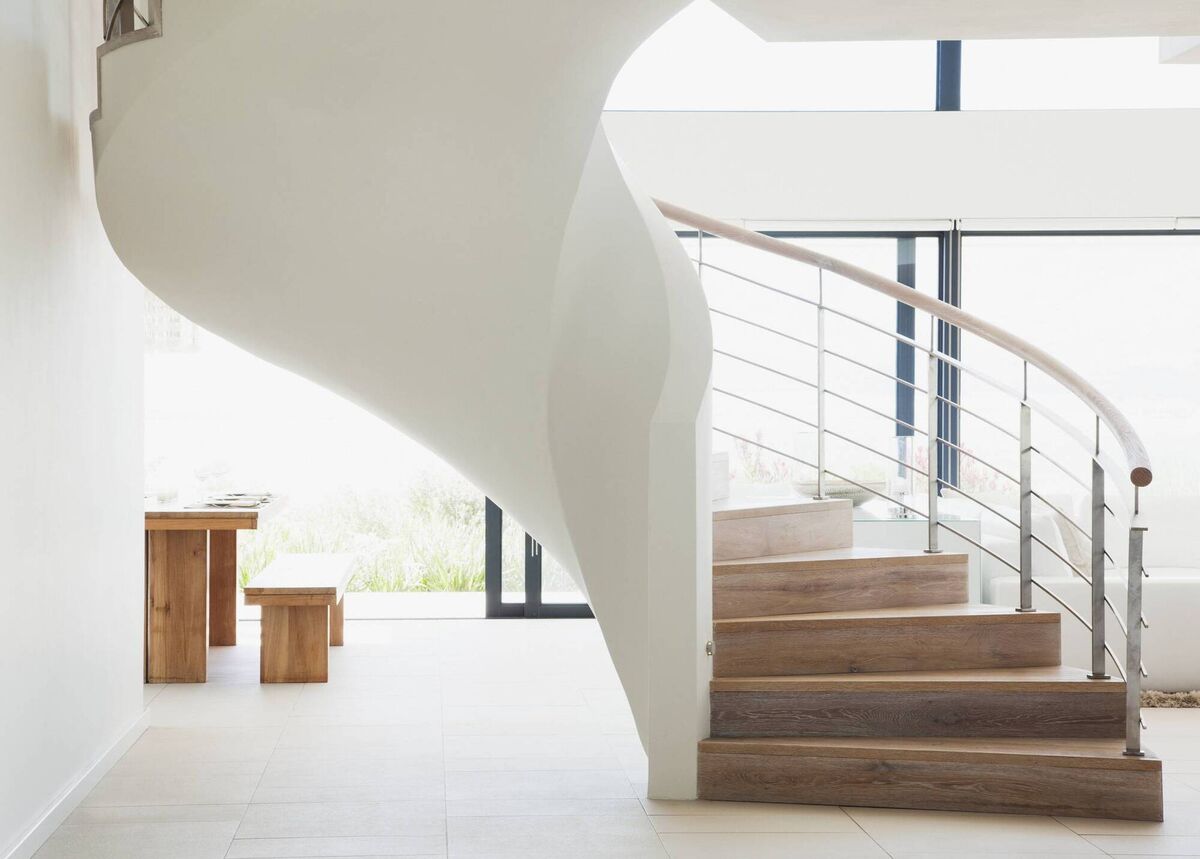
A tightly proportioned upright shot, the major advantage of standard spiral stairs is space-saving. With a modest diameter and weighted through its centre, this sinuous form can sit on a footprint (termed a well-opening) well under two square metres, where a full stair would demand more floorspace for a set of straight raked rises.
You still need a designated area to approach the bottom step and at least 5cm in the well opening to let your fingers glide along the banister safely as you meet the second floor.
Comfortable use and climbing a spiral stair will depend on its diameter, the size of the treads, and adequate head clearance. We can’t be clattering our head off the steps above us, so a good stair will offer at least two metres of standing room, and 800mm width to allow passage. The stacked design offers great versatility as it can be built to suit the height of a variety of indoor and outdoor spaces, and you can even put them through two levels, stepping off and then continuing upward.
Quality, design, and superb engineering are the mark of any good set of stairs. The risers, including those on spiral staircases (that measurement from the base of the step to the top face), should be no more than 220mm to prevent slips and joint strain. Too low (150mm), and you’ll be mincing along, and the stairs will have more (visually interrupting) steps to negotiate. A respectable measurement would be 175mm. Good “going” is a consistently sized platform that your foot sits into, allowing you to push off and up the stairs in a natural, balanced way without clutching on with your toes.
In a really strangled vintage spiral staircase, you can expect the pitch of the stairs to be more acute than the regulation 42 degrees. When buying old, ensure the spiral, including the banister is set in the direction you need — clockwise or anti-clockwise.
Will everyone in the house be able to negotiate a curving 800mm wide staircase? The steep, dramatic design may suit your situation today, but it will prove murderous on your hips and knees in ten years. Manufacturers generally recommend not using more than 22 stairs on one uninterrupted staircase. More is mountain-climbing. The 91m spiral stair in the Taihang Mountains in Linzhou, China, is built in wood and sways slightly in the wind. The Chinese don’t permit anyone over the age of 60 to make the climb, as its physical challenges have been known to cause cardiac arrests.
Accessing a fully converted attic with two bedrooms, we had to remove a floor-to-ceiling second-storey window and swing new or departing furniture up with ropes. It’s a unique physical sensation — pulling and twisting yourself up a steep spiral stair by the banister. Add a babe in arms or a laundry basket? Tricky, and only one person can use the stairs at a time.
Some spiral stairs and cantilevered designs are in wood or metal treads that won’t take carpeting. They can be slippery in socks or the wrong shoes. Choose wisely if you have young children or anyone in the home with a mobility challenge.

Ensure any balustrade has no more than 100mm gaps to protect children from being trapped or falling. These designs can be overly attractive to a toddler, presenting a touch of jungle-gym appeal. A narrow, high spiral might be alright for occasional access but intimidating for everyday use.
You might still be dizzy with desire for a modular or bespoke spiral, but tread carefully. Explore curved and space-saving staircase types from dog-legs to curved and straight spine-beams, pen-checks (cantilevers), helical stairs, and discreet quarter turns with an architect or a seasoned interior designer. The available room, including approaches and step-off to the room or corridor, should inform your choice.
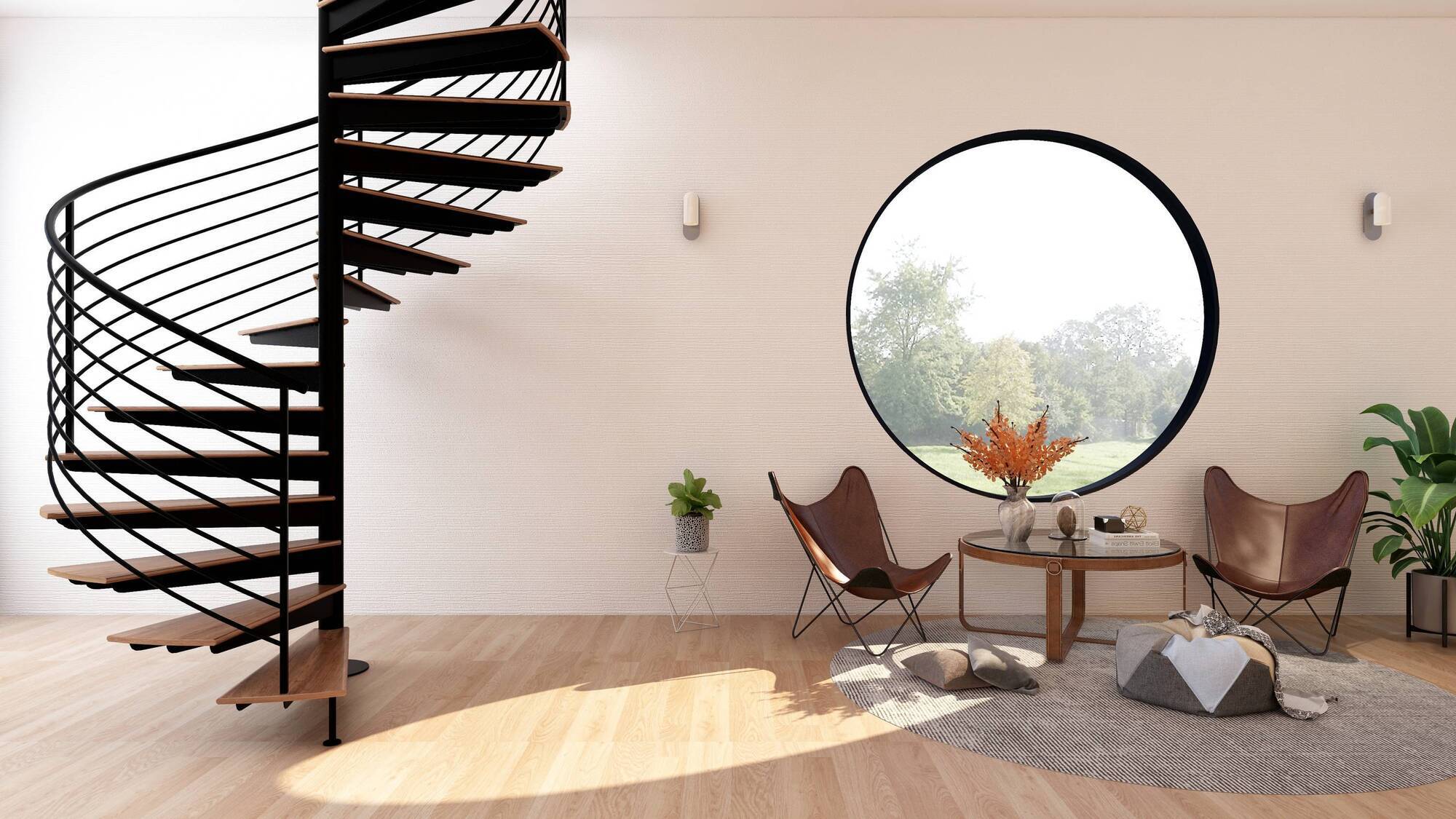
With a towering corkscrew silhouette, even a small spiral staircase is very present. Choose a bold, vertical anchor you’re happy to look at, around and through. Some people loathe spiral stairs at the gene level and regard their inclusion as showcasing a spatial compromise. There are actually dozens of design possibilities, and not every spiral staircase has a super circular, asymmetrical form.
Some look more cantilevered than others (glass panels forming the stringers). For blistering contemporaries? Look into mild-steel models in eye-watering powder coatings matched to timber treads, and open-tread concrete designs with (apparently frameless) curved glass panels. Public buildings offer inspiration that can be scaled down into sorts of domestic stairs, so keep your eyes open and your phone camera ready.
Staircase styles
Stone spiral or helical staircases (the tangent line at any point makes a constant angle with a fixed line called the axis) were known in the Roman Empire as early as the 5th century BC.
For luxurious theatre, they offer a curving, gently inclined C-shaped staircase without a central post. Sweeping through open space, they are highly sculptural but require a lot more room than a typical spiral stair. The execution of this complex screw, sometimes referred to as a “vice” for its wound design, draws gasps from modern engineers for the precision and difficulty of the construction. Many spiral stairs in ancient buildings all over Ireland are perfectly intact today, their narrow steps tight to the supporting stone newel.
Teased open, a helix or wider spiral staircase can work beautifully as a highly architectural main stairs meeting walls or standing independently in a rangy hall. They were wildly popular in the art deco era, and Leonardo da Vinci fashioned a famous double helix to allow people going up and down to use the same stairs simultaneously (Chateau de Chambord).
The tread on a helix staircase can be wider at some points, making it really interesting as well as a home’s unabashed centrepiece. Great stairs of this kind will reveal, frame, and enhance features of the room or hall from every angle as the higher steps are pulled up and out of the sightlines. Well chosen, a helix will lead the eye and be visually dynamic in metal, glass, or even traditional closed treads. They really float and fly. We’re talking about a seriously expensive structure, so get a set of eyes on the project early on — don’t just wing it.
Helix staircases tend to be pricey bespoke choices. For the same money as a good spiral stair, look into open-tread, compact cantilevered and straight or curved spine-beam stairs in wood, metal, and glass stringers (panels). Once properly anchored on one wall, floating stairs with robust balustrades and panels are perfectly safe, comfortable to use, offer greater access for bulky bits and bobs, and are aesthetically featherlight in the right design.
When converting an attic, your staircase must be fixed (that is, not an attic stair that’s just pulled down). This can include a spiral and a variety of other compact staircases that meet current building regulations, fire safety standards and that are suitable for an evacuation situation for everyone in the house. An engineer should check that the supporting floor can hold the weight of a staircase weighted over a smaller area than typical stairs, the “lateral restraint” needed at the top of the stair, any tolerance and torsion issues. There must be suitable anchoring points for the entire structure. If you’re building a new or renovating, start the discussion about any staircase, traditional or a curly-whirly, at the earliest stage of the design process.

Cancel anytime
CONNECT WITH US TODAY
Be the first to know the latest news and updates