'I signed up for a DIY course. Turns out there's lots to learn about internal walls — and it's worth knowing'
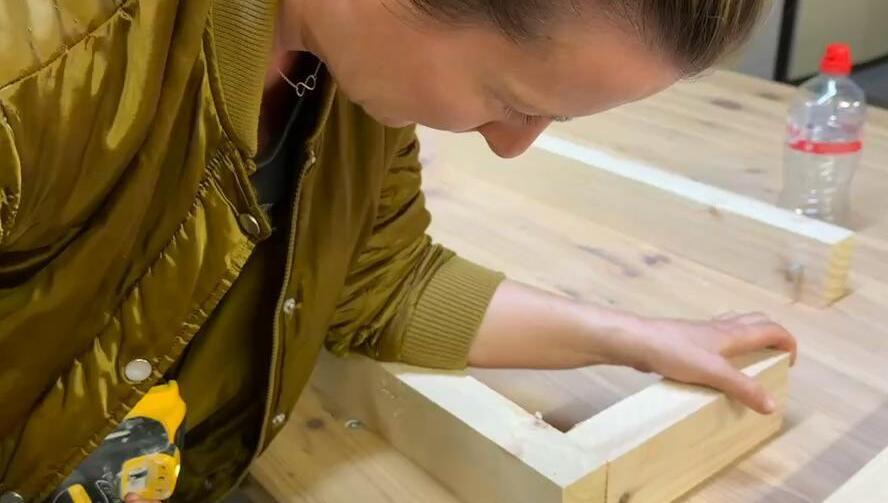
Vertical lengths of timber ('studs') — usually spaced between 400mm and 600mm apart — are screwed into 'plates', a length of timber fixed to the floor and ceiling.
I don't know if it’s middle age or what, but I’m firmly in my DIY era and loving it. I was always fairly handy, taught well as the only daughter of a father who could do pretty much anything needed around the house. A while back, I signed up for an evening DIY course, wanting to hone those skills and reduce my dependency on calling someone in for the bigger jobs. (If you've tried to get a tradesperson in recently, you'll know that particular despair.) All homes need some level of maintenance, and I get great satisfaction out of being able to do as much as possible of that myself.
The course has given me a proper framework for approaching home maintenance the right way, and introduced me to techniques I'd never have thought to try. We started off learning about how to build and repair internal walls, a topic I wasn’t prepared to be quite so intrigued by because I know how to hang stuff up, but turns out there was lots to learn — and it’s worth knowing.

Most internal walls in Irish homes — particularly the partition walls that divide rooms — are what's called stud walls. Rather than being solid brick or block, they're essentially a timber (or metal) skeleton clad in plasterboard, with a layer of plaster or skim coat on top. They look and feel solid enough, but there's a lot of hollow space in there.

We learned how to build them in class, and here’s the process we went through: a length of timber (called a plate) is fixed to the floor and ceiling where the wall will go, using screws. Vertical lengths of timber (“studs”) — usually spaced between 400mm and 600mm apart — are then screwed into those plates to form the frame.
Behind or through these studs, your electrician runs cables, and your plumber runs pipes, before it’s stuffed with insulation. Then, plasterboard is screwed onto the studs, the joints are taped, and the whole thing is skimmed with plaster. It’s a relatively laborious process, but overall a simple approach.
More recently, some builders have been switching from timber studs to metal ones. Metal studs go up faster, allow for a slimmer wall profile, come with pre-drilled holes for cables and pipes to pass through, and are more fire-retardant. All of which sounds great — until you want to hang something heavy.
All of this is good to know, because before you go hanging things up, you need to know what you’re about to screw into. Plasterboard itself can actually take a decent amount of weight if you use purposely designed plasterboard fixings — but it is no match for a heavy bookshelf (I learned this lesson the hard way in my 20s, and no, I did not get my rent deposit back).
Timber studs can take a good amount of weight — bookshelves, mirrors, heavy artwork — if you're drilling into them directly. Metal studs, on the other hand, can’t really be drilled into in the same way. If your home has metal-stud partition walls and you try to hang a heavy bookshelf or a large TV, you're going to need a workaround.
If you're building a new partition wall and you know in advance that you'll want to hang heavy items in a specific spot, the smart move is to add a horizontal piece of timber between the studs at that height before you close up the wall. Retrofitting is possible but messier: you'd need to cut into the plasterboard, add the timber reinforcement, then patch and repaint.

So, how do you find the studs in an existing wall? If you’re pre- or mid-renovation, I highly recommend taking as many photos or videos as you can of your walls before they are closed up. If you’re past this phase, this is where a decent detector comes in. You can also knock along the wall and listen to what sounds solid vs what sounds hollow. Personally, I use a Multi Stud Detector 3-in-1 that I bought in Woodies a few years back, and it was worth the €25 or so that I paid for it. It detects timber and metal, and critically, it also detects live wires and pipes.
This bit is very important. Detecting where the studs are is all well and good, but behind your plasterboard, alongside or through those studs, there may be electrical cables and water pipes. Drilling into either of these is not just an inconvenience — it can be highly dangerous and incredibly expensive.
Cables should be run either horizontally or vertically from switches and sockets, and pipes should be insulated and not placed right behind the plasterboard — so in theory, if you avoid drilling directly above a socket or in a straight line from one, you should be less likely to hit a wire or a pipe.
We live in the real world, though, and sometimes things aren’t done as they should be, for myriad reasons. A friend of mine discovered this the hard way recently while hanging a TV: the pipe they drilled into wasn't wrapped, and wasn't where it should have been. It was a very bad day.
This is why a detector that covers all three — studs, cables, and pipes — is worth every penny.
Repairing holes in plasterboard is more doable than you think.
Whether you're patching over an old TV mount, covering a mistake, or repairing damage from a move, plasterboard repair is achievable for a home DIYer. The course gave me much more confidence in tackling this myself.

First, you need a filler. Powdered filler, which you mix yourself with water to a peanut-butter consistency, is widely held to give a better result (though I still use the pre-mixed stuff for small chips or cracks). For small holes and screw marks, mix up your powdered filler and apply it with a filling knife.
The technique that was taught in our course is to apply the filler in a cross pattern rather than just going in one direction: up and down first, then left to right. This pushes the filler into the hole more evenly.

For larger holes, or for cracks you want to make sure stay fixed, plasterboard mesh tape is your friend. It comes in a roll, it's self-adhesive, and you press it over the damaged area before applying your filler or plaster. It reinforces the repair and, for cracks especially, stops them from opening back up. You can sand it back once dry.
If the hole is too large for tape and filler to bridge, you'll want to cut a clean square around the damage using a small saw or a multitool, and create a matching patch from a spare piece of plasterboard. Put a small piece of timber behind the hole for the patch to screw into, and you have a solid repair. Tape the joins with the mesh tape, apply a thin coat of plaster, let it dry without overworking it, and sand smooth before re-painting.
I am not suggesting everyone should go off and become DIY experts (you can keep reading my column instead!). But a basic understanding of what's inside your walls and how to repair them is very useful for any homeowner. If there is an evening DIY course near you, I'd really encourage you to look into it.