How well do you know your garden bees?
Get to know your garden bees (Alamy/PA)
Can you tell your average buff-tailed bumblebee from its murderous cuckoo relative? Do you know which bees can sting and which can’t, or which are likely to live in a bee hotel or make their nests underground?
In the run-up to World Bee Day (on May 20), which aims to raise awareness of the importance of pollinators for food security, biodiversity, and ecosystem health, perhaps it’s time to observe the bees that visit your garden more closely and consider planting some of their favourite plants.
Anyone who doesn’t really know what they’re looking for may want to bag a copy of by bee expert Dave Goulson, founder of the Bumblebee Conservation Trust.
Bees live in burrows, holes in trees and even empty snail shells. They have favourite flowers. Some even sleep curled up in the blooms, says Goulson, who is also professor of biology at Sussex University.
“Quite a lot do that, because the males don’t typically have a nest. Flowers provide a bivouac for the night. The males of all bees are pretty useless creatures. Their only job is mating. They don’t gather food for the nest. In the daytime, they often sit on flowers, having a bit of a drink to fuel their next search for a mate.”
Here are some of the bees you may spot in your garden at this time of year.

This is the most common bumblebee in this part of the world. “It’s one of our biggest bumblebees, on the wing from late February right through to summer. It has two yellow stripes and a slightly brownish bottom, hence the name ‘buff-tailed’,” says Goulson.
The queen comes out of hibernation in early spring, feeding on spring flowers and then looks for a nest in a hole in the ground, so can often be seen flying low to the ground.
Lavender, catmint and borage, although they will feed on many other plants.

“As the name suggests, it’s a bit like the bird — it specialises in attacking nests of buff-tailed bumblebees. The female comes out of hibernation a little bit later, when the buff-tailed bumblebees have already built their nest and got their first batch of workers, and the southern cuckoo bumblebees try to sniff out a buff-tailed bumblebee nest.
“If they find one, they murder the queen. They are big, strong insects with a thicker skin and a longer sting than normal bumblebees, and kill the queen, then they basically enslave her worker bees into their own workforce.
“They show no interest in people. They are quite common, with broadly the same yellow stripes as the buff-tailed bumblebee, but they have an extra bit of yellow next to the white on the tail.”
The males are particularly fond of brambles.
“This is one of our most common solitary bees. People think of bees as living in a hive, the social creatures of queen and workers, but it’s only the honey bee and the 20-plus bumblebee species that are social."
The females have distinctive inward curved horns, used to gather, carry and mould balls of damp soil that are used to construct cells for their brood.
The red mason bee is the most common occupant of bee hotels, made of horizontal tunnels such as bamboo canes and other hollow stems. They also nest in holes in walls or trees with holes in them and are only on the wing in April and May.
“They are quite small, red and fluffy, and are called mason bees because the female bee nests in holes. They cannot sting humans. The stings of most solitary bee species are too weak to penetrate human flesh.”
Apples and pears. You may also see them on forget-me-nots, grape hyacinths, rosemary and pulmonaria.

One of Goulson’s favourite bees, the male is a fluffy brown, emerging in early spring, followed a week or two later by the jet-black female, which has orange hind legs. “They are about the size of a small bumblebee, so they are quite big solitary bees.
"The name comes from the fact that the male’s midlegs have long hair protruding from the feet.
"The females nest in holes, but they burrow into clay banks usually and they are on the wing at this time of year.”
They have a distinctive hovering and darting flight pattern different to most other bees.
Their favourites are comfrey and lungwort, he says.
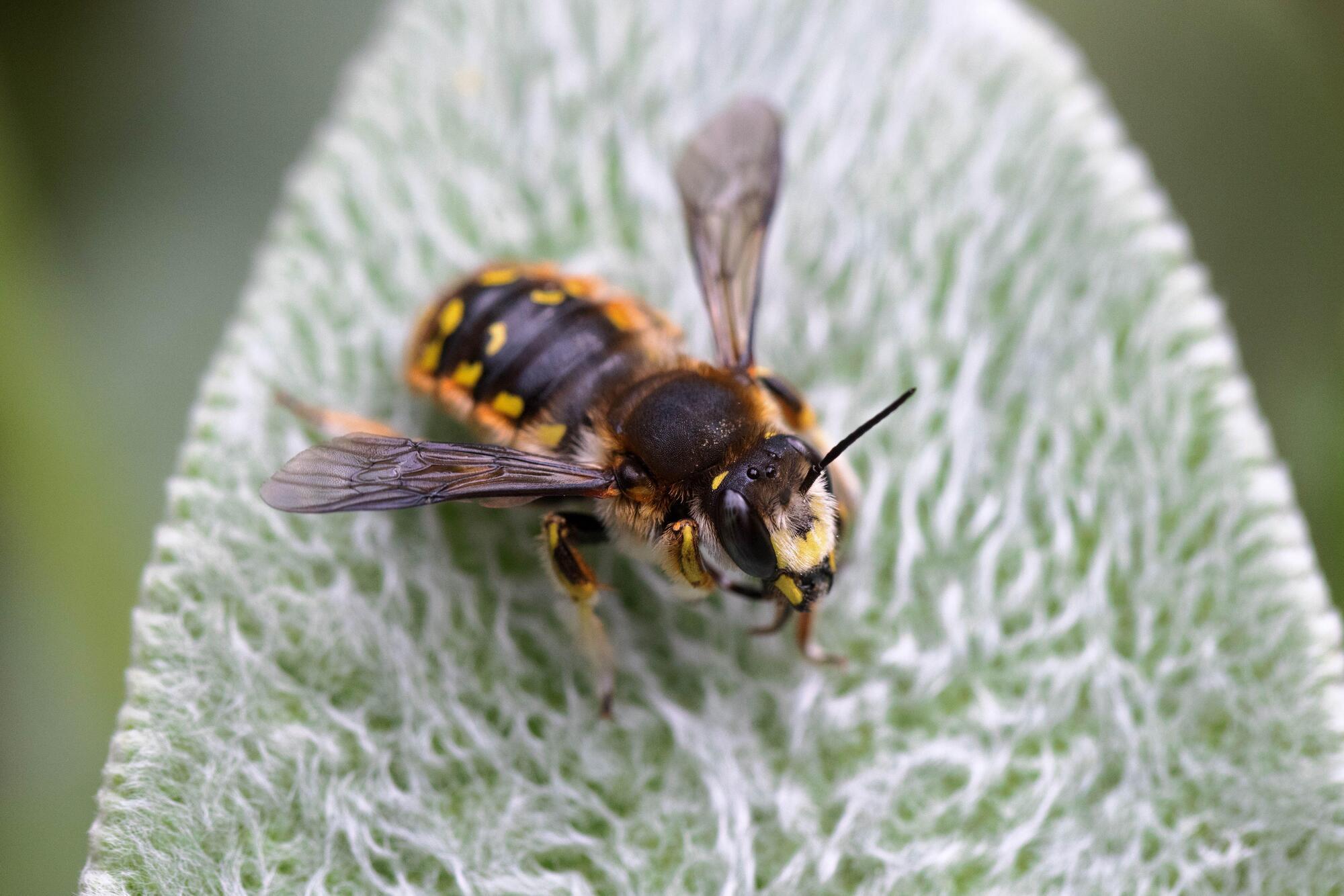
This is a striking solitary bee with bright yellow spots along the sides of its abdomen. It’s called the wool carder bee because the females collect hairs from hairy-leaved flowers and use them to build a nest which looks like it’s made out of cotton wool.”
The male is really aggressive, Goulson notes. “They look for a patch of lamb’s ear and defend it against any other bee, not just their own species, but any other insect, in fact, that comes into the patch (but not humans).
“They’ll fly at it and have these big pointy bumps on the underside of their body, which they’ll stab at any insect that dares to enter their territory and crush it. They do that because basically they’re defending a resource that the female needs.”
Wool carder bees, which are on the wing from late May to early August, nest in cavities and will take any man-made opportunity, Goulson says. “I’ve got some drill holes in my wooden picnic table in the garden at the moment. They are coming out on the wing now and a bit later into the summer.
Lamb’s ear (Stachys byzantina) for building nests. They feed mainly on woundworts and legumes like bird’s-foot trefoil.


CONNECT WITH US TODAY



Be the first to know the latest news and updates