HSE warns of 'several hundred' Lyme disease detections a year
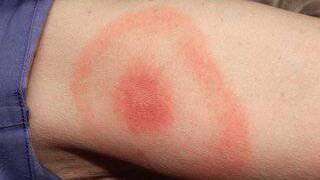
The most common sign of infection is a skin rash, known as Bullseye rash or erythema migrans. File picture: HSE.ie
The HSE has warned that “several hundred” people are likely infected with Lyme disease every year in Ireland, and has called on people to be aware of ticks.
The tiny insects are found in woodlands and other areas, and there are concerns the warming climate is extending their season in Ireland.
“While the exact number of Lyme disease cases is not known, it is likely that several hundred cases of the milder forms of Lyme disease occur in Ireland annually,” the HSE said.
In addition, a more severe type of Lyme disease occurs in smaller numbers here.
The HSE’s Health Protection Surveillance Centre is notified by doctors of around 10 to 20 cases of neuroborreliosis annually.
People who spend time outdoors need to be aware of these risks, according to consultant in public health medicine with HSE National Health Protection, Dr Paul McKeown.
“Ticks are present everywhere in Ireland, including both urban and rural environments and are active from spring to autumn,” he said.
He said they are “more numerous and more active in the summer months”, and this is when doctors expect to see more cases of Lyme disease.
Chief medical officer Professor Mary Horgan said while ticks are found across Ireland, “most people who are bitten do not become ill”.
However, she said: “Lyme disease can occasionally cause serious health problems if not diagnosed and treated early, so awareness is key.”
The most common sign of infection is a skin rash, known as Bullseye rash or erythema migrans.
Dr McKeon said: “In a small number of cases however, the infection can be more severe, leading to serious nervous system, heart and joint disease.”
He urged anyone who has this rash or other symptoms to tell their GP they have been bitten by a tick.
Lyme disease can be treated with antibiotics.
Early removal of a tick significantly reduces the chances of being infected.
The HSE advised: “The entire tick, including its mouthparts, which might break off, should be removed with tweezers by gripping it close to the skin.
“The skin where the tick was found should then be washed with soap and water, and the area checked over the next few weeks for swelling or redness.”
Prof Horgan advised people to know the areas where ticks are found and to check their skin carefully after being outdoors.
“Seek medical advice promptly,” she said, for “symptoms such as a rash spreading outward from a bite site or flu-like symptoms following a tick bite".
Dr McKeown advised preventing bites by wearing long-sleeved tops or trousers along with a hat. Long hair should be tucked in, and people should wear insect repellent, preferably containing DEET.
CONNECT WITH US TODAY



Be the first to know the latest news and updates