Letters to the Editor: In Cork, LDA looks like a State vulture fund
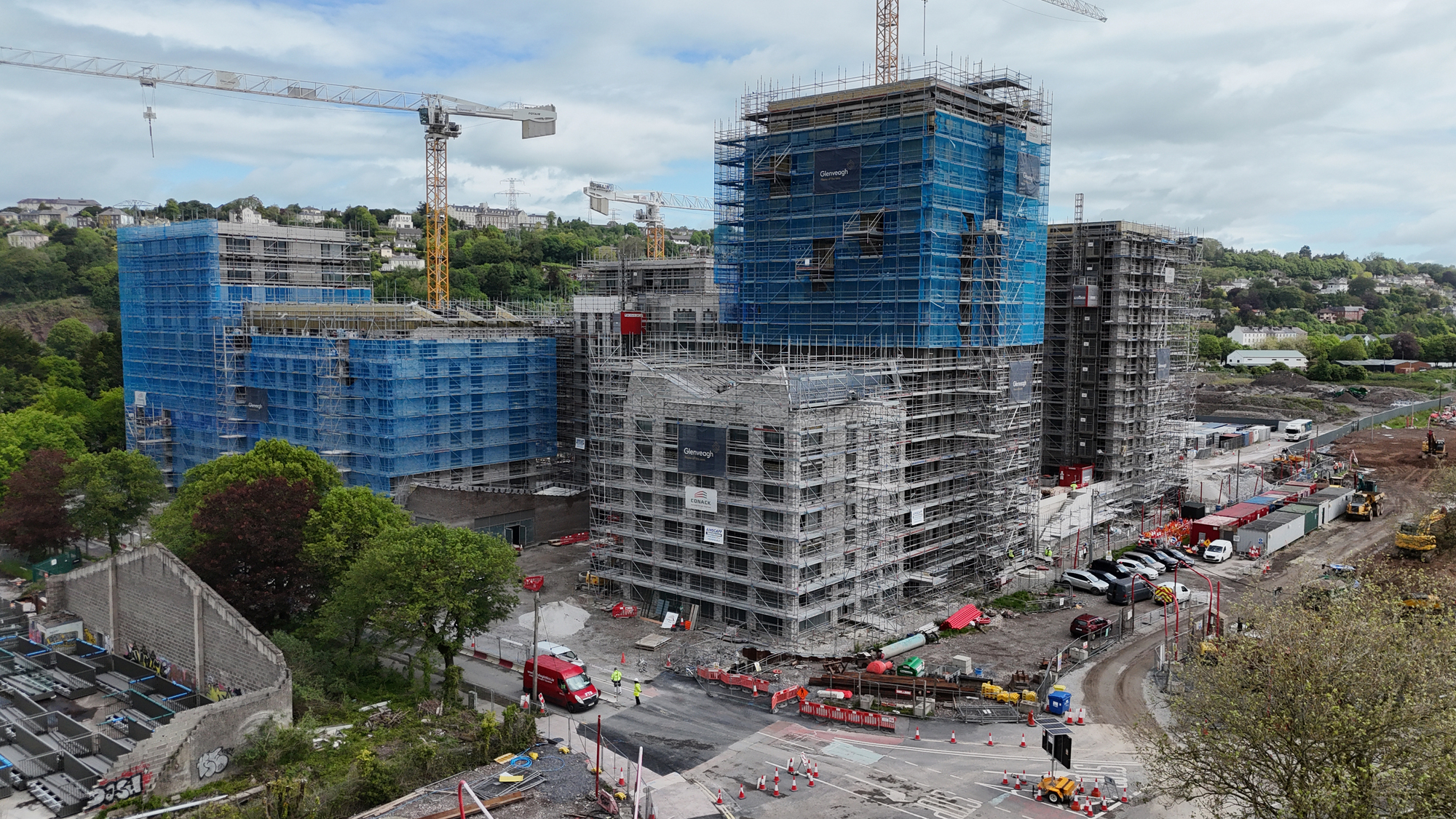
The LDA acquired all 337 apartments in the first phase of Marina Depot in Cork. Sinéad McCarthy says the Government is backing an institutional buyer of its own. Picture: Larry Cummins
I’ve been following the excellent coverage in the on housing in Cork — from Donal O’Keeffe’s investigation into Cork City Council’s social housing, to Amy Campbell’s reporting on the apartment boom, and Alan Healy’s examination of ownership, permanence, and the kind of city now taking shape.
Cork is finally building apartments at scale. Yet if you want to buy one and live in Cork City, the choices are remarkably limited.
Marina Depot is a stark example. The first phase of 337 apartments has been acquired by the Land Development Agency (LDA) for cost rental and social housing for Cork City Council. An entire first phase gone.
The following phases of this development are likely to follow the same model.
And Marina Depot is only part of the picture. Look at the Rail Yard, Horgan’s Quay, and the LDA’s growing involvement across the Docklands.
Development after development is being acquired or brought into the State’s social and cost-rental housing pipeline.
At what point do we ask what is actually going to be left for people who want to buy an apartment in Cork City?
Read More
The Government has previously acted to stop institutional investors bulk-buying homes and crowding out individual purchasers. Yet the State is now backing an institutional buyer of its own. The LDA increasingly looks like a vulture fund with a State logo on it.
The contradiction is hard to ignore.
Government spends public money on Help to Buy and the First Home schemes, while State bodies use public money to acquire new housing at a scale no ordinary buyer can compete with.
Of course there is demand for social and cost-rental housing. But why does delivering it have to mean entire new developments where home ownership simply disappears from the equation? Where is the balance? Where are the genuinely mixed-tenure developments?
Then there is Cork City Council. Donal O’Keeffe’s reporting showed the state of parts of the housing stock it already manages. The council cannot properly manage and maintain what it has. Why are we giving it more?
I have spent months asking the LDA, Cork City Council, elected representatives, and the Department of Housing where people who want to buy an apartment and live in Cork City fit into these plans.
I think the answer is clear: We don’t figure in them.
That is what troubles me most.
Cork is being reshaped by institutions that appear to have very little regard for those of us who want the fairly ordinary thing of buying a home and living in our own city.
Where are we supposed to live?
I completely agree with all the points Aislínn Kelly makes in her article regarding the potential for increasing the availability of rail transport in Ireland, and particularly around the city and county towns of Limerick (‘Gen Z wants an Ireland where a car is handy but not essential’) — , August 19.
Why are we not pulling out all the stops to reinstate these old commuter lines, thereby opening up opportunities for sustainable working and living out into the surrounding counties, without the inevitable increase in traffic congestion and emissions that come from building ever more roads?
If the Foynes to Limerick railway was extended to Shannon Airport, Limerick could become the first city in Ireland connected by rail to both a port and an airport.
It’s time for more joined-up thinking, and rail is the way to go — not just for Gen Z, as Aislínn pleads, but for Gen Xs like myself and even Boomers too.
The fragility of Ireland’s national electricity grid has been repeatedly highlighted by AmCham Ireland, as a potential deterrent to attracting US foreign direct multinational investment.
The shortcomings of the national grid infrastructure was exposed during the recent solar eclipse, whereby backstop emergency power had to be provided by the Tarbert Power Station.
Given Ireland’s fragmented and dysfunctional energy generating and supply system, the country is now much more vulnerable than other EU member states to energy supply shocks. Moreover, 50% of EU countries derive their primary energy from nuclear power facilities.
According to the Sustainable Energy Authority of Ireland, Ireland has to import some 80% of its annual energy requirements compared to an EU average of 57%.
Had Ireland gone down the route of building a nuclear power generating facility at Carnsore Point in 1978, the country would be now 100% self sufficient as regards its energy needs. Whilst wind and solar have their merits as alternate energy sources, it is only so when the meteorological conditions are in their favour and that is not always the case. Dependable energy provision has to be reliable, steady state — and consistent.
Ironically, Ireland or at least the current political ruling mandarins, are considering the nuclear option possibly by way of small nuclear reactors. The parlous state of our utilities infrastructure, energy system, and for that matter water, does not bode well for future foreign direct investment, despite the fact that Ireland continues to remain an attractive location for multinational investment, but competition has never been so tough.
As far back as 1958, the economic visionary of the time T K Whitaker emphasised the importance of investment in reliable utilities infrastructure as being critical to economic development.
Ireland is still very adept at attracting foreign investment, but to continue to do so is predicated on having reliable key energy and water infrastructure in place together with a transparent and enabling planning and development system. By doing so will remove the bottlenecks inherent in the current system
Ireland has been basking in unprecedented, glorious sunshine for most of June, July, and August to date.
The downside, however, is that during this period, regrettably, little or no wind blew, becalming wind turbines across the country.
Onshore wind in Ireland generated a mere 3GWh to 5GWh per day of electricity for prolonged periods in June, July, and August to date, against a national daily demand of between 90GWh and 100GWh (windeurope.org).
The result is that Ireland is being forced to depend almost totally on imported oil and gas to keep the country and economy functioning, coupled with up to 20% of electricity imported directly through vulnerable interconnectors from Britain.
Such is the current pressure on supplies in Britain that the grid operator Neso warned that the grid was close to becoming unmanageable, forcing the UK to restrict power exports to some EU countries. Also, Britain’s own source of natural gas is rapidly waning, clearly ominous for Ireland’s future supplies (The Guardian).
It is an unpalatable fact that the scientific data issued by Eirgrid and WindEurope over the last several years clearly shows that extended periods of widespread becalmed winds are becoming more frequent, and critically, that future offshore turbines will not be immune from doldrum-type weather patterns.
Clearly, the outcome for Ireland’s energy security and economy, already on a knife edge, could well be disastrous. The Government is sleepwalking into a crisis, content to discuss nuclear and LNG, neither of which will be available until well after 2030.
Inexplicably, the Government has shunned the opportunity of a possible early solution by irresponsibly refusing to even discuss the re-evaluation of the substantial indigenous Barryroe oil and gas field off Co Cork and delaying a licence for further exploration at Corrib South off Co Mayo.
Significantly, Cork County Council has recently called for an urgent review of the development of Barryroe, now with substantial financial backing.
All of this should be a serious wake-up call for the Government, NGOs, and commentators calling for the rapid phasing out of fossil fuels, as independent scientific studies have shown that Ireland will, regrettably, depend on fossil fuels for decades to come, as backup to unreliable renewables.
Climate change and increasingly prolonged fallow weather patterns have seriously compromised Ireland’s energy security. The Government must act with urgency, pragmatism, and courage to address what could be an existential national disaster.