Letters to the Editor: Smart use of electricity resources
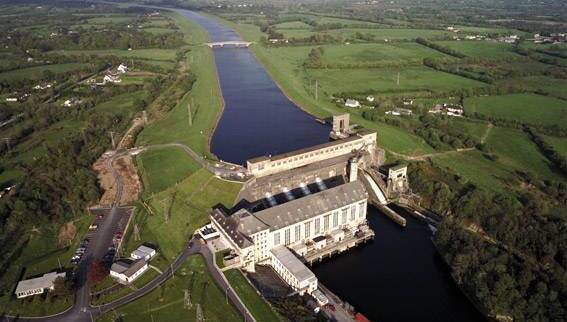
Opened in 1929, Ardnacrusha cost around 20% of Ireland’s GDP to build and it produced 95% of the country’s electricity needs. File picture
In the 1970s our neighbours in Mayo had a small dairy farm and chicken house. They had a back up generator powered by a tractor for outages. Their neighbours had candles, oil lamps, and turf fires. We were envious.
In the early 1980s as an apprentice electrician in Galway, I, with three classes of apprentices, visited Ardnacrusha Power Station which opened in 1929 . It cost around 20% of Ireland’s GDP to build and it produced 95% of the country’s electricity needs. A question was asked: What happens to all the power produced at night? Answer: Nothing, it was lost.
Power generated 24/7/365 by wind, solar, hydro or gas (fossil) can be stored in batteries. The trick is to store as much power from renewables or when a grid is not under pressure, ie, at night. Battery packs can help bridge the gap when fossil is needed, such as early morning or from 5pm to 7pm. Night and EV rates between 11pm and 8am are cheaper, so this is when the majority of storage should be bought and then used during day or peak times.
I’m disgusted at the insult to people on welfare — mostly the elderly. I’m one of them. I’m 70 and on the widow’s pension, and the moment I heard of the €3 extra for the living alone allowance I thought I was going to throw up. How dare they even mention €3 like it was a big deal.
Are they for real? Their kids wouldn’t even know how to spend €3. How much do they spend on house keeping a week? Do they even know what €10 would get you? The Government is out of touch with the people and the way we are living hand to mouth.
In recent days, we heard about government departments competing fiercely to advance their own vital projects or economic priorities, with each department hoping to get as big as possible a slice of the budgetary cake. That’s understandable, and indeed commendable, and they are right to seek the best possible funding for what’s important to them.
But how can it possibly make sense to fork out a whopping €102m to horse and greyhound racing, with the usual 80-20 split between the two?
With so many sectors crying out for State support, it’s mind-boggling to witness the ongoing love affair between these industries and our political establishment.
Both of them claim to be sensational money-spinners, generating wealth and boosting the rural economy. So why the need for lavish state funding?
Greyhound racing is rife with animal welfare problems … the damning spectre of cruelty hangs over it … with weekly reports of injuries, deaths, over-breeding, and unnecessary culling of greyhounds.
Sadly, the horse and greyhound industries are politically better connected than any of the poorly funded sports. I presume that’s why successive governments gloss over so many other worthy sports, and infinitely more deserving causes, in favour of dogs and horses running around in circles.
“It is deeply unfair on the general public for there to be significant disruption to their daily lives because unions are unwilling to sit down and engage constructively. “Meaningful progress can only be achieved where both parties are open to constructive and sustained engagement.” I had to laugh.
These are the words of a spokesperson from the Department of Public Expenditure, communicating the position of minister Jack Chambers on teachers' protests. Taking aim at those troublesome public service unions and excoriating them for not trying to work things out at the table. Espousing the view that progress can only be achieved through dialogue and engagement, and deeming it appropriate and fair to chastise as unreasonable those who are not open to talking.
Does somebody want to tell justice minister Jim O’ Callaghan?
Because he, as a minister within the same coalition government — and indeed the same party — seems to have missed that memo.