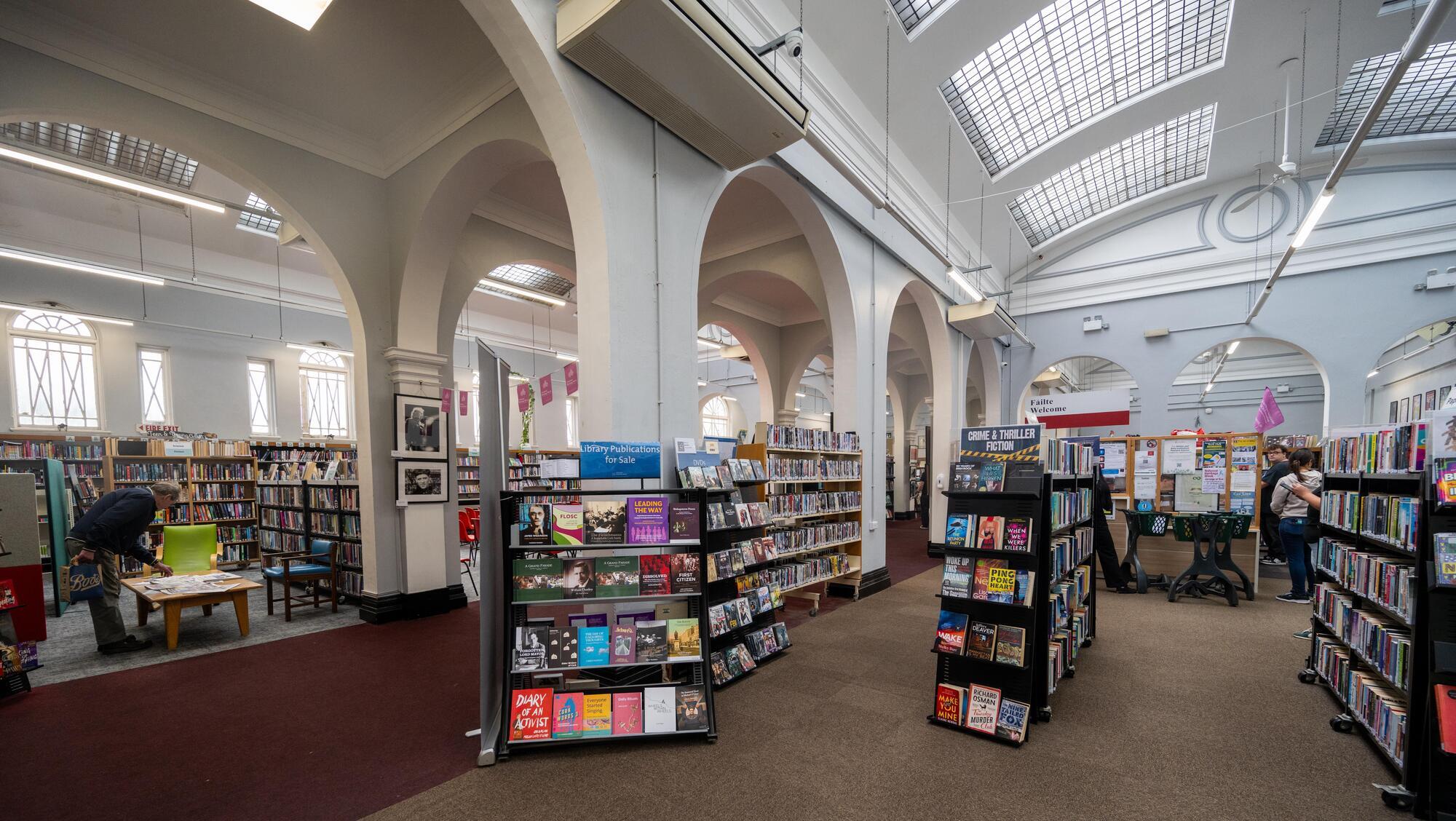
I was genuinely taken aback when I visited Cork City Library recently and saw a section prominently labelled “General History of the British Isles”. One might expect to encounter the term “British Isles” in an old book, where it reflects the terminology of the period in which the book was written. What I did not expect to see was an Irish public library in Cork actively choosing to use it on its own signage.
Ireland is an independent, sovereign republic. It has been so for generations. Yet apparently, according to the signage in Cork City Library, the island on which this country is situated is still to be categorised under the heading “British”. I am aware of the argument that “British Isles” is an established geographical term. That does not make its use compulsory, nor does it make it neutral. Language evolves, particularly when terminology carries a considerable historical and political baggage.
Triple lock will not affect our neutrality
The ‘triple lock’ concept, despite some conflation of the positions, has nothing to do with traditional neutrality and everything to do with an unnecessary limitation on Ireland’s sovereignty.
The Defence (Amendment) Act 1960 yielded our nation’s ability to engage in overseas peacekeeping operations to permission granted by a non-elected, non statutory entity, the UN Security Council, whose permanent members (the P5) have not agreed on a peace-keeping mission for 15 years. This is unlikely to change.
In 2026, this 66-year-old anachronism should be jettisoned. Ireland is a mature, liberal democracy, capable of making decisions about its international profile as a contributor to peacekeeping without the interference of totalitarian or extreme nations of any ilk.
This will not affect our government’s policy of military neutrality. It will, however, permit Ireland to continue its proud tradition of assisting the maintenance of safety and peace for vulnerable people, as has been the case in Lebanon for 48 years. The benefits and experience gained there are irreplaceable!
Tim O’Connell Capt (ret’d)
Ballinteer, Dublin
Are we prepared for an emergency?
Most households should have received the BE EMERGENCY READY booklet by now.
Having read its 20 pages, it is arguably less than useless, and it may even be dangerous because it gives a false impression of the potential for very serious emergencies. It only refers to: “Events like storms, flooding, cyber-attacks and disruptions to critical supply chains”. There is no mention of possible terrorist attacks, or conventional military attacks due to our Government abandoning Irish neutrality, and its failure to promote international peace.
The risks of nuclear war, or nuclear accident, are ignored. There are 57 nuclear reactors in France, while Sellafield is too close for comfort. Radioactive fallout fell on Ireland after the Chornobyl disaster in 1986. Radiation knows no borders. There are over 12,000 nuclear weapons globally. In his address to the UN, US president Trump threatened to annihilate Iran, indicating the possible use of nuclear weapons. Russia threatened to use nuclear weapons if its Kaliningrad territory was attacked or blockaded.
Neutral Switzerland has 370,000 underground bunkers capable of providing shelter for all its 9m citizens. Our Irish Government makes no provision for such shelters for its ordinary citizens.
Two important factors need to be considered in planning for emergencies. What is the most serious possible emergency, and which emergencies are the most likely to occur? In this 21st century, humanity has too many irresponsible leaders. As a result, even the most serious possible emergency, such as a nuclear war, may be likely to occur. It is irresponsible of our Government not to plan for such emergencies and keep our citizens informed. It looks like our national planners were so afraid of another publicity debacle like the iodine tablets that they took the option of doing virtually nothing. Proper emergency planning is a deadly serious matter.
Edward Horgan
Castletroy, Limerick
Ireland is failing children with special needs
Over the past few days, I have listened to parents of children with special needs commenting on Cork’s 96FM Opinion Line, in relation to difficulties they face getting their children to school.
I find it sad and tragic that “we”, the people of Ireland, are failing these parents.
Ireland looks upon itself as an “advanced” country.
Our Government hands out hundreds of millions of euro annually, yet school transport cannot be provided in many cases for children with special needs.
I suggest the failure to provide adequate transport reflects on Ireland as a nation, on us the people, and on those we elect to represent our interests.
We the people need to encourage our elected representatives to ensure the requirements of parents of children with special needs are met.
As a constituent of Cork South Central, I call on Micheál Martin, as my representative, in addition to his role of Taoiseach, to face his responsibilities in particular, in relation to children with special needs.
Michael Moriarty,
Rochestown, Cork .