Letters to the Editor: Parents must show good example to children on tech and social media

A mother photographing her son. 'If parents and other adults in a child’s life are misusing tech and social media, or are spending too much time online, then how can we expect children to use it in a responsible way?' Picture: iStock
I write this as someone who has been teaching IT skills to adults and teenagers for the past 25 years and who has worked in other areas of the IT industry over that period.
Mick Moran is wrong when he says that parents can do nothing to prevent children from coming to harm online — ‘European states urged to prioritise child safety online’ (Irish Examiner, June 13). The rapid development of AI and other technology means that parents are now more critical then ever, in ensuring the online safety of their children.
Neither the EU nor individual national governments can adequately replace the vital role parents play in this context. The limited space here permits me to give just two examples of that.
It is recommended by most, if not all of the reputable experts in this area that children should not be allowed to have their smartphone or other tech in their bedrooms overnight; while nothing is easy when it comes to regulating children’s access to the online space, restricting their physical access to tech in that way is a relatively simple way to protect children and parents are the only people who can implement such a vital measure.
The second area to address is parents own use of tech, social media, etc: If parents and other adults in a child’s life are misusing tech and social media, or are spending too much time online, then how can we expect children to use it in a responsible way?
It is critical that parents set firm boundaries on their children’s use of technology and it’s just as critical they give good example to their children in their own use of AI and other technology.
Read More
The draft short-term letting national planning statement published on Tuesday by housing minister Peter Burke is a wolf in sheep’s clothing.
While many people in towns with fewer than 20,000 people, and have been operating for seven years or more, may be celebrating, this plan precludes many people who have set up in recent years and who have perhaps brought a disused building back to life or converted an empty shop to an Airbnb. Under this plan, people who have been operating for seven years or less, in communities with fewer that 20,000 people, will still have to apply for planning permission to operate short-term lets — assuming they do not already have it — and most don’t.
Read More
So what does this mean and how will it affect rural tourism? It means that just to continue in business, many property owners who never considered long-term rentals, will have to shell out thousands of euro with no guarantee they can still continue in business.
A survey by the Irish Self-Catering Federation found that if forced to close, 93% of their members would not change to long-term rentals.
In my part of the country, West Cork, the seaside town of Baltimore now benefits from year-round tourism as a result of holiday home owners renting out their homes outside the summer months. If you were a holiday home owner, would you go to the hassle and expense of applying for planning permission — of course not.
So Baltimore will lose thousands of euro of much needed tourism revenue. This will be repeated across the country and Ireland will lose thousands of self-catering properties. So where will tourists stay? In hotels? Possibly, if not given over to asylum seekers or refugees.
Anecdotal evidence shows that American tourists are already opting to go to Scotland as they can’t rely on finding guaranteed Irish accommodation. If the seven-year rule is enforced, rural Ireland will, once again, been found wanting.
This plan does not balance tourism needs with housing needs. It will destroy tourism in rural Ireland without creating any noticeable increase in long-term rental accommodation.
Back to the drawing board I’m afraid.
Health minister Jennifer Carroll MacNeill, in her engagement with hospital consultants, is lauded by many for her forthright stance in achieving the objectives of the Government.
The power of medical consultants, although diminished in recent years, should not be underestimated.
Many years ago, my uncle, Jimmy Carty, was employed in the Cork offices of the Revenue Commissioners as a senior tax inspector and he was approaching retirement age with a view to finishing out his career in Cork, his beloved adopted city.
Read More
His staff got wind of the word that a plane load of consultants were due to attend a medical conference in Switzerland, some of whom would use the occasion as a cover for exporting large quantities of cash from Ireland to various banks abroad.
On the day in question, members of Jimmy’s staff boarded the plane before it took off from Cork Airport and noted details of the many briefcases stuffed with bank notes bound for Europe.
On return to the office the next working day, Jimmy and a member of his staff who had boarded the plane, were given written instruction of their immediate transfer to the Limerick office. It seems that any case that might have developed in relation to the operation had swiftly evaporated and no further action was deemed necessary in relation to the issue.
The welcome recent visit of Canadian prime minister Mark Carney to Ireland provides an opportunity to highlight the extent to which Ireland and Canada share common political goals and mindsets.
Notably, the central theme of the championing of a ‘just society’ has been a pivotal slogan of the Canadian Liberal Party (that Mr Carney leads) since the 1968 Canadian general election when it was embodied in a campaign driven by one of his predecessors as prime minister, the enigmatic and venerated Pierre Trudeau. This is a theme that Mr Carney frequently cites as Canadian premier, including an example in his address given to the audience in Trinity College Dublin during the inaugural John de Chastelain lecture last weekend.
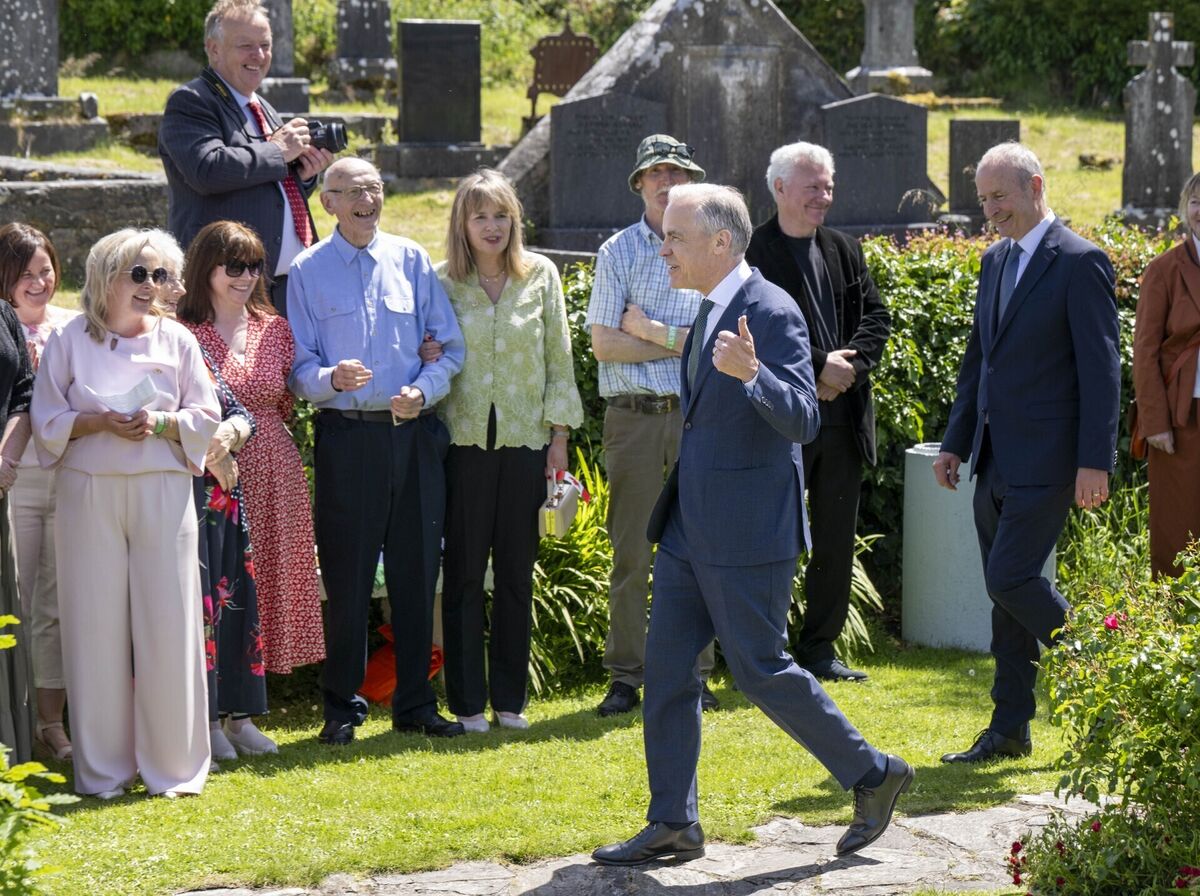
This theme would be more familiar in Ireland as espoused in the document ‘Towards a Just Society’ by the former attorney general Declan Costello written in 1965. At an event in UCD on Sunday last to mark the centenary of the birth of Garret FitzGerald, his own celebration of promoting a ‘just society’ as taoiseach was emphasised and its relevance to the values of the Fine Gael party remain steadfast.
Both Mr Costello and Mr Trudeau in selecting such a theme to promote would have been influenced by the writings of the 19th century philosopher John Stuart Mill who supported the concept.
In fact, in an instance of political consonance, the title Mr Trudeau selected for his first book (co-edited with Thomas Axworthy and published in 1990) after departing the Canadian premiership after nearly 16 collective years in office in 1984 was also called Towards a Just Society — identical to the one chosen previously by Mr Costello for his policy document.
Canadian and Irish political leaders can decide how they wish to advance the common ground of a just society in an updated, latest contemporary era representation, promoting objectives naturally derivable from its theme not just within their domestic societies but on the international stage. The modern values consistent with a just society ought to include, but not be limited to, support and encouragement for: Stability and safety; peace; compassion; equality of opportunity; progressive yet prudent economics; a robust and fair equilibrium upon the scales of justice that serves to safeguard citizens; rewarding of effort, enterprise and hard work; accessible healthcare, efficiently available; plentiful availability of food and water; a society that supports all age ranges and provides adequate supports for those in need; provision of housing, childcare and education within reasonable reach for all concerned.
CONNECT WITH US TODAY



Be the first to know the latest news and updates