A typical Kate O’Connor morning of clutch and class at the Euros
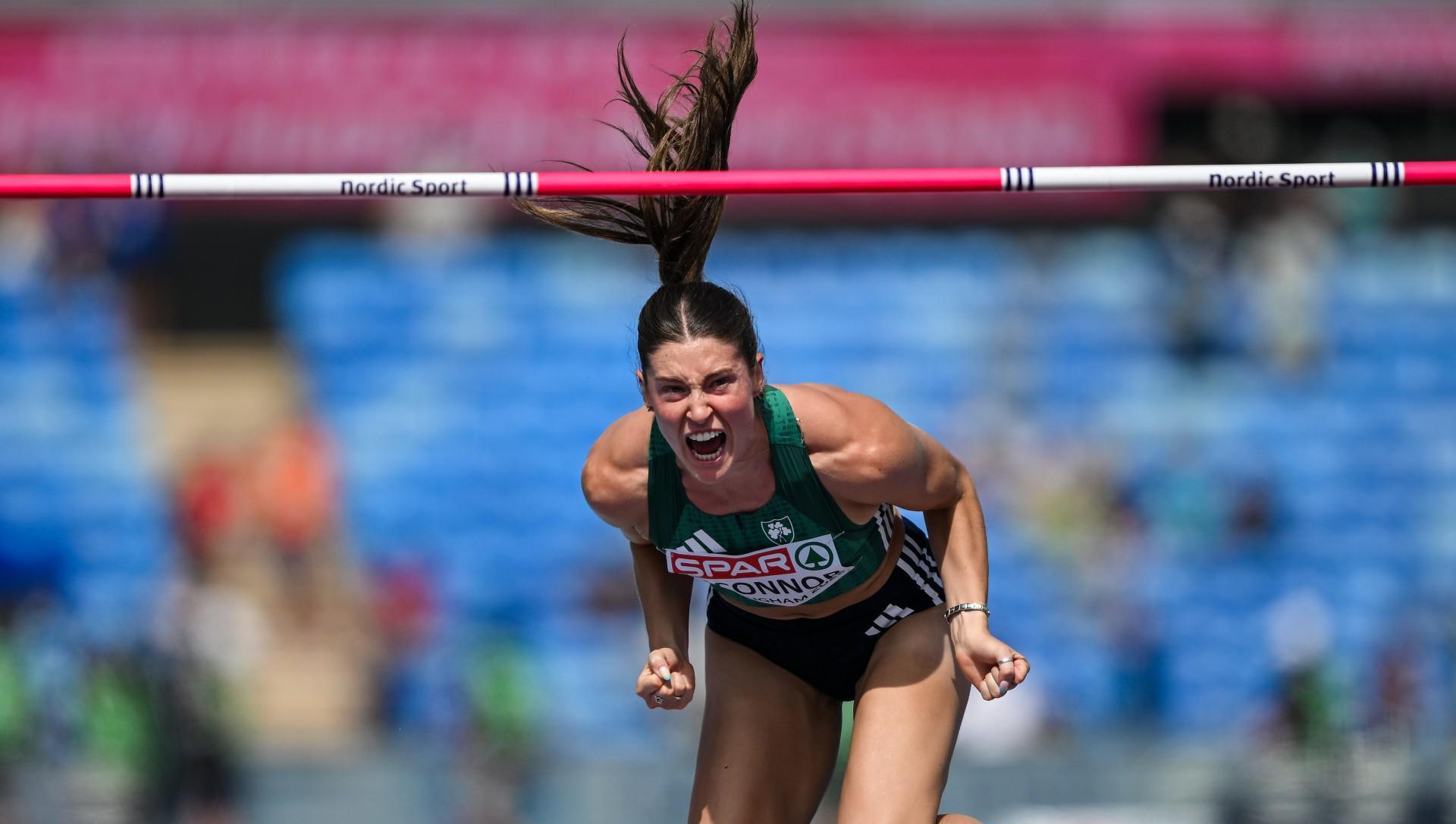
Kate O'Connor of Ireland celebrates after clearing 1.83m in the high jump during the women's heptathlon during day five of the European Athletics Championships 2026 at Alexander Stadium in Birmingham, England. Photo by Sam Barnes/Sportsfile
She spoils us. She’s spoiling us again.
Two events, two lifetime bests. A single point off the gold medal leader. This was your typical Kate O’Connor morning session of clutch and class.
The past 18 months have repeatedly taught us never to doubt the pressurised heights the 25-year-old can climb to mid-competition. Not even when she’s twice clipped the high jump bar at 1.86m, and neither jump has given the indication that equalling her 1.86m lifetime best from last summer is on.
Kate O’Connor will pull out the necessary jump. She always does. Friday noon in Birmingham was no exception.
Heading for the evening’s shot put and 200m, O’Connor’s current 2,134 total is right up on the heels of Poland’s Adrianna Sulek-Schubert, who also cleared 1.86m in a captivating high jump watch.
Sophie Weißenberg of Germany is 60 points behind her in bronze, with European lead, Annik Kälin, 80 points adrift back in fourth.
Crouching down for her opening event shortly before 11am, it wasn't that the wind was unkind to O’Connor in her heat of the 100m hurdles. It was more that the wind was a much greater friend to gold medal rival, Switzerland’s Kälin.
Read More
O’Connor’s lifetime best of 13.30 for fourth in the second heat, bettering by a sizable chunk her PB of 13.44 from last summer’s World Championships, was pushed along by a +1.3m/s headwind.
Just seven minutes later, though, that headwind had strengthened to +3.3m/s, leading to Kälin clocking 12.59 for 1,187 points, over a 100 more than O’Connor’s 1,080.
Another medal challenger, Emma Oosterwegel, also filled her shopping cart in that third heat. Coming in with a best of 13.21, the Dutch athlete’s sub-13 clocking of 12.98 banked 1,127 points.
Seven of the times in that third heat bettered O’Connor’s, contributing to the Dundalk native sitting in 11th as they moved infield for the high jump.
“I’ve done so much work on my hurdles, and my opening hurdles I definitely wasn’t happy with, but today was a little better, a PB, I still think there’s definitely a lot more there. But it was a good start,” she reflected.
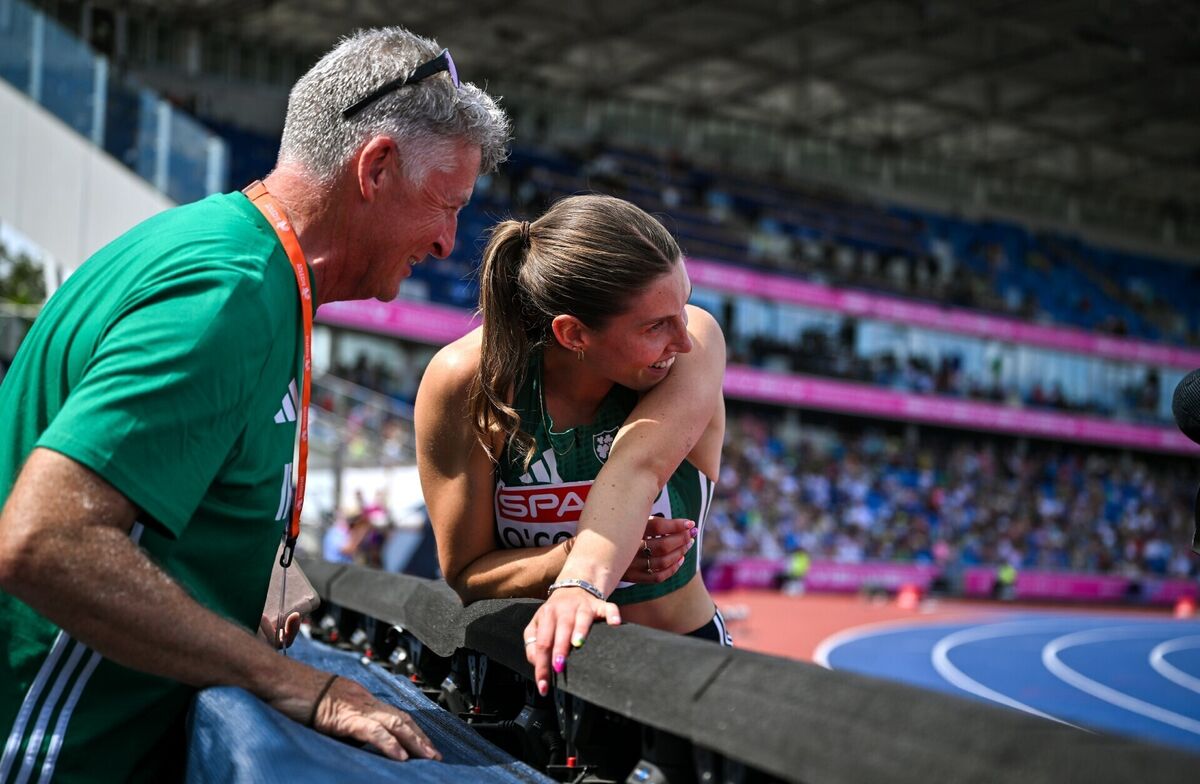
Her high jumping was for so long flawless. Her first six attempts sailed over 1.68m, 1.71m, 1.74m, 1.77m, 1.80m, and 1.83m. As mentioned, 1.86m momentarily troubled her. But upon nailing her third and final go, there was a guttural roar and fist pump to the large Irish contingent situated on the first bend.
Her third and final go at 1.89m wasn’t far off at all. The outright lead will have to wait for now.
“I’m delighted,” O’Connor said of her second event. “1.89m was there on that last attempt and I believe I can jump it, it’ll maybe come another day. But 1.86m – I haven’t jumped that since last year in Tokyo, so I can’t complain.” And as for the Irish dominating in the stands?
“Oh my God, it was insane. I’m still too nervous to get a clap going but maybe at some stage, in the long jump, I’ll get something. I’ll get home, rest, recover, and chill out. I’m looking forward to this evening.” Elsewhere, there were deeply contrasting fortunes for Cathal Doyle and Andrew Coscoran in the semis of the 1,500m.
Coscoran’s 3:41.86 for fourth in the second semi took him comfortably inside the required top six, even if there was a moment of brief concern rounding onto the home stretch when he began to fall back.
Qualification delivered the 30-year-old Dubliner a fifth European final appearance on Saturday evening (9.07pm).
“Everyone is always a bit nervy in the heats. There’s always a bit of moving and chopping, but I found a little gap on the inside, and I knew once I got into that, I could hold that position behind Jake [Wightman],” said Coscoran.
For Doyle, who fell in the opening semi, his championships appear over.
Having been involved and survived two altercations on the penultimate lap, it was third time unlucky as he hit the deck, along with Spaniard Carlos Saez, with 550m remaining. Doyle jogged around thereafter, knowing he had to finish to be in a position to lodge an appeal.
“I am sick of this now,” Doyle said post-race.
“This is the second Europeans now in-a-row, I get the same stuff every time, ‘Ah, he puts himself in that position’. I didn’t deserve that at all. My plan was to stay in the top six all the time. I realised that at the important part, was starting to move up, and sure there is nothing I can do.
“I am sick of everyone saying, ‘Awh, he put himself in the wrong position’. I didn’t do anything wrong.
“Bit of a trip there [with 700m remaining], but it was fine, rally on. The other one, you didn’t get a chance to think and you were gone. It is just annoying. It is not my fault. The last time I feel I fell I was blamed for putting myself in that position, but I didn’t do anything wrong. It is just embarrassing jogging around [after the fall].” On a very busy Friday morning for the Irish, neither 4x400m relay quartet succeeded in securing a final berth.
The men’s four, consisting of Andrew Egan, Jack Raftery, Joe Doody, and Sean Doggett, were fifth in their semi-final and 10th overall.
Beyond placing, their 3:01.76 was the third-fastest ever produced by an Irish men’s quartet. Being just half a second off the 11-year-old national record of 3:01.26 added further impressiveness onto the morning run.
Both Raftery and Doggett, on the second and fourth legs respectively, turned in sub-45 efforts of 44.7 and 44.86. Raftery, in particular, brought the Irish into contention for a small q that, ultimately, proved outside of their combined capabilities.
“We have [European] team championships next year, and we will have World relays in 2028, so we need to run within the next calendar year to get ourselves [to World Relays], and that is the qualification for LA 2028,” said Raftery.
“We have so many guys 25 and under coming through that we can build a team of eight or nine, and that is what we need. Athletics is a game about luck. We can’t have four fit lads. We need a team of depth. So that is the goal, build, build, build, and get there.” For the depleted women’s relay quartet, it was a far more sobering outing.
Minus Rhasidat Adeleke, Sharlene Mawdsley, recent national champion Rachel McCann, and retired Phil Healy, the 3:32.58 by Sophie Becker, Jenna Breen, Cliodhna Manning, and Arlene Crossan was 13 seconds down on the national record from the Paris Games two years ago and 10 seconds down on the silver medal from these championship that same 2024 summer.
With only Becker, on the opening and non-rolling first leg, managing a sub-53 clocking, this semi-final was a real eye-opener for the need to improve 400m depth.

CONNECT WITH US TODAY



Be the first to know the latest news and updates