Irish Examiner view: Trump should be given a polite welcome to Ireland 
If Trump does visit during the Irish Open, the Government should welcome him courteously, conduct the necessary official business, and wish him an enjoyable break. Beyond that, there is no reason for elaborate ceremonies or additional honours
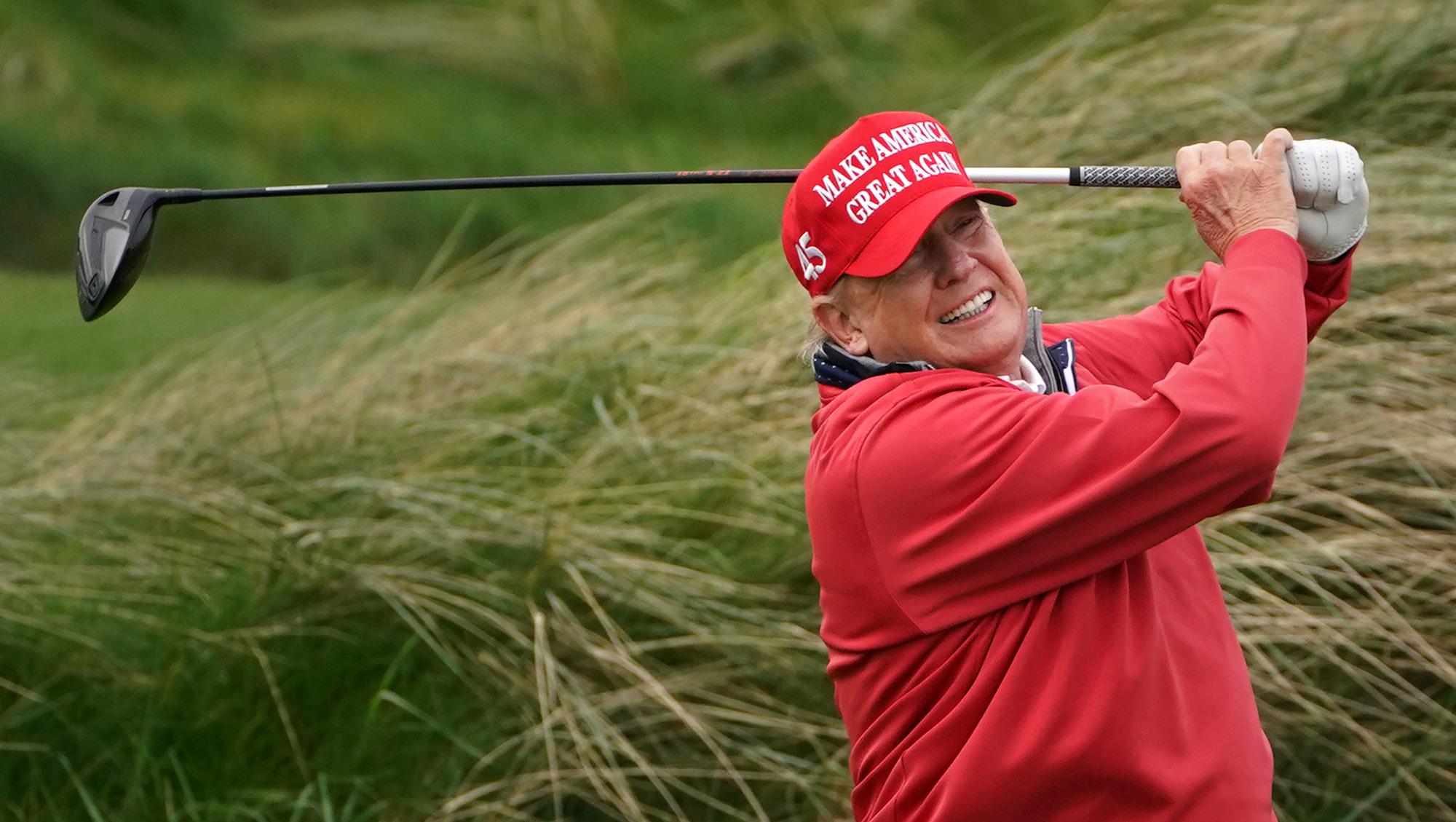
US president Donald Trump playing golf at Trump International Golf Links & Hotel in Doonbeg, Co Clare, during his 2023 visit to Ireland between his two presidential terms. File picture: PA

US president Donald Trump playing golf at Trump International Golf Links & Hotel in Doonbeg, Co Clare, during his 2023 visit to Ireland between his two presidential terms. File picture: PA

While it has yet to be formally confirmed, a visit to Ireland by US president Donald Trump is widely expected next month to coincide with the Irish Open in Doonbeg, Co Clare.

Government preparations for the anticipated visit are reported to be at an advanced stage, with Air Force One expected to land in Dublin Airport on Saturday, September 12, from which Mr Trump will travel to Farmleigh for a meeting with the Taoiseach.

He is then expected to turn the sod on the new American Embassy before going on to the real purpose of the visit, the prestigious golf event at his own resort, the Trump International Golf Links and Hotel.

The official welcome being planned is, by all accounts, on the modest side. That is exactly as it should be.

There has been talk, although nothing has been decided, of a meeting between Mr Trump and President Catherine Connolly. Independent TD Mattie McGrath has suggested that the Dáil be convened early to allow the US president address it, an honour accorded previous American presidents and other distinguished visitors.

Neither of these gestures is necessary.

Ireland should, of course, extend the normal diplomatic courtesies to the president of the United States. The office he holds commands respect, as does the country and the people he represents. But that obligation does not extend to providing a political leader with the kind of céad míle fáilte that might in any way be interpreted as an endorsement of him or his record.

There are ample reasons why many would find such an endorsement deeply objectionable.

This is a man who started a war he is now incapable of concluding. He is presiding over a profoundly divisive and disruptive period in American political life.

He and his family have become wealthier to the tune of billions of dollars since he took office; at the same time, millions of Americans are struggling with soaring food and fuel prices.

His attacks on political opponents, his confrontational approach to America’s traditional allies, his disruption of international trade with his tariffs, and his aggressive rhetoric towards other countries and territories have contributed to an increasingly unstable and dangerous international environment.

Unpalatable though it may be for many, none of the above means Ireland should snub him. Diplomacy requires that we engage with a country with which we have deep historical, cultural and, not least, economic ties.

The Government should welcome president Trump courteously, conduct the necessary official business, and wish him an enjoyable break at the Irish Open. Beyond that, there is no reason for elaborate ceremonies or additional honours. A minimalist approach to our welcome is sufficient.

Keep active to cut cancer risks

There was more good news this week about actions we can take to cut our risk of developing cancer without it costing us.

At a time when people are being bombarded with ads and influencers urging them to buy expensive, and frequently unnecessary, supplements and treatments to improve their health, science continues to show that the best approaches to reducing our cancer risk are free.

The latest research, reported yesterday in this title, suggests that replacing even a few minutes of exercise a day with sedentary behaviours, such as sitting at a desk or watching TV can increase cancer risk by 15%.

The researchers, analysing the data of almost 60,000 volunteers taking part in medical research, found that the more people moved, the lower their risk of cancer.

The link between cancer and physical inactivity has been well established. What is worrying is that, as the global incidence of cancer continues to rise, so too does the rate of physical inactivity.

The World Health Organization reported in 2024 that almost one third (31%) of the world’s adult population were physically inactive — that is, they did not meet the global recommendations of at least 150 minutes of moderate exercise per week.

The level of physical inactivity rose by five percentage points in just over a decade.

Science cannot yet prevent every cancer but we should be grateful for what it has taught us.

The knowledge that smoking, excessive alcohol consumption, obesity, and physical inactivity increases cancer risk is invaluable, and it is knowledge that generally costs us nothing to act upon. Some of the most powerful ways to protect our health are not be found on a shelf, but in the choices we make every day.

Enjoy the eclipse safely

It promises to be a once-in-a-generation celestial spectacle, it will be accessible to everyone and it is free — so tomorrow’s solar eclipse is worth getting out for. Depending on what part of the country you are in, between 93% and 98% of the sun will be obscured by the moon at the peak of the eclipse.

It is an incredibly rare phenomenon. The last time such an eclipse was witnessed in Ireland was 27 years ago, when the moon began to cross the sun at around 10am on 11 August 1999.

The next one will not happen until 2090. Viewing events have been organised at several locations including at the observatories in Blackrock Castle, Cork; Dunsink, Dublin; and in Armagh. However, no one has to travel far to share in the experience — the eclipse will be visible from any spot with a clear view of the setting sun at this time of the year.

The event will begin soon after 6pm when the moon starts to cross in front of the sun, and will continue until it clears the sun by around 8pm.

Experts warn that people should not look directly at the sun, even when it is partially covered by the moon, but the effects, observed indirectly, will be worth experiencing.

x

More in this section

Revoiced

Newsletter

Had a busy week? Sign up for some of the best reads from the week gone by. Selected just for you.

Cookie Policy Privacy Policy Brand Safety FAQ Help Contact Us Terms and Conditions

© Examiner Echo Group Limited