Irish Examiner view: Fishing industry faces a perfect storm
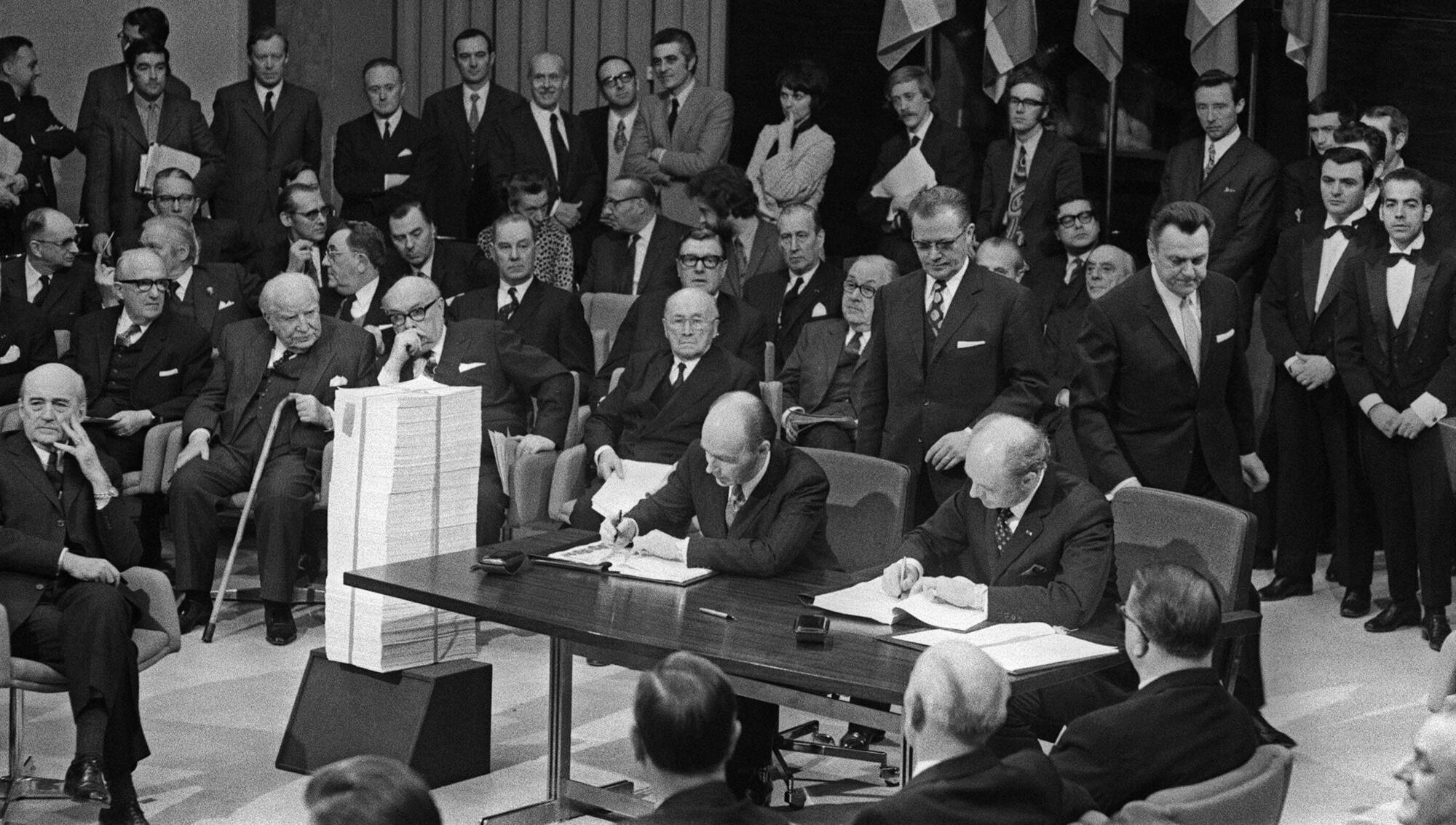
Then president Paddy Hillery signing accession papers to the EEC in 1972. The idea that joining the EU damaged Ireland's fishing industry is disputed — but the recent post-Brexit deal certainly was a real blow. Picture: AFP/Getty
The plunge in the number of fish being caught does not just exist in dry statistics, either. Recently, a fish shop shut down in Killybegs for lack of fish to sell — which is difficult to believe.
It is a long-held belief that joining the then European Economic Community in 1973 was a blow to the Irish fishing industry, though that claim has been much disputed since then.
What cannot be disputed is the indirect impact that Brexit has had on Irish fishing. To facilitate a post-Brexit deal between the EU and Britain, Ireland suffered a huge cut in its fishing quota.
Representatives of the association believe the industry is facing another challenge with the prospect of the EU agreeing to allow Icelandic fishermen to fish in Irish waters.
When the association warns of a perfect storm of circumstances conspiring against the industry, it is not an exaggeration.
Consumers face higher prices for less fish, and jobs are under threat in the interdependent fishing and processing industries.
Many of those jobs are located on the western seaboard, where employment opportunities are less plentiful than in the eastern half of the country.
The much-vaunted plan for balanced national development will be difficult to implement when one of the economic mainstays of the west coast, Ireland's fishing industry, is facing an existential threat.
This industry deserves immediate and imaginative Government support.
Midleton in Co Cork was the focus of national attention last October as it suffered severe flooding during Storm Babet.
Much of the country was affected, but few areas endured the same level of inundation, one that wrecked many houses and business premises in the East Cork town: The images broadcast from Midleton were frightening, and the testimony of locals was heart-rending.

Taoiseach Leo Varadkar himself struck the right note when saying at the time: “We are not just here as a Government to express solidarity. We are here to help.
"We are putting in place a financial package to help homes and businesses that are not insured. We are going to ensure that help is on the way.”
It is all the more disappointing to learn, as readers of the 'Irish Examiner' did on Wednesday, that so many Midleton residents are fighting for funding almost six months later.
The Taoiseach promised last October that there would be no cap to the State’s humanitarian aid fund, but there has been a good deal of frustration expressed about the administration of that scheme, which is a matter for the Department of Social Protection’s Community Welfare Service.
Local politicians have stated that those affected by the floods — and it is estimated that up to 350 people are still dealing with its effects — are suffering from stress and anxiety due to the way the scheme is being administered.
This is not good enough given the trauma already suffered by those affected by the floods, and it is incumbent upon those in the department to either streamline the scheme or to provide more staff to expedite the cases involved.
What should also be acknowledged is that the ongoing effects of climate change mean such situations are likely to become more and more common, and the State mechanisms for addressing such problems will need to be adapted to deal with them more efficiently. It was Midleton last October, but somewhere else may be affected next.
Having been scheduled for planned abdominal surgery in January, her disappearance from public view since then has fuelled some wild conspiracy theories in recent weeks.
Kate Middleton seen for the first time in months riding in the passenger seat of a car being driven by her mother. pic.twitter.com/j0GVr3YUbj
— Yashar Ali 🐘 (@yashar) March 4, 2024
Those theories were hardly dented by a photograph which surfaced this week of the princess in a car; the relatively poor quality of the picture simply set off a fresh round of fevered speculation, with much comment online and elsewhere as to the ‘real’ reasons for her lack of public appearances.
Parking for a moment a little-cited part of the announcement in January about her surgery — that she would not be making public appearances until after Easter — the story sheds an interesting light on the modern media.
Not so much the interest in Ireland, where an interest among many people in the shenanigans of the British royal family is an undeniable fact, but in Europe as a whole. Much has been made of the relative silence among British media outlets which usually slaver for any royal titbits, particularly when compared with the candour of certain outlets in Spain and Greece, for instance, which are speculating on the ‘real’ reasons for Kate Middleton’s disappearance.
So gossip addicts in Britain, which opted out of Europe, now rely on European outlets for ‘information’ about their own royal family. Yet another victory for Brexit, that great generator of ironies.
Check out the Irish Examiner's WEATHER CENTRE for regularly updated short and long range forecasts wherever you are.