Alan Kearney: Ireland's navy needs backing, not bureaucracy
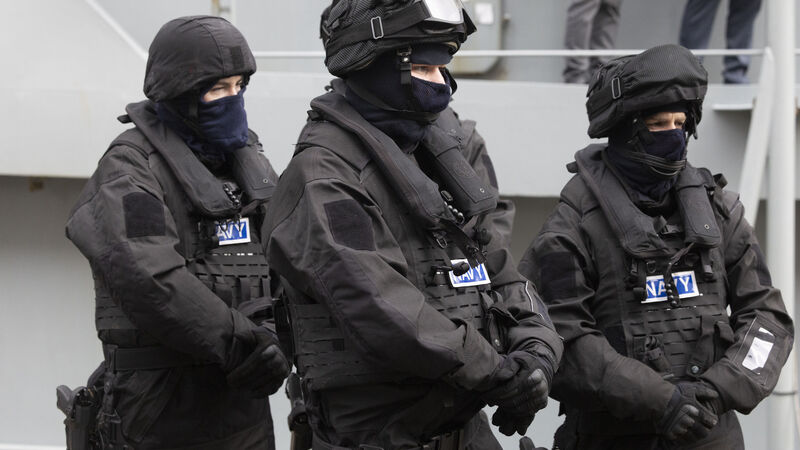
Irish navy personnel at the launch of the maritime defence strategy at the LÉ Samuel Beckett in Dublin. Pictures: Sam Boal/Collins
The represents a necessary pivot for a state whose economic and digital lifeblood is exposed across an undersea frontier.
Awareness alone does not deter interference; deterrence emerges where awareness is paired with credible response. However, as a policy framework, the strategy’s credibility depends on a transition that is as much cultural as technical. The strategy identifies maritime risks with clarity — undersea cables, energy interconnectors, and opaque “shadow fleet” activity — but offers limited articulation of the naval and aerial capability required to address them.
The document correctly identifies the shift in the global security environment, yet the language remains anchored in “co-ordination” and “resilience”, terms that can obscure the absence of coercive capacity. While the strategy presents a road map for the next five years, it remains a framework until the State addresses the historical preference for a constabulary, non-combatant military identity.
This cultural inertia is most visible in the strategy’s reliance on reassurance — the assumption that disruption is unlikely — rather than assurance, which is the practice of preparing in case disruption happens.
For decades, Ireland has designed a military optimised for presence and restraint, a posture that made sense for a historically peripheral state but is ill-suited to a modern, highly-interconnected economy. This is most evident in the gap between the procurement of hardware and the institutional capacity to generate a combat effect.
The naval service is defined as the State’s “principal sea-going agency”, tasked with fisheries protection and maritime defence. Yet, the historical record of failing to realise capability, exemplified by the LÉ Eithne, which possessed a flight deck but never sustained an organic helicopter capability, suggests that without an operational doctrine that demands use, capability simply atrophies.
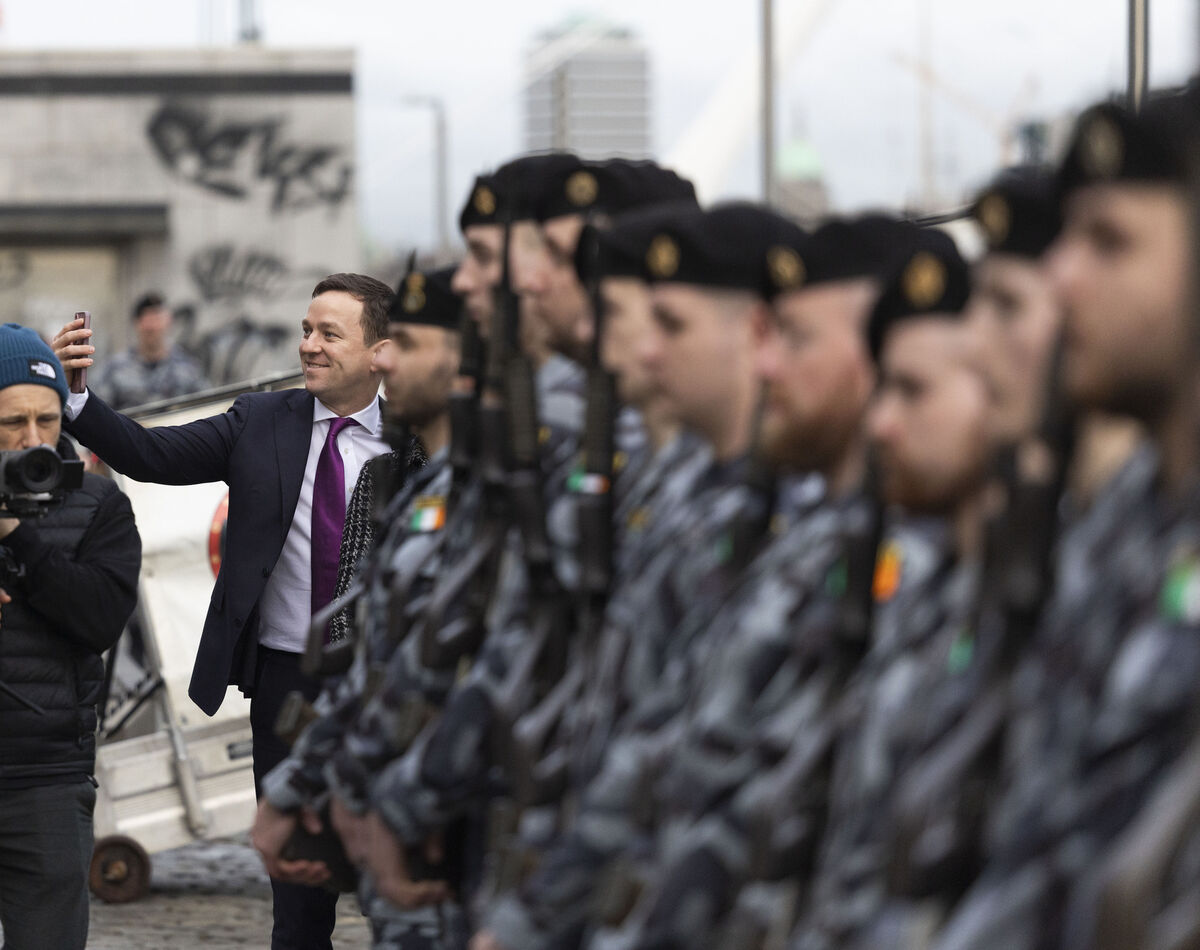
The strategy acknowledges that “insufficient personnel” currently limits the ability of the naval service to patrol the Exclusive Economic Zone, yet the fix is presented as a series of administrative milestones rather than an urgent operational requirement. If the military is never required to exercise the management of violence, it loses the institutional reflexes required to do so when force becomes unavoidable.
The strategic objective to “defend the State’s maritime domain” requires more than the “persistent presence” mentioned in the text; it requires a willingness to define the Defence Forces by their war-fighting role. Because the document utilises such ambiguous language, there is a significant risk that the subsequent “force design” and capability development processes will lack the explicit direction needed to deliver meaningful sea-denial capability.
The recent welcoming reception of the strategy highlights this very trap. While there is praise for “forward operating bases” and “monitoring hubs”, these are discussed primarily through the lens of recruitment and regional presence rather than lethal persistence. A navy that treats a base in Dún Laoghaire or Ros a’ Mhíl as a tool for “community connection” risks reinforcing the perception of a coastguard in name only.
Ireland already possesses a coastguard for safety and law enforcement; what it claims to want now is a navy, a branch defined by its capacity to conduct military operations. Strategic maturity requires recognising that a “national maritime security centre” is an empty engine if the ships it directs lack doctrine, ammunition, or cultural permission to move beyond observation into active denial.
In practical terms, maritime defence reduces to three clinical questions: Who turns up? With what? And for how long? Awareness of a threat is only the first step; what the State can do about what it now knows is the second; and the capacity to actually do it is the third. Without a fundamental cultural change that prioritises this functionality, little in our waters will change. Such absence of resolve will be immediately evident to any actor who seeks to exploit such a circumstance.
There is a nostalgic memory in Irish society of a time when doors were left unlocked, a symbol of trust. Yet, often forgotten, is that poverty and peripheral status reduced the incentive for intrusion. Modern Ireland is a wealthy, high-value node in a global system, yet we continue to approach security with the instincts of that earlier era. Success has increased our strategic value, but it has also changed the cost of being wrong.
Ultimately, the security strategy document is primarily a maritime co-ordination framework rather than a naval capability strategy. Its proposed governance structure, placing a maritime security working group beneath a hierarchy of a national security secretariat, committee, and ministerial council, reflects a system designed for bureaucratic alignment rather than rapid operational response. It identifies risks and responsibilities clearly but offers limited direction on the force structure required to address them. Success will be measured by whether it moves Ireland beyond strategic deferral.
Ireland currently invokes the UN Convention on the Law of the Sea as a “constitution of the oceans”, yet law without enforcement capacity risks becoming declaratory rather than operational. For the 2026-2030 objectives to be real, the State must bridge the gap between its legal rights and the cultural and industrial realities required to defend them decisively.


CONNECT WITH US TODAY



Be the first to know the latest news and updates