Mick Clifford: A Kerry town built a community around asylum seekers — now Caherciveen is losing them
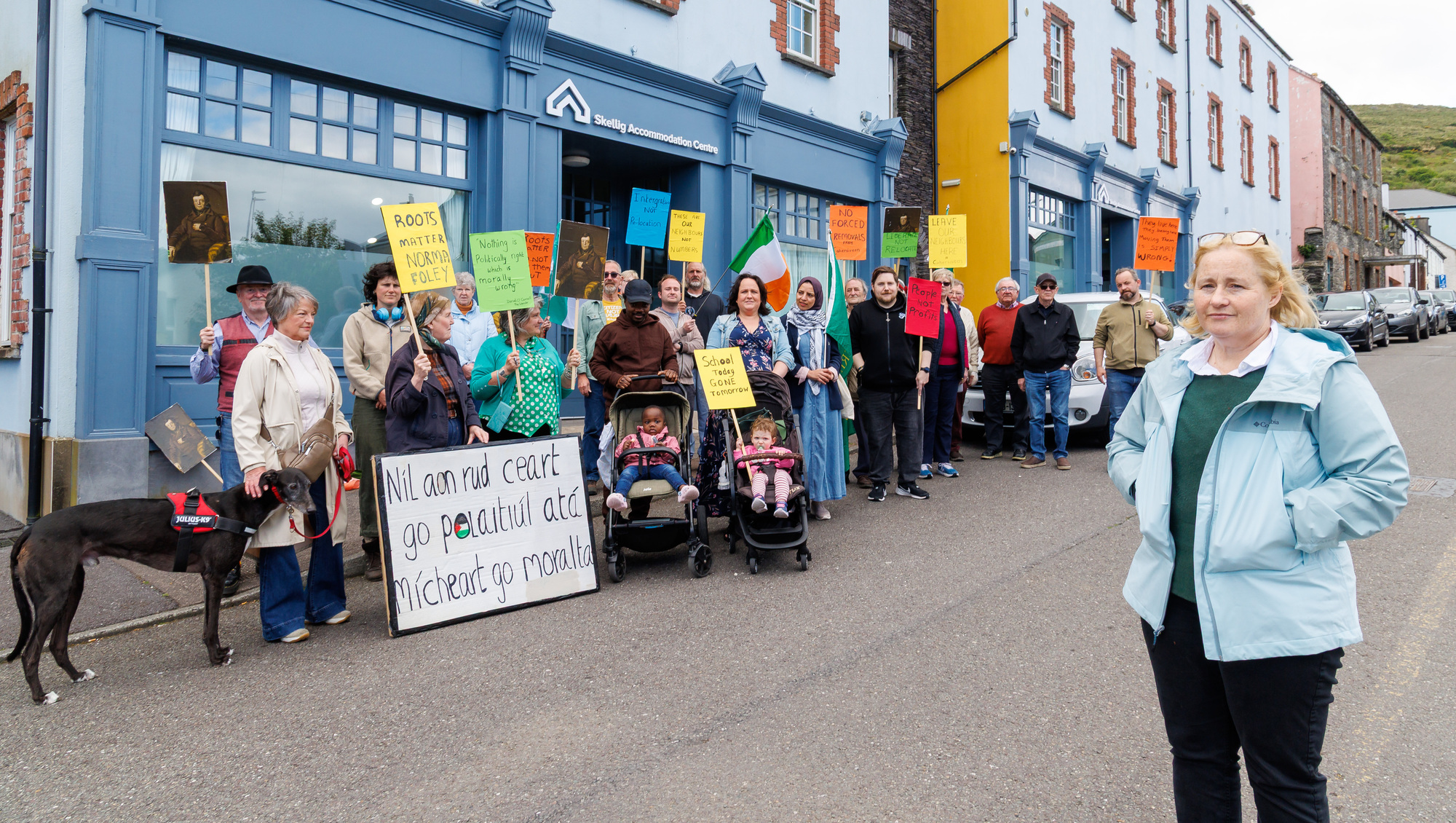
Cllr Norma Moriarty, front right, with locals at the Skellig Accommodation Centre in Caherciveen, Co Kerry, on Wednesday to voice their support for the residents of the Ipas centre who wish to remain in Caherciveen, after a number of families with children under the age of one were moved earlier in the morning. Picture: Alan Landers
With the high season opening up, Darragh O’Driscoll thought he was prepared and ready.
He owns and runs the Oratory pizza restaurant in Caherciveen, Co Kerry, where the year depends greatly on tourism.
Staffing eateries like The Oratory is never easy, heavily dependent on students, but this year O’Driscoll had a mature adult to add to his complement of staff.
Asadur Rahman Hasan was taken on last January, trained in pizza making, and quickly became a valued component of the operation.
Read More
Hasan is from Bangladesh and in the process of applying for international protection.
He was resident in the Skellig Accommodation Centre, formerly the Skellig Star Hotel, a centre for asylum seekers in the town that has a controversial history.
Today it houses 199 men, women, and children, a figure that represents about a fifth of the town’s population.
The children are all being educated in the town, or in one of the national schools in the hinterland.
Crucially, for an area so remote, many of the adults were, like Hasan, employed in the local economy while awaiting decisions on their applications.
They worked in retail and hospitality, but others are also filling vacancies at community hospitals in the town and on nearby Valentia Island.
Some have been resident in the International Protection Accommodation Services (Ipas) centre for about a year, but most are there for over two years and some as many as three.
This week, all that changed. A total of 157 residents in the Ipas centre were told they were to be transferred out of the town to other locations.
The previous week, they had received letters from the Department of Justice telling them “you will no longer be accommodated” at the centre, and to be prepared to move. No reasons were given.
They were just told that if they wished to continue being housed in a State-sponsored facility they would have to move.
The development has outraged many in the south Kerry town’s community.
In recent years, in some places, when plans were in train to bring asylum seekers to an area, protests and campaigns to stop the new arrivals were mounted.
There have also been well documented incidents in which proposed Ipas centres were literally burned to the ground.
What happened in Caherciveen this week is of a completely different order.
The move to take asylum seekers out of the community was met with protests, for a number of different reasons, including the impact it will have on the local economy.
“Asadur started working for me in January,” O’Driscoll says.
“He had worked in kitchens before but he had no experience making pizzas. I’ve trained him up and he’s flying now, a great worker and ready for the summer. Then this. He’s to be moved.
“That’s tough on him and his family, as he doesn’t want to go. From my point of view, as an employer, it’s hard enough to get staff here, particularly anyone looking for full-time work.
“And this one time I have somebody ideal and the next thing they want to take him away”.
O’Driscoll’s reaction is typical of many employers, and wider society, in the town.
The local people did not protest at the conversion of valuable tourist beds into an IPAS centre.
Instead, everybody just got on with it, making the new arrivals welcome, fully aware that the system has multiple flaws but that it wasn’t the fault of the new arrivals.
One of the reasons that places like the south Kerry town were selected as locations for Ipas centres was the availability of beds that were often unused during the fallow winter months.
The result has been less available accommodation for tourists, and a corresponding impact on the local economy.
One benefit, however, has been the availability of a new workforce as the residents of the Ipas centres have been snapped up for employment in all areas, including hospitality, retail and, crucially, the healthcare sector.
Fianna Fáil councillor Norma Moriarty says there was some shock when it was revealed that a group that was making a positive contribution was to be taken away again.
“A lot of them are here for three years,” she says.
“The majority don’t have status yet, but have been to interviews and are going through the process.
“One woman I’ve spoke to is a qualified healthcare assistant. She went out to the community hospital in Valentia and they snapped her up straight away.”
The south Kerry town, about as remote as it is possible to get from Dublin, may not have been a favoured destination for those arriving on these shores seeking asylum.
Yet, once sent there, a large cohort have adapted and seen that they can make a contribution locally.
“There are some who would like to move but others enjoy it here for the peace and quiet,” she says.
“So those who want to go should be facilitated but it should be done in an organic, manageable way.”
Moriarty agrees that in a perfect world the hotel being used would be reassigned to its original purpose as a tourist destination.
But the Department of Justice has confirmed that it will continue as an Ipas centre and new residents will be arriving soon.
“We can’t keep having new groups brought in and taken away just like that. It’s energy sapping for the local community.
“And then employers are being asked over and over to take a risk with new people after often investing time and resources in training up people already.”

She cites one local restaurant where four of the employees are from the Ipas centre. The restaurant may face difficulty in opening fully for the season.
On Wednesday, one of the residents, Lola, who is from Nigeria, was in a state of distress at the upheaval.
“We have been stressed out,” she says.
“There is one lady here with a baby and she is being told she must leave tonight but it’s getting messy.
“People have agreed to leave but why couldn’t they even give us time to get everything in order.”
Lola was until this week working in a local supermarket. Her husband was employed in a nursing home.
"She is just three weeks short of completing a course for a healthcare qualification at the local adult education centre, which would have allowed her to work in one of the community hospitals. That isn’t going to happen now."
The Department of Justice says all of this is just business as usual.
“In order to manage pressures and to ensure the department makes the best use of the beds available in the Ipas system, it is sometimes necessary to move people to more suitable accommodation,” it said in a statement.
However, just as other communities — and their political representatives — frequently hit out at a failure to communicate plans to establish Ipas centres, so now there has been no apparent regard for the impact on the south Kerry area in moving residents away, to be replaced by a completely new batch.
Following repeated approaches from the local community, the department sent down the head of the community engagement section who met with a local delegation on Wednesday.
One of those representing the local community was Stephanie O’Shea. She emerged from the meeting convinced it had been an exercise in window dressing.
“The official was a nice person but she said that she couldn’t do anything about what was happening. She had no power,” Ms O’Shea said.
“As far as I can see, she was just sent down as a PR exercise. In case the minister has to answer any questions about this he will refer to her appearance.”
O’Shea says that the abrupt transfers is undoing, in a short space of time, a huge effort that was made locally to integrate the residents.
“A lot was put into building a stable and well integrated community,” she says.
“Employers, schools, voluntary groups and residents have all contributed.
“All of this risks undoing the progress and discouraging a community that has gone to great lengths.”
The remaining 42 residents who weren’t scheduled to be transferred this week are understood to include families with school age children.
All of these will have to leave in June once the school term finishes.
Joe Moore is an English language teacher in the local Scoil Saidhbín primary school. He has been teaching foreign students who have landed in the town over the last five years, starting with Ukrainians fleeing the war and then international protection applicants.
“All of those kids we now have are going to be moved, just as they and all of the community has made huge efforts in settling them in,” he says.
“One lad in sixth class is from Nigeria. He’s here three years and is now playing for St Mary’s (the town’s GAA club) and is a fine footballer.
“He was going to go to secondary here and ready to do the curriculum through Irish.”
“They are moving people who don’t want to be moved. Families have settled. Kids have settled.
"We have put a lot of resources into this since it began first with Ukrainians who arrived and integrated and then were moved off.
“Now this is happening again. It’s not fair on them and it’s not fair on the local people who helped them to integrate. It’s just cruel.”
The department statement acknowledged that relocating can be very disruptive for people.
“While Ipas recognises that people may be integrating into the community, attending education or working, given the dispersed nature of our available accommodation options, new accommodation may not be available in the same area.”
Three years ago the local community faced a similar situation.
Eighty Ukrainian residents of the Skellig Star Hotel were told they were being moved out to make way for international protection applicants.
There were objections locally to this upheaval, but it was partially resolved by finding accommodation for the Eastern Europeans locally in some instances.
The asylum seekers came to the hotel at that point and were welcome, integrated, and many employed.
During covid, the hotel was first opened as a state-run accommodation centre and was the subject of huge controversy when people were transferred down at a time when the town was covid free.
By this weekend, the evacuation of the residents was underway, although the pressure brought to bear has ensured that some who are studying for healthcare certificates will be allowed to complete their course.
The future for those who were employed is far less certain.
Locally, the sentiment is one of huge frustration on the basis that a welcoming mat was laid out and the best made of a difficult situation, only to have the powers that be decide that none of that really matters in the bigger scheme of things.
It also conveyed the reality that contrary to the official line, local communities who are being asked to host temporary residents, or who go ahead and do so willingly, will not form any consideration when the department is juggling its resources.
CONNECT WITH US TODAY



Be the first to know the latest news and updates