Paul Hosford: Ireland needs a decade of infrastructure building, even if it means significant disruption
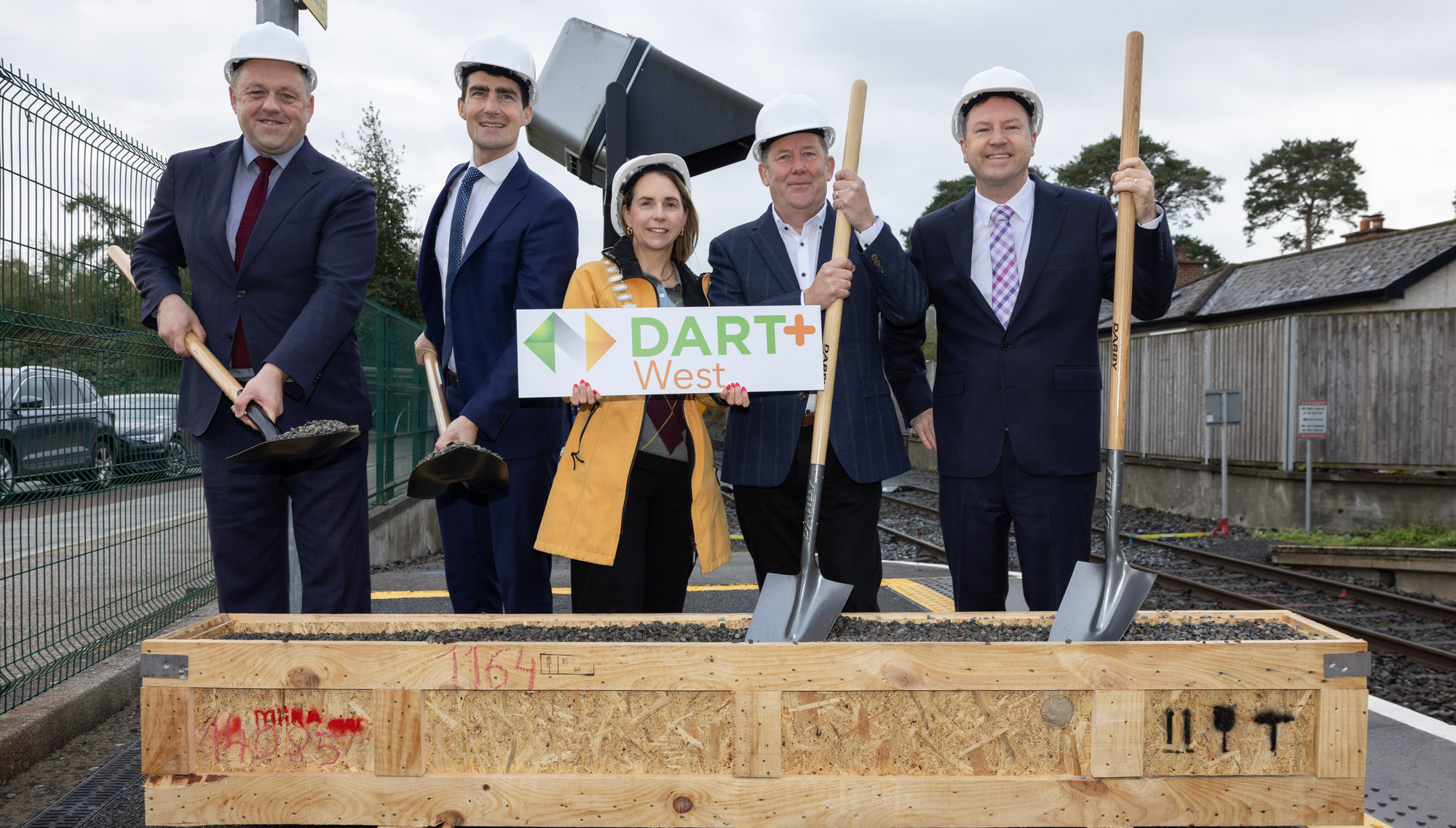
Minister of state Thomas Byrne, public expenditure minister Jack Chambers, cathaoirleach of Meath County Council Sarah Reilly, minister for transport Darragh O’Brien, and higher education minister James Lawless. Picture: Paul Sharp/Sharppix
ON WEDNESDAY morning, a group of ministers turned the sod on something that felt small, but could be huge. On the platform of Dunboyne train station in Co Meath, transport minister Darragh O’Brien, public expenditure minister Jack Chambers, and further education minister James Lawless flipped some provided sod to mark the beginning of works on Dart+ West.
Some 120 Iarnród Éireann staff will be engaged in the work across the weekend. It will see track lowering works at two bridges between Hansfield and M3 Parkway in the west of Dublin to facilitate future electrification.
Dart+ West is designed to double train services along the Maynooth line from six to 12 an hour in each direction, increasing hourly passenger capacity from 5,000 to more than 13,000 each way.
While the works this weekend will be modest, they are a long time coming. According to 2024 Eurostat figures, just over 2% of Ireland’s rail network is electrified and the Dart expansion was announced eight years ago as a 10-year plan. So forgive the giddiness with which a few enabling works are met with.
But that work points to a greater issue: Ireland has reached a point where its infrastructure deficit can no longer be treated as a collection of isolated problems.
The housing crisis, chronic congestion, constraints on electricity connections, and deficiencies in water and wastewater systems are all symptoms of a broader failure to build the physical foundations required by a growing economy which has experienced rapid population growth.
For too long, Ireland has tried to accommodate rapid economic and population growth through incremental improvements to infrastructure that was already struggling to meet demand. The result is a widening gap between the country we have become and the infrastructure we possess.
Read More
Ireland needs a fundamental change in ambition: A national programme of construction on a scale that accepts significant disruption today in exchange for a more prosperous, productive, and liveable country tomorrow.
Across the Atlantic, Boston’s “Big Dig” offers an instructive, if imperfect, example. Over a two-decade span, the US city took the motorway which dissected its downtown and put it underground. It was painful and expensive and littered with safety and spending issues, but its central lesson is that when existing infrastructure becomes an obstacle to a city’s future, the solution may require a decade or more of difficult construction rather than generations of incremental fixes.
As Mr O’Brien extolled the works being undertaken by the Government in the areas of heavy, light, and commuter rail, he was somewhat shy of detail until the end of the press conference when he accepted that what starts this weekend may not see the people of West Dublin on Dart trains until midway through the next decade.
But as the saying almost goes: The best time to electrify your rail network was 30 years ago, the next best time is today.
Which is to say that Ireland should embrace a decade of purposeful disruption. Not by reproducing Boston’s engineering decisions or repeating its financial mistakes, but by recognising that the inconvenience of construction is temporary, while the economic and social costs of inadequate infrastructure can endure indefinitely.
The scale of Ireland’s problem is striking. Research by the International Monetary Fund in 2025 estimated a physical infrastructure gap of 32% relative to the infrastructure frontier, alongside a quality gap of 27%. To put it another way — stacked up with competing economies, we have one third less physical infrastructure and what we have is only three-quarters as good.
In 2024, the Irish Fiscal Advisory Council estimated that Ireland’s infrastructure stock per capita was around a quarter below the average for high-income European countries.
These papers use different methodologies and benchmarks, but point towards the same conclusion: Ireland’s physical infrastructure has not consistently kept pace with its economic success.
And this is not an abstract accounting problem. Good infrastructure determines so much about our daily lives.
Of course, the irony is that Ireland’s success has intensified the problem. Population growth and economic expansion have increased demand faster than the country has delivered the infrastructure needed to support them.
But that means this is not a choice between disruption and an undisturbed status quo because the status quo already imposes disruption: Dublin drivers lose 158 hours per year during rush hour alone and more than 6% of Cork City buses did not run as planned in the first half of this year as this paper reported earlier this week.
Nowhere is the deficit more apparent than in housing. Ireland completed 30,330 homes in 2024, while the Fiscal Advisory Council’s research estimated a requirement of approximately 68,500 homes annually to address demand and population growth. The precise number needed will change with demographic and economic conditions, but the underlying challenge is unmistakable.
But as anyone who has spent hours playing a city building simulator will tell you; housing not simply a matter of constructing more buildings. Homes depend on water supply, wastewater treatment, electricity, transport links, schools and other public services. A country cannot build the homes it needs if it cannot provide the infrastructure that makes those homes viable.
Transport offers the clearest parallel with Boston. Before the Big Dig, the city’s elevated central artery carried more than 200,000 vehicles daily through downtown. Congestion was a persistent feature of urban life, earning the original road the name the “Distressway”. But instead of relying on minor improvements, Boston undertook a major reconstruction, replacing the elevated highway with an underground expressway and creating new connections to the wider transport network.
Construction began in 1991, and major sections opened in stages. The project transformed the urban landscape, freeing up land previously occupied by elevated roads. But it also suffered substantial cost overruns and delays. The Big Dig demonstrates both the potential rewards of ambitious infrastructure investment and the dangers of poor cost control and unrealistic planning.
Ireland should take the lesson, not copy the blueprint. Dublin does not need Boston’s road network. It needs a co-ordinated transport system in which rail, bus, cycling, and strategic road infrastructure work together. Major public transport projects must advance alongside commuter rail improvements, reliable bus services and essential road upgrades where these are justified.
For commuters, this would mean diversions, construction noise, temporary road closures, and changes to familiar routes. Yet these inconveniences must be weighed against a transport system that restricts access to employment, lengthens journeys and limits where people can realistically live. And it is incumbent upon government to make this argument, even at a short-term political cost.
Meanwhile, the transition to renewable electricity, the electrification of transport and heating, and the demands of a growing economy require substantial investment in generation and grid capacity. Renewable projects cannot deliver their full benefits if the electricity network cannot accommodate their output. Housing and industrial developments can also be constrained by delays in obtaining connections.
These interdependent challenges demand co-ordinated investment rather than disconnected projects delivered on separate timetables.
Ireland’s updated national development plan commits €275.4bn in public capital investment over 2026-2035. This provides a substantial financial framework, but the real test is what gets built. Announcements, allocations, and money spent are not substitutes for completed infrastructure that expands capacity and improves public services.
Boston also offers a warning about costs. The Big Dig’s original estimate was approximately $2.6bn in 1982 dollars; by the early 2000s, the estimated cost had risen to $14.6bn. Changes in scope, technical difficulties, delays, and management problems all contributed.
Ireland must avoid the temptation to sell transformative projects on optimistic budgets and unrealistic schedules. We are in a deficit, but realism is appreciated by the public. If a project will take 10 years, tell people it will take 10 years.
The political challenge is equally significant. Construction creates immediate, visible inconvenience, while its benefits may take years to materialise. Governments are naturally tempted to favour projects that are quicker to announce and less likely to provoke opposition. But this can leave the country trapped in a cycle of postponement, where every government inherits the same deficiencies and the costs continue to accumulate.
Above all, the public must be able to see that disruption is producing results. Journey times should improve, housing completions should rise, water systems should gain capacity and electricity connections should become more reliable.
Without measurable outcomes, a decade of construction risks becoming a decade of inconvenience.
Ireland should not romanticise Boston’s experience. The Big Dig was expensive, technically demanding, and far from a model of flawless delivery. But it illustrates a fundamental truth: Transformative infrastructure requires political commitment to projects whose benefits may not be fully realised within a single electoral cycle.
The next decade should be defined by the infrastructure Ireland needs for the country it is becoming, not merely by the deficiencies inherited from the country it was.
We should prepare for a decade of construction — and accept that disruption will be part of the process.
CONNECT WITH US TODAY
Be the first to know the latest news and updates

More in this section