Colin Sheridan: UN failures are no excuse for weakening Ireland’s military neutrality
The Government’s push to change military deployment rules and the UAE’s UN leadership bid demand tougher scrutiny, argues Colin Sheridan
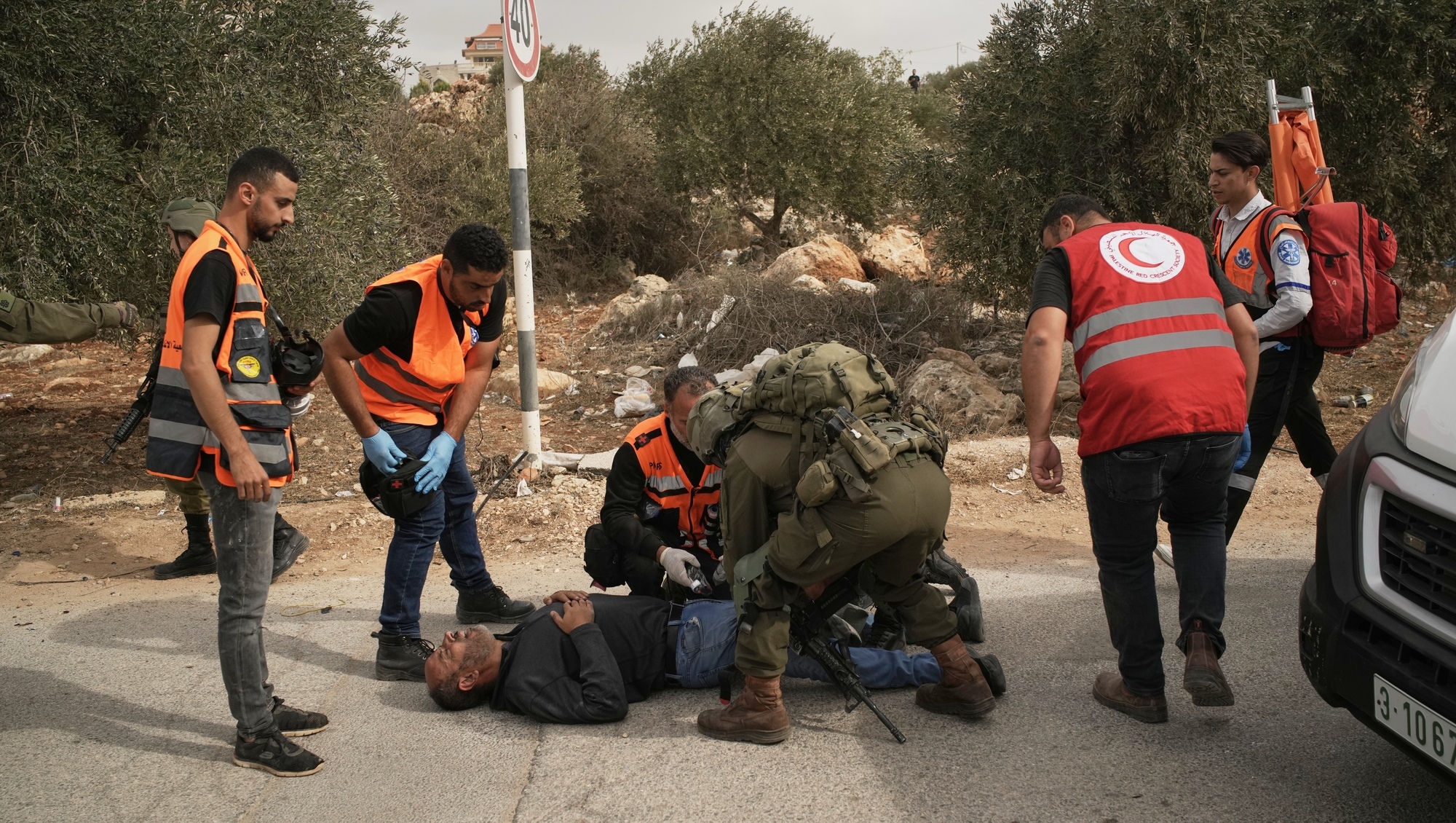
Palestinian medics and an Israeli soldierattend to a Palestinian man shot by Israelisoldiers following a settler attack onPalestinians harvesting olives in the West Bank village of Abu Falah, two weeks ago. Picture: AP

Palestinian medics and an Israeli soldier
attend to a Palestinian man shot by Israeli
soldiers following a settler attack on
Palestinians harvesting olives in the West Bank village of Abu Falah, two weeks ago. Picture: AP

AS HEADLINES go, this one leaves little to the imagination:

“Israel has committed war crimes and crimes against humanity in the Occupied Palestinian Territory amid continuing genocide in Gaza, UN Commission of Inquiry finds.”

Published on Monday, it describes a world in which the evidence accumulates and the consequences remain optional. A commission investigates. Survivors testify. Findings are published. Governments express concern. The machinery of impunity keeps turning. For some, this is proof that the United Nations is useless. I wonder what they imagine would happen if the investigators disappeared too.

In 1954, Dag Hammarskjöld told an audience in California that the United Nations was not created to bring us to heaven, but to save us from hell. He introduced the observation with “It has been said”, acknowledging that the thought preceded him. Its endurance is understandable. We keep furnishing it with fresh evidence.

The UN may be broken, but it is the best we have. Its failures should make us furious enough to demand better. There is something grotesque about watching powerful countries obstruct an institution, then treating its resulting paralysis as proof that those countries should enjoy greater freedom of action.

There is also more to the UN than the Security Council chamber. There are the people delivering food, treating children, documenting torture, and recording testimony that perpetrators would prefer erased. Their work continues long after the powerful have stopped pretending to listen.

Ireland appears increasingly susceptible to this reasoning.

The Government’s campaign to remove the requirement for UN approval of overseas military deployments is presented as an overdue encounter with reality. The world has changed. The Security Council is dysfunctional. Russia has a veto. Those of us who remain attached to the triple lock apparently need these things explained more slowly.

We understand.

We understand that the Security Council is profoundly compromised. We understand that governments can invoke sovereignty when what they want is fewer constraints. We understand, too, that Irish soldiers can serve European strategic interests without those interests becoming universal merely because an Irish flag is sewn to a sleeve.

Understanding the triple lock does not oblige us to support its removal.

Some say senator Tom Clonan is too earnest. Sinn Féin, too terrorist. Academics, too communist. There is a label available for every objection, saving its recipients the trouble of answering it. Dissent becomes a defect in the dissenter. Government policy becomes the adult position by virtue of being government policy.

Last weekend, Helen McEntee advocated Irish participation in an EU mission in Lebanon involving peacekeeping and peace enforcement. She linked that participation directly to changing the triple lock.

That deserves considerably more interrogation than it’s currently receiving, especially as the two most vocal and influential critics of the soon-to-be-deceased Unifil are the US and Israel. They will inevitably welcome the EU mission. You’d have to wonder why.

The European Union has borders, markets, energy dependencies, and strategic ambitions. It represents its members. Its decisions emerge from bargaining between governments with interests of their own. We belong to it, benefit from it, and have every reason to want it to succeed. None of that confers universal moral authority on its military choices, especially if those choices become increasingly linked to corporate interests.

An EU mission can have UN authorisation. The proposal is to allow Irish participation without requiring it. That is a substantive change in where we locate international legitimacy. Calling it modernisation does not make the question any less worthy of answering, and those asking any more deserving of ridicule.

Having served in Lebanon, I cannot regard the future of an international presence there as an administrative problem about finding another mission for Irish troops. The people living among the ruins are entitled to know what any force is there to do, whose authority it recognises, and whose interests determine its priorities.

So are the soldiers.

A desire to remain overseas cannot substitute for an argument about what we are being asked to accomplish there. Nor can defending the UN mean averting our eyes when it threatens to betray its own purpose.

This week marked a year since the Rapid Support Forces overran El Fasher in Sudan. After 18 months of siege, the city’s fall brought massacres, sexual violence, and people hunted as they fled. The UN Human Rights Office documented more than 6,000 killings in the first three days of the offensive. It warned that the actual toll was significantly higher.

Consider that number before proceeding to the diplomatic niceties. The UAE has nominated Lana Nusseibeh, its minister of state and former ambassador to the UN, to become the organisation’s next secretary general.

The same UAE that Amnesty International has identified as almost certainly supplying sophisticated Chinese weapons used by the RSF. The same UAE whose alleged military support through Chad was judged credible by UN experts.

The UAE denies arming the RSF. Nusseibeh has repeatedly defended those denials. Human Rights Watch has documented her rejection of evidence implicating the government she represented. She now seeks to lead the institution whose findings she disputed.

No. An organisation struggling to persuade the victims of powerful states that international law means something cannot afford this appointment. The secretary general must defend investigators when their conclusions become inconvenient to governments. Every government. Diplomatic accomplishment cannot compensate for a record that raises such fundamental questions about that responsibility.

Nusseibeh says Sudan would be a priority. Sudanese people are more than entitled to dismantle that promise against her record. Ireland should oppose her candidacy. It should defend independent investigations, demand accountability for those fuelling Sudan’s war and insist that the findings on Palestine carry consequences. It should put political effort into strengthening the institution to which it professes such loyalty.

Reform will be difficult. The countries enjoying disproportionate power are unlikely to surrender it graciously. That difficulty is an argument for sustained diplomacy, resources and pressure. Small countries should be particularly suspicious of a world in which restraint is dismissed as an impediment to getting things done.

Our independence ought to mean retaining the capacity to challenge our supposed friends. Our neutrality ought to involve more thought than selecting a larger collection of interests to follow.

The United Nations has failed to save far too many people from hell. That failure is no argument for handing the keys to the devil who put them there.

More in this section

Revoiced

Newsletter

Had a busy week? Sign up for some of the best reads from the week gone by. Selected just for you.

Cookie Policy Privacy Policy Brand Safety FAQ Help Contact Us Terms and Conditions

© Examiner Echo Group Limited