Irish Examiner view: Gaza visa ruling the right decision
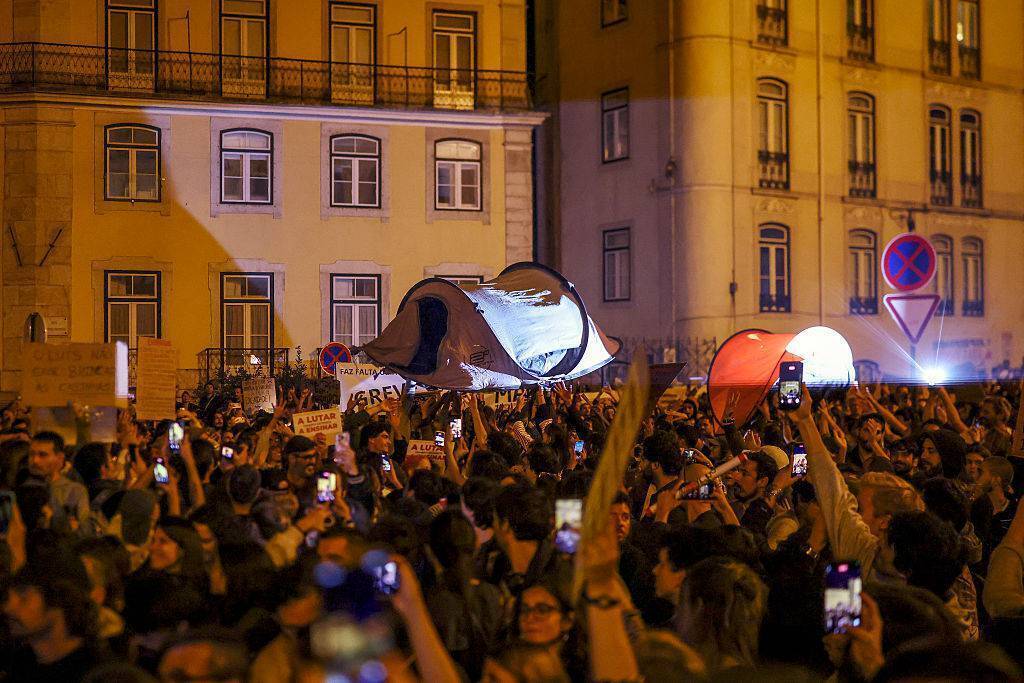
People hold up tents during a protest against the housing shortage, soaring rents, and low wages in front of the Portuguese Parliament in Lisbon. Picture: Patricia D Melo Moreira/AFP via Getty
Shaymaa Abudalu has had to demonstrate more resilience than any young person should be asked to possess.
She should not have had to go to the High Court to ensure that documents submitted with her Irish visa application were properly considered.
The 20-year-old from Gaza has been offered a fully funded place to study engineering at University College Cork.
On Tuesday, Mr Justice Anthony Barr overturned the refusal of her study visa, finding significant errors in the decision-making process.
Her application must now be reconsidered.
Among those errors were failures to consider financial documentation and evidence of her proficiency in English.
The State argued that the refusal could stand.
That position is difficult to reconcile with the care such a consequential decision demands.
Behind the paperwork is a young woman whose mother and siblings were killed in an Israeli missile strike.
The court heard that she spent hours buried beneath rubble beside her sister’s body.
She subsequently achieved 96.7% in her final school examinations.
Those details explain the circumstances in which her application was made.
They should not be the price of admission to our sympathy.
A person seeking an education should be entitled to a fair assessment without first having to establish extraordinary achievement or unimaginable suffering.
The judgement does not exempt Palestinian applicants from immigration requirements.
Nor does it automatically grant Ms Abudalu a visa.
The court rejected her argument that she had a legitimate expectation that certain documentary requirements would be waived.
Difficult as it may be to stomach, those distinctions matter.
So does the finding that the errors in her case were substantial.
This was a failure in the State’s application of its own procedures, with potentially devastating consequences for someone whose opportunity to study depends on a timely decision.
Read More
Ireland’s expressions of solidarity with Palestinians create a reasonable expectation that its institutions will act with humanity.
Ministers cannot credibly urge compassion abroad while accepting administrative indifference at home.
The distance between those positions damages trust in what the Government says.
The greater concern is what the original decision meant for Ms Abudalu: Another barrier between survival and the possibility of rebuilding her life.
A university had offered her a place.
Our visa process failed to assess her application properly. Justice minister Jim O’Callaghan must ensure the fresh decision is made promptly and carefully.
His department should also examine whether the same errors have affected other applications.
Students should not have to pursue separate legal challenges to secure the consideration they were entitled to receive initially.
Fair procedures and compassion are compatible obligations.
Applying rules responsibly requires attention to the evidence submitted and to the realities facing the applicant.
It also requires an understanding that delay can destroy an opportunity as effectively as refusal.
The Government now has a chance to demonstrate that its commitments mean something in practice.
It should begin by getting this decision right, and by ensuring that every similarly placed student receives a fair, timely assessment.
That is the minimum Ireland should expect of itself.
Police can dismantle a protest camp in a matter of hours.
Repairing the conditions that brought people there takes more effort.
The clearing of housing protest camps in Lisbon and Porto, with officers using batons and dogs, has become the latest disturbing image of Europe’s autumn of discontent.
Fresh demonstrations followed.
Investigations into police conduct are now under way.
The ripple has become a wave.
Across Portugal, Spain, France, and Italy, anger over housing, living costs and public services is spilling into the streets.
Serbia’s protest movement has its own roots in corruption and accountability.
These are distinct national crises, but they share a dangerous ingredient: The conviction that those in power have stopped listening.
For anyone unable to afford a home despite working, assurances about economic progress can sound like a description of somebody else’s life.
When rent consumes the wages needed for food, heating, and raising children, frustration becomes something more enduring.
The future begins to feel closed.
Violence against people or property cannot be excused by hardship.
Equally, peaceful protest must be protected, and allegations of excessive police force require independent scrutiny.
Governments cannot treat every expression of anger as a public order problem and expect the underlying grievance to disappear.
Housing is fundamental to the bargain between citizens and the societies they sustain.
People need a reasonable prospect of security, independence and a place to live.
When that prospect recedes, confidence in democratic politics can recede with it.
Ireland should recognise the warning.
The answer requires homes people can afford, services they can rely on, and policies judged by their effect on daily life.
Clearing a square may restore the appearance of calm.
Unless governments address what drove people into it, the anger will remain.
There was a time when the chief danger of a family meal was an argument.
Now it may be that nobody looks up long enough to start one.
Fifteen Sardinian restaurants are joining a trial requiring families to put away their phones at the table.
Games and drawing materials will help fill the conversational void.
Some will welcome the assistance.
Others will wonder whether ordering pasta should involve instruction in parenting.
A voluntary restaurant scheme, however, hardly amounts to the state confiscating the family silver.
Adults should resist treating this solely as a problem with children.
It is difficult to preach the virtues of conversation while checking your own notifications beneath the table.
Expect more such interventions as we struggle to establish boundaries around devices.
For now, dinner offers a modest place to begin.
The food might even taste better if it hasn’t been photographed before being eaten.

CONNECT WITH US TODAY



Be the first to know the latest news and updates