Gareth O'Callaghan: AI let me meet my 5-year-old self — but the experience came with an important warning
Gareth O'Callaghan explores how AI created an image of him with his five-year-old self, reflecting on memory, photography, childhood, and the future of artificial intelligence
Even with an old photo, AI can track ancient camera movements and then use the same tracking to insert me into the frame as though I’ve always been there, writes Gareth O'Callaghan.

Even with an old photo, AI can track ancient camera movements and then use the same tracking to insert me into the frame as though I’ve always been there, writes Gareth O'Callaghan.

The best parts of life are the ones that call you back in time.

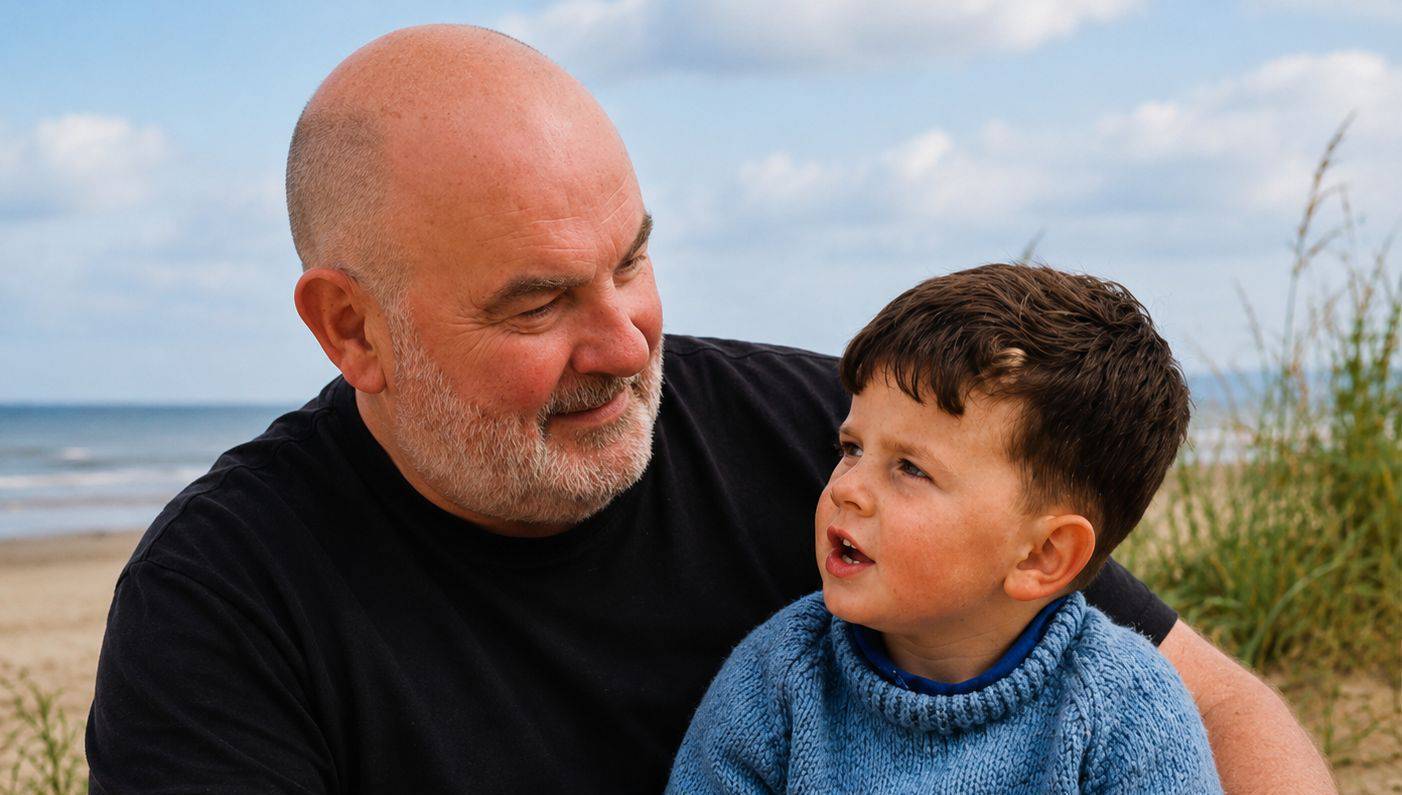
This photo could have been taken last week. It’s a perfect summer’s day on the beach, and it’s as if I’m listening to my grandson as he explains why jellyfish have nothing to do with real jelly, and how you can hear the wind if you hold a spiral-shaped seashell up to your ear.

He’s five years old. Just out of shot is his yellow bucket, spade, and a sprawling sand fortress with turrets and a deep moat that would have made Edward I — the English king most renowned for his passion for castles — proud as punch.

It’s one for the family album. Well it would be if it was real, but it’s not. I don’t have a grandson.

The boy in the blue jumper is my five-year-old self on a sunny afternoon on a family holiday in Barleycove, West Cork, in 1966, while the older version of him on the left is still some 60 years off in the future.

Who would have thought it possible that one day I could appear in a photo with my five-year-old self?

Of course, I couldn’t have been in the original photo unless, as the writer Margaret Atwood once said: “If you knew enough and could move faster than light, you could travel backward in time and exist in two places at once.”

HG Wells would have been proud of me navigating the time dimension so perfectly.

Welcome to the world of AI. Or the machine, as I prefer to call it. What you see in this photo is called depth and perspective matching, camera motion tracking and, finally, harmonisation. It all happens in seconds.

For the uninitiated — I was one until recently — it’s a process that uses advanced algorithms to study and manipulate images to create a scene as perfect as possible by matching the spatial relationships between an old film-roll photo of the boy in the blue jumper (taken by my mother) and a digital older me taken at home last month (taken by my wife).

Even with an old photo, AI can track ancient camera movements and then use the same tracking to insert me into the frame as though I’ve always been there, matching any shadows and lighting in order to preserve the original 1966 scene.

For pulling at the heartstrings, it scores a 10. A family friend even became teary when she saw the photo last week.

“Where was that taken?” was her instant reaction, even though she knew the boy in the blue jumper was me, which reinforces my belief that there’s something inside all of us that secretly longs to be reunited with our childhoods — that inner child that never ages.

Albert Einstein believed that the distinction between past, present, and future is an illusion. Science writer James Gleick wrote that, while the body remains grounded in the present, the mind travels back through time using memory and forward into the future using imagination.

As a sci-fi reader, I’m reminded of Audrey Niffenegger’s The Time Traveler’s Wife.

What if some day we could travel back in time and meet our younger selves? Would the boy in the photo even know who I was, and how would I explain where I had come from?

Let’s not get carried away here. This is technology that’s difficult to grasp, and the onus is on us to learn because it’s our future. But a lot of AI is not reality, as I realised the more I studied the photo.

While its sentimental value is priceless in the sense that it’s a bridge that connects my childhood, when jellyfish and seashells were my biggest concerns, to now when climate change and warring factions are never far from my thoughts, another concern is how such photos can bend how our brain functions.

Just like our friend asking where this photo was taken, we don’t examine photos in a forensic way when we look at them.

For a moment, it never occurred to her that the photo was fake. Our visual systems are not wired to detect fake images when we’re scrolling, which is how most of us look at photos these days.

Hardcopy photos are as rare as paperback books, which is a shame. Fine details require a focused effort, and most people just don’t have the patience.

If you study this photo, it’s clear that our images are too sharp in contrast to the sky and the sea.

A digital camera would have focused on a more natural setting, equally distributing all of the different aspects of the scene.

Inattentional blindness

It’s the small details that we don’t notice because the initial impact is what our visual systems seize on, which is why first impressions last.

In psychology, this is what is known as inattentional blindness — how we miss the objects in the photo that we’re not actively watching out for.

The photo is filled with subtle distortions that most of us don’t notice, which are what make it a fake.

Will AI kill photography? I don’t believe so.

The skill required in capturing a couple of newly weds’ first kiss or a newborn baby’s first cry just at the right second can’t be replaced by the machine, simply because AI doesn’t have emotional gut instinct that senses the precise moment to take a snapshot that preserves a sacred moment in time.

Photography is a human art form.

AI can generate flawless picture-perfect waterfalls, sunsets, and forests, but it can’t recreate the passion of the experience of actually being there on location to take the photos.

What advice would I give to the five-year-old in the blue jumper if he was starting out now, if I could sit on the beach with him on a sunny afternoon in Barleycove?

I read so much about the impact of stress and anxiety on the minds of young children. Anxiety is as old as time. Remember you are optimistic and adaptable.

Don’t blame life — it owes you nothing. You have one life, and one day you’ll realise that’s all you have. Look after it

The happiest days of your life, to quote psychologist Albert Ellis, are the ones in which you decide your problems are your own.

Learn as much as you can about AI. You’re only five, but already it’s everywhere. All you need to know now about AI is that it’s the science of making computers learn and do things like humans do.

Your young brain is like an information sponge, much like the computers that train the machine.

AI can only learn how to do things by being shown how over and over again. You’re a fast learner. If anyone knows that, it’s me.

Understand how computers learn how to “think” instead of settling for apps. We all love apps, but they only serve a purpose. Think broadly, always see the big picture.

AI is unlimited and it always will be. You’re the perfect age to be one of your future’s great inventors, and don’t ever let anyone tell you that won’t be. When life feels like it’s out to get you, then find an empty beach.

Never stop building sand castles, they will keep you feeling young and distracted from the detritus of life.

Building a sand castle is like building a future. Make it a very big castle. Do things that make you feel younger than your age. Take photos of the people you love, that will be the joy of your past preserved.

Without keeping them safe for posterity, the memories of who you once were will be lost on those you leave behind.

Study old pictures of yourself from time to time, and never forget how important those days were — like the photo on the beach when you wore your blue jumper and built the perfect sand castle. It will always be one of your favourites.

More in this section

Revoiced

Newsletter

Had a busy week? Sign up for some of the best reads from the week gone by. Selected just for you.

Cookie Policy Privacy Policy Brand Safety FAQ Help Contact Us Terms and Conditions

© Examiner Echo Group Limited