Gareth O'Callaghan: Bosco was ahead of its time — why the beloved RTÉ children’s show still matters today
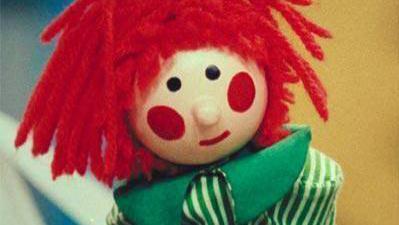
Bosco was a small red-haired permanently-five-year-old puppet with red cheeks who lived in a brightly painted box, whose magical interior was more akin to a child’s bedroom. File picture

The attitude you have as a parent is what your kids will learn from more than what you tell them. creator Jim Henson spoke those words. I was reminded of them last week when news reached me of the passing of Wicklow-born actor Gráinne Uí Mhaitiú, who was 72.
Gráinne, alongside her colleague Cork-born actor Frank Twomey, who died in 2023, will be best known to a whole generation of once very young viewers in the 1980s who fell under the spell of Bosco on afternoon television.
Bosco, for the rare few who might never have heard of this national treasure, was a small red-haired permanently-five-year-old puppet with red cheeks who lived in a brightly painted box, whose magical interior was more akin to a child’s bedroom.
The show first appeared on the RTÉ schedule in autumn 1979, barely days after Pope John II had departed these shores following his three-day visit, and ran until 1987 when it was dropped after 386 original episodes — no mean feat.
Despite what some might say, RTÉ blazed a trail with young people’s content in its early pre-satellite technology days. Characters such as Lúidin Mac Lú, a woodland-based leprechaun, and a duck called Dáithí Lacha were 1960s household names, long before Jim Henson’s hugely-popular aired on the station in 1971.
debuted in 1968, later in 1980, presented by Aonghus McAnally and Kathy Parke, and with Fran Dempsey in 1983.
Henson’s slick production with its colourful characters was aimed primarily at a US audience. Ireland’s culture — its sense of itself — was a very different reality to what American preschool children were about. It lacked the homegrown effect.
Small children wanted to hear a character that sounded like they did, that they could relate to — not someone from Forest Hills in Queens. Accents matter.
Bosco was in a league of its own, quite literally. Why was it so popular? Two reasons — Bosco’s philosophy on life, sparingly shared each day, shaped young minds in their formative years; and in the private worlds of children who clung to every word of that mindset Bosco was more than just a puppet.
I always felt that the idea that Bosco appealed to a childish imagination was too limiting. Even though Bosco lived in a box, Bosco never allowed anyone to put Bosco in a box, so to speak.
Why so many references to Bosco’s name? Because for years, Bosco was neither he nor she. Personal pronouns only became a nightmare for Bosco in later years.
By talking to boys and girls in an all-inclusive way, Bosco avoided taking sides by being neither boy nor girl. If we were to read between the lines, it was the first time children were being taught the importance of sexual equality in the simplest way.
It wasn’t until 2011 on Ray D’Arcy’s radio show that Bosco let it slip that he was a boy, having kept his true gender a secret for 32 years. But we all knew. Didn’t we, boys and girls? Bosco’s favourite song to sing was .
Bosco wasn’t phased by the slip-up. In the great scheme of being five, it’s not important. To the best of my knowledge, Bosco is still five years old, and still staunchly gender-fluid. Growing up is confusing and messy, and when you arrive at ‘grown-up’ status it gets worse. As for sexuality, it’s not something that should concern a five-year-old.
Did it matter in 1980s Ireland that Bosco was non-binary, that his preference was to operate as a gender-neutral child? I have no recollection of letters to Arthur Murphy’s Mailbag from viewers demanding an explanation to this mystery.
I don’t recall the RTÉ press office being flooded with calls from anxious parents desperate to know what box to put him in. “I’m not a girl, or a boy,” shrugged Bosco when asked by Donal O’Keeffe in an interview for the back in 2019. I also don’t believe that Bosco’s gender-neutral stance had anything to do with the more recent transgender use of such words.
Bosco might have loved the art of being vague, but I think it was more about sleight of mouth — a persuasion technique that encouraged young viewers to respond to what they heard in ways that could influence their thoughts and perceptions, which is at the heart of the modern psychology of neurolinguistic programming.
A classic example was when the show opened one afternoon and all that viewers could see were Bosco’s legs sticking out of his box. Frank’s face was out of shot, while all we could see were his legs stretched upwards across the table.
Gráinne is confused. “What’s happening?” she asks, “Everything’s upside down.” Frank springs to his feet. “Just one of those things, Gráinne,” he replies casually. Then he looks into the camera. “It must be one of those upside down days, mustn’t it. Are you upside down today?” he asks viewers.
It was what’s known as verbal reframing, where Frank’s question could have been reinterpreted to suggest something else. It’s a less-confrontational way of asking if you’re having a bad day, or if you’re feeling upset by something that happened.
It’s a technique often used by therapists with young children who only have access to a limited vocabulary and perception of reality. It might sound like a throw-away question, but it taps into a higher level of abstraction if a young child is feeling that their world is upside down but don’t have the words to explain.
Back in 1979, Ireland’s education system was bog-basic, with a curriculum aimed at a third-level path or a pensionable job in either finance or the civil service departments. There was no room for outliers — for children who, from an early age, didn’t conform through no fault of their own.
Life is difficult. What’s particularly tough about being a young child who can’t adapt to what other children don’t have a problem with, is when the invisible blockages that hold you back make you self-conscious. Multiply that over and over in the 1980s. Bosco stepped in and opened that magic door with a clever funny-yet-wise vocabulary.
One woman, Teresa, told me during a discussion in 2004 how she “twigged” in 1980 that there was something wrong with her six-year-old daughter. “She hated noise and loud voices on the television,” she told me.
“She was a loner. She hated school.
"She’d sit up close to the television set and chat to Bosco, and to Gráinne and Frank when they’d ask questions. Bosco never made her anxious. It was a revelation.”
Jim Henson once said: “With puppets, I don’t think you should try to duplicate what humans do. It can cause problems.” Bosco never copied what Gráinne and Frank did, and other presenters who followed them over the years, and that was why this five-year-old was able to hold the limited attention span of its young viewers for longer.
Autism has been with us through the ages. Teresa told me that she always just thought her daughter was “a bit different”. She even recalled her own childhood as being “a bit different too”.
It might not have had the budget or the glamour of or , but through its simplest of conversational styles between a five-year-old and two trusted grown-ups who listened to what a child puppet had to say, it achieved so much more.
was light years ahead of its time. And the little puppet's human friends showed many tiny viewers that adults could listen, and play, and be their allies.
That's quite a legacy. Rest in peace, Gráinne.

CONNECT WITH US TODAY



Be the first to know the latest news and updates