Shona Murray: Europe left dealing with the mess from a war it never chose
Donald Trump rightfully pointed out that it’s Europe — as opposed to the US — which has suffered greater economic losses from the closure of the Strait of Hormuz
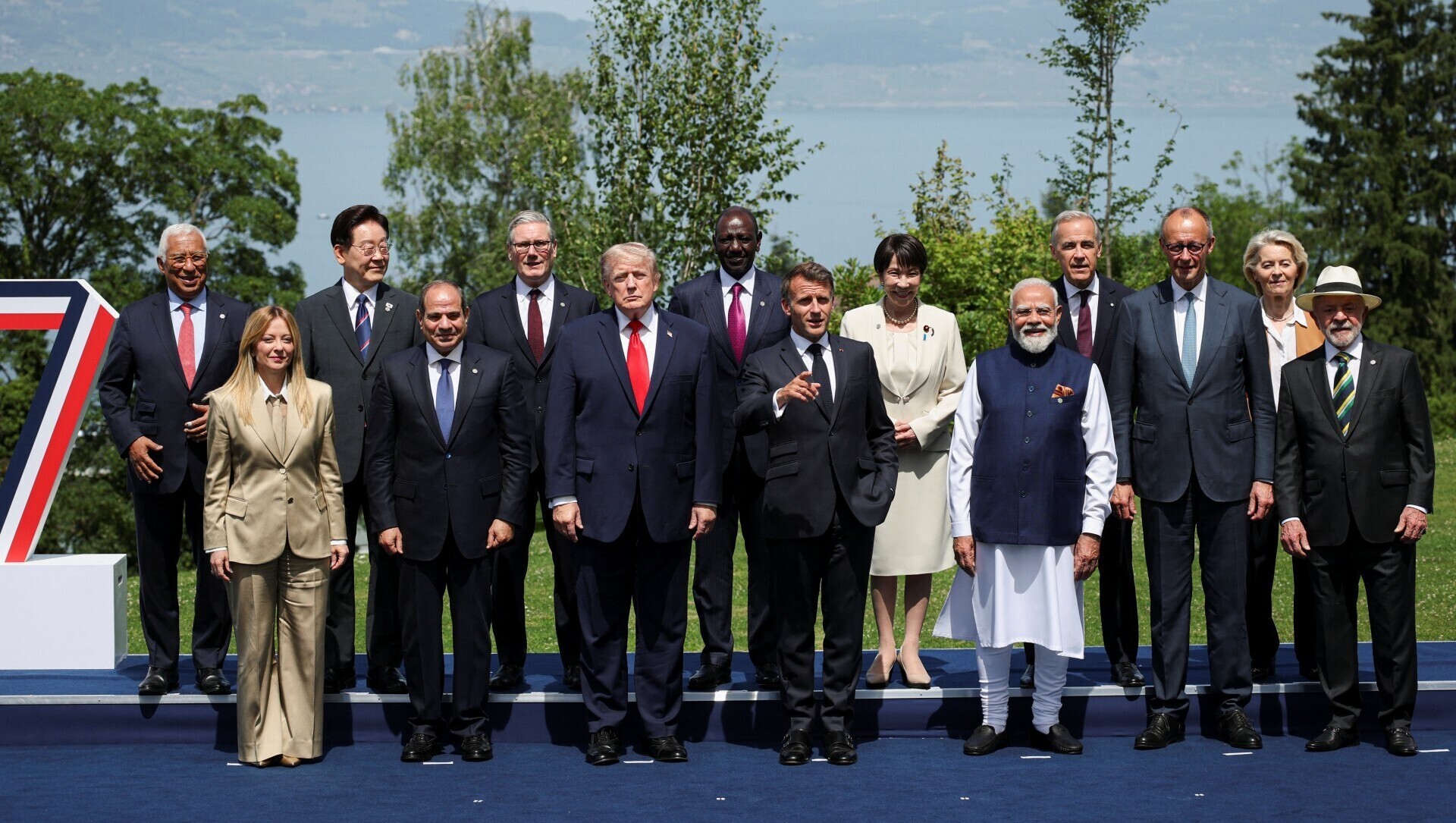
From left: European Council president Antonio Costa, Italian prime minister Giorgia Meloni, South Korean president Lee Jae Myung, Egyptian president Abdel Fattah al-Sisi, UK prime minister Keir Starmer, US president Donald Trump, Kenyan president William Ruto, French president Emmanuel Macron, Japanese prime minister Sanae Takaichi, Indian prime minister Narendra Modi, Canadian prime minister Mark Carney, German chancellor Friedrich Merz, European Commission president Ursula von der Leyen, and Brazilian president Luiz Inacio Lula da Silva pose for a photo during the G7 summit in Evian, France, on Tuesday. Picture: Isabel Infantes/PA

From left: European Council president Antonio Costa, Italian prime minister Giorgia Meloni, South Korean president Lee Jae Myung, Egyptian president Abdel Fattah al-Sisi, UK prime minister Keir Starmer, US president Donald Trump, Kenyan president William Ruto, French president Emmanuel Macron, Japanese prime minister Sanae Takaichi, Indian prime minister Narendra Modi, Canadian prime minister Mark Carney, German chancellor Friedrich Merz, European Commission president Ursula von der Leyen, and Brazilian president Luiz Inacio Lula da Silva pose for a photo during the G7 summit in Evian, France, on Tuesday. Picture: Isabel Infantes/PA

US Secretary of war Pete Hegseth delivered a blistering attack on European/Nato allies during the week, telling them they were “shameful” for not joining the US and Israel in the war in Iran.

In a gathering of defence ministers in Brussels, he accused his European and Canadian counterparts of wasting too much of the last few decades focusing on ‘ climate change and gender equality’ when they should have been defending the continent.

He said they’d been ‘free riding’ on US security instead.

In a speech reminiscent of US vice president JD Vance - attacking Europe for allowing its own “civilisational erasure” by creating a cordon sanitaire or bulwark against the rise of the far-right in Germany and France - Hegseth’s tirade was purposeful.

It had very little to do with mutual defence and security. It was steeped in far-right ideology, designed to humiliate and weaken western leaders.

“Instead of tanks and fighters and air defences, the focus had been on gender equity and climate change and defence austerity,” he said. 

Europe’s borders flew wide open, welfare states expanded, defence budgets cratered, along with Europe’s belief in itself and its civilisation, he said.

At the start of the Iran war, some countries — Spain and Italy — refused the US military access to bases on European territory, while France on a couple of occasions refused Israel use of its air space to transport American weapons to bomb Iran.

European leaders attempted to take a stand because they were not consulted about the war, nor was it a matter for them given Iran is not part of European or Nato territory.

And there was the obvious question about the legality of widespread airstrikes and military action against a state when there was no evidence that the country posed an imminent threat - notwithstanding the barbaric nature of the Iranian regime when it comes to its own citizens and nefarious influence across the world such as in Ukraine and elsewhere.

US and Israel use military force against Iran

Moreover, for the second time, the US and Israel used military force against Iran while in the middle of negotiations to settle the serious issue of Iran’s nuclear ambitions and ballistic and drone missile programme.

In addition, the war was deeply unpopular among voters domestically, and unlike some countries, European governments are answerable to constituents.

In fact, UK security advisor Jonathan Powell — an experienced diplomat from his key role in negotiating the Good Friday Agreement, said he was surprised at the decision to strike Iran as there had been some progress on the talks.

Meanwhile, Germany and the UK gave the US full access to bases and have led a coalition of around 40 countries — mostly from Nato but also Japan, Australia, and South Korea which are sending assets to the Gulf to reopen the Strait of Hormuz.

As Trump rightfully pointed out throughout the last few months, it’s Europe — as opposed to the US — which has suffered greater economic losses from the closure of the Strait.

In the end, it’s European and other countries who’ve sent valuable assets and personnel to the region to clean up the mess caused by an ill-conceived decision by the US and Israel to begin an armed conflict without the faintest idea of how to end it.

Let’s not forget that on the first day of the war, a US bomb killed more than 160 people — most of them children — in the Shajareh Tayyebeh (the Good Tree) school in the city of Minab.

At no point have European allies, or the leadership of the European Union, or president of the European Commission Ursula von der Leyen condemned this incident — known to be the worst single case of civilian casualties in decades of US conflicts in the Middle East. Nor did they call for a full investigation. 

EU Leaders align themselves with Trump

Instead, they quietly rolled back any reservations they had about the legality or frivolousness of the case for going to war. And went about taking action to remedy what has been a horror show of epic proportions in a bid to align themselves with Trump once again.

Indeed, it may seem a fool’s errand to take Trump to task for his actions. 

When German chancellor Friedrich Merz criticised the lack of strategy or basic war-gaming about the potential scenarios that would occur if the US and Israel attempted a coup in one of the most deeply entrenched regimes in the world, the retribution from the White House was swift.

Trump launched several verbal assaults at Merz and announced a cut in 5,000 troops from German territory.

Merz had said “the problem with conflicts like this is always you don’t just have to get in — you have to get out again”. 

“We saw that very painfully in Afghanistan for 20 years. We saw it in Iraq,” he told an audience in Germany in April.

“An entire nation,” he concluded, “is being humiliated by the Iranian leadership.”

Donald Trump’s notorious ego

To be fair, it was an ill-advised thing to say given Trump’s notorious ego, but in normal circumstances these diplomatic faux pas among mature foreign leaders dissipate.

Instead Europe must suffer the consequences. Hegseth announced a further troop review of American soldiers in Nato territory — a provision that has existed since the Cold War and is as much part of US power projection as a European defence.

In addition, he said the US will now keep a “close eye on allies who are not” stepping up on defence spending.

At the G7 last week there was a moment of cautious optimism as Trump and the rest of the group applauded his détente with Iran. The mood seemed better than it had been for a long time. Convivial even. Hours later, the US secretary of war burst that bubble.

Europe has bent over backwards to keep Trump onside for fear he will create further instability. But it is a fool’s errand.

More in this section

Revoiced

Newsletter

Had a busy week? Sign up for some of the best reads from the week gone by. Selected just for you.

Cookie Policy Privacy Policy Brand Safety FAQ Help Contact Us Terms and Conditions

© Examiner Echo Group Limited