Mick Clifford: 55 years after Martin Kerrigan’s brutal killing, his family deserves answers
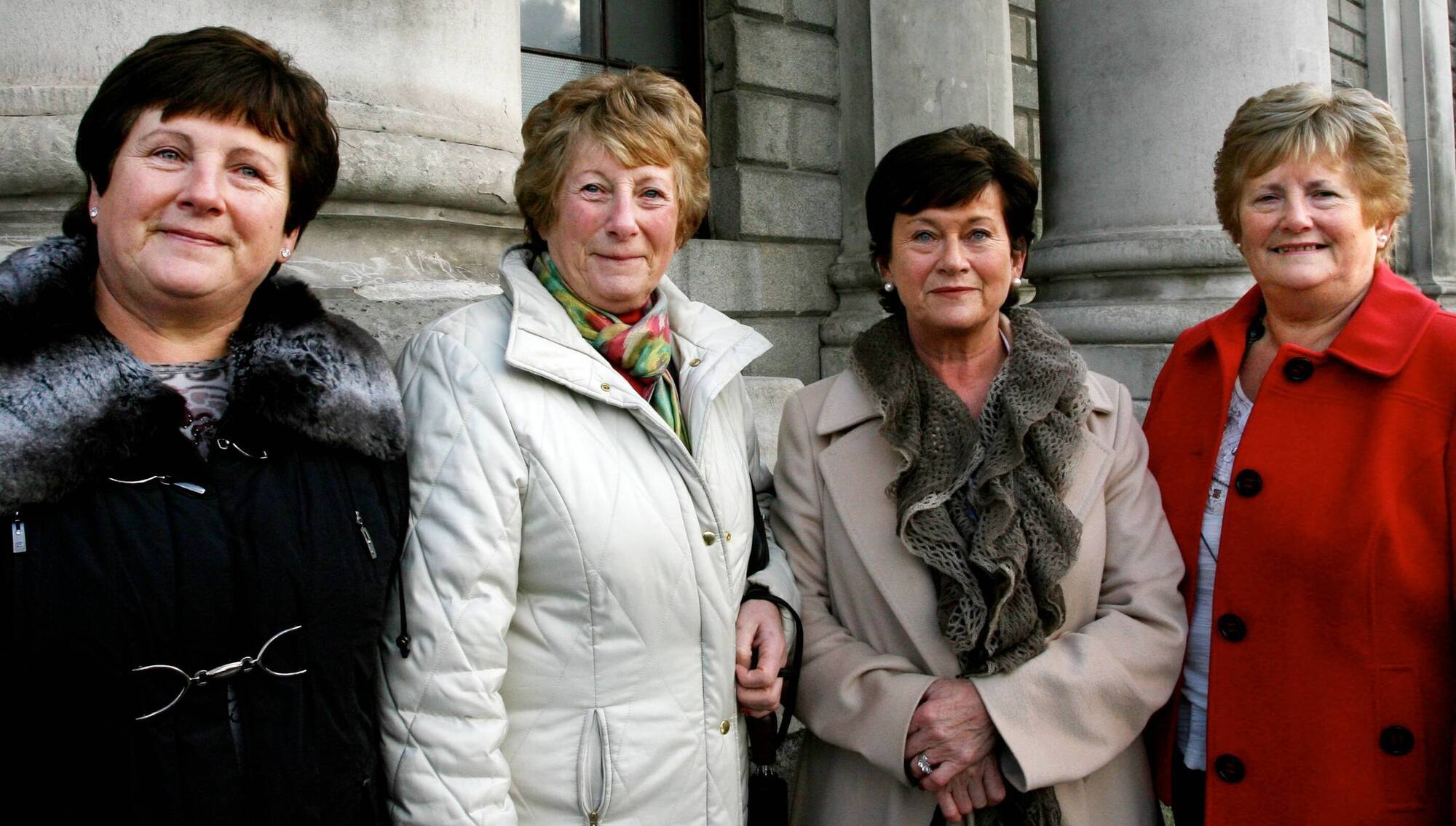
The late Martin 'Marty' Kerrigan's sisters — Kathleen O'Neill, Mary Ryan, Eileen O'Brien, and Ann Donnelly — at the Court of Criminal Appeal in 2010 where Martin Conmey's manslaughter conviction was quashed. Now aged between 72 and 83, they too have faced endless delays and blockages to finding out what really happened to Una and Martin. Picture: CourtPix
The eldest of the Kerrigan siblings is 83. The youngest is 72. There are five, four women and a man. Practically all of their adult lives, they have lived with loss, a wound that has never been closed.
Four years ago, they were given hope that their pain would finally be addressed.
Yet today, at a time when the passing years are more precious than ever, they appear to be no nearer to closure.
Their brother Marty Kerrigan was brutally killed in the early hours of December 20, 1971. At the time, he was, according to An Garda Síochána, a suspect in the murder of a neighbour, Una Lynskey. The case has been well aired in recent years.
Una Lynskey disappeared from her close-knit community near Ratoath, Co Meath, on October 12, 1971.
The gardaí quickly suspected three neighbours of involvement: Richard 'Dick' Donnelly, Martin Conmey, and Martin 'Marty' Kerrigan were brought to Trim Garda Station.
It is now widely accepted that the three — aged between 19 and 22 years at the time — were physically abused in custody.
Conmey and Kerrigan signed statements that were inconsistent, rambling, and incomplete. Crucially, none of the admissions revealed where Una’s body was.
Later, Conmey would claim the confession was in effect beaten out of him, that he signed it to stop the violence.
A month later, Una’s body was found in the Dublin mountains.
A week after that, Marty Kerrigan was bundled into a car and taken to a location near where Una’s body had been found. He died violently. There were signs of an attempt to disembowel him.
Two of Una’s brothers and a cousin were convicted of his manslaughter. Donnelly and Conmey were then put on trial and found guilty of manslaughter in Una’s killing.
Donnelly’s conviction was overturned on appeal. Conmey served three years in prison, came out, and tried to get his life back together. Over 20 years later, he launched an attempt to clear his name.
His journey finally ended in 2010 when the Court of Criminal Appeal overturned his conviction. Subsequently, he received a “miscarriage of justice” certificate and compensation from the State.
Nobody has ever been convicted of Una’s murder, but it is now widely accepted that the three local men had nothing to do with it.
In 2022, Marty Kerrigan’s sisters met with the then garda commissioner, Drew Harris. They asked that Marty’s name be cleared.
When he died, Marty Kerrigan was a murder suspect. His two friends had a chance to clear their names. That was never afforded to him.
Harris told them that if a review of the case showed that their brother was wrongly under suspicion, they would receive an apology.
On October 12, 2023, the 52nd anniversary of Una’s disappearance, An Garda Síochána held a high-profile press conference at which it was announced there would be a review of the killings of Una Lynskey and Marty Kerrigan.
The Kerrigan family was led to believe that once the reviews were complete, and if it was shown that Marty was wrongly suspected, an apology would be forthcoming.
Yet despite the publicity at the time, there was something highly unusual in a review of Marty Kerrigan’s violent death. Three men had been convicted of killing him in 1972.
They admitted their culpability and didn’t dispute the verdict.
Una’s murder was entirely different: Nobody has been convicted for it, and no new suspects were ever identified.
That case was ideal for a full review and investigation, whereas the review of Marty Kerrigan’s should have been an entirely separate exercise.
What was at issue in the Kerrigan case was whether some gardaí had effectively concocted a case against him, including using violence to do so.
Investigating that should have been relatively easy. There are court records, testimonies, medical evidence, changed statements, and a complete paper trail.
It should have been a separate exercise from chasing down suspects for Una’s murder.
It could have been completed quickly and, if the result confirmed the huge body of existing evidence, the Kerrigan family could have got an apology. Yet, three years on, the case appears no closer to resolution.
The understands that members of the review team have been in contact with the Kerrigans on a relatively frequent basis.
No aspersions are cast at their efforts to advance the case.
Read More
There is, however, a long tradition of the State moving slowly when it comes to dealing with citizens who have been wronged.
Different reasons have often been advanced for this snail’s pace in addressing wrongs, but in all cases, it is to the State’s advantage that things are not done quicker.
The dreaded day when a State agency will have to account for itself is pushed further into the future.
• Click here to listen to Miscarriages of justice: Martin Conmey and the Lynskey Case, a recent episode in which Professor Claire Hamilton, 'Irish Examiner' journalist Mick Clifford, and senior counsel Remy Farrell discuss the case.
And who knows what can happen between now and a resolution that is placed further out on the long finger?
In the overall case connected to the Lynskey and Kerrigan killings, there has already been plenty of delay.
When Martin Conmey was attempting to clear his name, roadblocks began to appear out of nowhere.
He was told in 1997 that the file on his case had been lost.
He was, in effect, sent from Billy to Jack, from a rat-infested garda station to the National Archives to a body called the Government Supplies Agency in search of the evidence.
As a senior counsel Remy Farrell noted in a recent Irish Courts Podcast on the case, this was a slow-moving train.
“It took 12 years or more for that material to be provided to him [Conmey],” the barrister said. This, he said, was in the context that the new evidence Conmey was seeking was in the file in possession of the State.
The DPP also ensured that nothing would be easily gotten by a man attempting to clear his name.
Conmey’s efforts were fully contested by the DPP.
“If you look at the arguments that were put up by the DPP [in Conmey’s appeal case], one of the points was that there had been an excessive delay on Conmey’s part,” Farrell said. This, he noted, “was not a hugely convincing point when you look at how long it took for disclosure”.
In other words, the DPP was excessively slow in complying with the court and then blamed Conmey for being excessively slow in complying with the court. The three appeal court judges were not impressed.
Is history repeating itself in the same case? Is somebody or something within the State apparatus ensuring that the day when the Kerrigans can rest easy on behalf of their brother will be put on the long finger?
There is a large body of evidence that Marty Kerrigan was fingered as a suspect by the investigating gardaí in a nefarious manner.
There is copious evidence that he was assaulted in custody.
Statements taken by witnesses were fashioned to enhance the suspicion against him.
He was an innocent man, beaten to death by neighbours who had been led to believe by members of An Garda Síochána that he was a murderer.
Over three years since a review of their deceased brother’s case, it’s high time his family had closure.
They are citizens of the State, not enemies. They deserve to have their lingering pain soothed at this late, late stage.

CONNECT WITH US TODAY



Be the first to know the latest news and updates