Blue health: How time by the sea can improve your health
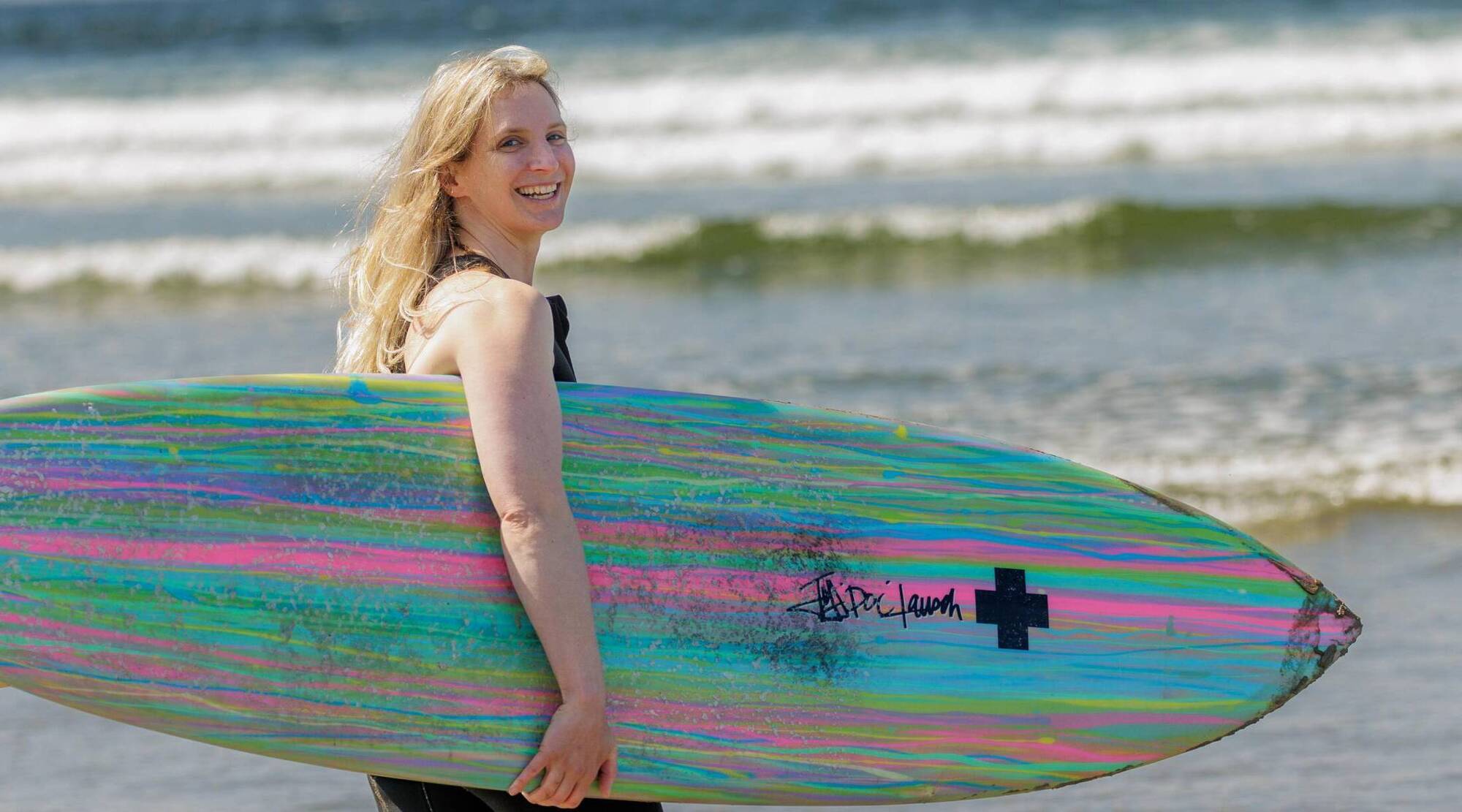
Easkey Britton’s life revolves around the sea, from relaxation to work. Her research into blue health builds a strong case for spending more time in and near the ocean. We’re an island nation, so taking to the water couldn’t be easier
Blue health: How time by the sea can improve your health

Easkey Britton Credit James Connolly

Dr Easkey Britton is named after one of her dad’s favourite wave breaks at Easky on the Sligo coast — her name also sounds like iasc, the Irish word for fish. The champion big-wave surfer and now blue-health scientist has spent her life embodying her name, with life and work centred around the sea. Specifically, the cold Irish Sea of the north-west.

She was born into a surfing family. In the mid-1960s her grandmother, a hotelier in Rossnowlagh, Co Donegal, bought two surfboards back from Malibu (“enormous 10-foot boards”) ostensibly for hotel guests, who had no idea what to do with them. Her dad, Barry, who was 12 at the time, and his four brothers used the boards to float on the water. “They hadn’t a clue what to do; they’d never seen surfing,” she says. No wetsuits, no board wax, no YouTube. They spent the first year lying flat on the boards, until they saw a foreign visitor standing up, and realised there was a whole other level to it.


“My younger sister and I grew up on Rossnowlagh beach, which is one of the best places to learn to surf, because it’s not too dangerous. My mum surfed too — the whole family did,” Britton says. “It felt very normal, even though I was the only kid in my school who surfed.”

Easkey Britton: My younger sister and I grew up on Rossnowlagh beach, which is one of the best places to learn to surf, because it’s not too dangerous. Picture: Manu Lopez

Her grandparents founded one of the first surf clubs in the country. “But in the winter there’d be nobody there — just me, and my mother flashing the car headlights trying to get me to come in.”

As a competitive surfer from the age of 12, she won five national titles, and surfed professionally around the world (“before there was pay parity in prize money — if you won a competition you’d be lucky to cover your airfare”). She says that while surfing Pacific big waves is “humbling”, she loves Irish big waves the most, even with the “ice cream headaches” induced by winter seas.

“The Irish coastline is not like any other I’ve been to,” she says. “It makes me feel more alive. Same with swimming, that shock of cold.”

These days, Britton is a marine social scientist, author, and filmmaker. She lives and works around Donegal Bay, is the parent of twin toddlers, and has “a lovely intergenerational connection with the sea.” She surfs regularly, as does her dad, now in his 70s.

She speaks of the “fear and intimacy” of being on the water, and how she uses mindfulness and breathwork to regulate her nervous system when surfing: “When you’re on a wave, you’re nowhere else. It’s an incredible state of presence.”

Good-in-a-crisis energy

On dry land, she exudes the calm centredness of someone with a very well-regulated autonomic nervous system — smiley, unflappable, good-in-a-crisis energy.

She says her love of surfing was “a vehicle to better understand this whole other world” — the ocean, and how its health and our health are intrinsically linked. Her first degree, aged 21, was in environmental studies at Ulster University — “five minutes from the sea, so I could still surf”.

Now 40, she’s an adjunct professor at the marine science institute at the University of Galway and the author of three books and a ton of research about the sea.

She’s also a blue health adviser to the Liquid Therapy, and is currently working on a research project with the youth-support charity “to capture and evidence the wellbeing benefits of surf therapy”.

She talks about blue attunement — how surfing connects people to the water, which has all kinds of physical and mental health benefits for humans; and how in turn the health of the sea equally needs human connection. We are far more likely to pollute water than land.

 Easkey Britton:When you’re on a wave, you’re nowhere else. It’s an incredible state of presence. Picture: Manu Lopez
Easkey Britton:When you’re on a wave, you’re nowhere else. It’s an incredible state of presence. Picture: Manu Lopez

“Restoring our relationship with the water has become known as blue health,” she says. “This is what I have been experiencing my whole life — the effect water has on us, especially mood and mental health.”

Through her research she found that interacting with water —“swimming, surfing, or simply paying attention to water” — brings measurable benefits for “mental health, stress reduction, overall resilience.”

And most importantly, “feeling connection that is so often missing in our modern lives.”

Anyone who has swum in cold water knows how good they feel afterwards. “We are multi-sensory beings, and so much of modern wellness is visually dominated through technology — we absorb images at surface level,” she says. “But water takes us back into a full sensory experience that’s often missing in day-to-day life.

“The sound of the waves and flow, the touch of the temperature — we have so many more cold water receptors on our skin than warm water receptors, so we feel instantly awake and alive. And the pressure, especially in salt water, the buoyancy, the sensation of being held, the smells of water — for time-poor caregivers, going for a cold water dip doesn’t take very long to get the benefit of a total reset.”

That feeling of euphoria after a cold water swim is down to a 250% increase in dopamine release — no wonder it’s so addictive. “It’s restorative as well as relaxing, because it builds the adaptive capacity in the body,” she says.

Easkey Britton says even just paying attention to water around you can bring measurable benefits for mental health and stress reduction. Picture: James Connolly

“Getting into cold water is really uncomfortable, but the power of being with that discomfort builds up resilience even at a cellular level, so when we meet other stressors back on shore, we’re far less reactive, less triggered. It has a lasting impact on how we cope.”

It literally and figuratively chills you out.

For those of us who don’t live near the sea, she says any body of water will do, and you don’t even need to get wet. She points us to , a 2014 book by her late mentor, the marine biologist Wallace J Nichols, who wrote about the science of “how being near, in, on, or under water can make you happier, healthier, more connected, and better at what you do”.

Dr Wallace, she says, “explores the science of the how and why water makes us feel the way it does psychologically — the calming and restorative properties of water in all its forms.”

These beneficial properties are not just from being near seas and rivers, but are found even in the aerosols of spray released by breaking water –research into waterfalls and sea spray aerosols shows how they have anti-inflammatory properties. Observing surfers with cystic fibrosis showed how inhaling sea spray has a therapeutic effect on the lungs. Britton mentions surfer and swimmer Alice Ward’s award-winning short film Salt, about her experiences of tapping into the healing power of the sea to manage her cystic fibrosis.

Draining effect

We’re often in environments that emit lots of positive ions, which can have a draining effect on us, like when we're on our screens too long, says Britton. “The antidote would be to spend time in negative-ion environments [like water]. The research is overwhelmingly positive, especially on the psychological benefits.”

“You don’t even have to get into the water to benefit from it — you just have to notice it,” she says. “Any body of water has an immediate calming effect on us. Also, access to water can be exclusionary — getting to the coast, access to water sports, the growing problem of clean and healthy water bodies.”

She says that what she most notices when working with young people via the charity Liquid Therapy is “the confidence and shared experience with their peers, and with the ocean — this sense of belonging, of being part of something bigger than ourselves, which is often the root cause of us not feeling well, of having poor mental health.”

At the heart of her work, she says, is “an invitation to rethink our relationship with water and how we go about doing that.” She challenges the idea “that water is external, a place we go to — yet we are water bodies.” (The human body is around 60% water).

Water “can be both teacher and healer”, she says. “When we are in the ocean, those boundaries between ourselves and the environment, that sense of separation, just naturally softens, even dissolves for a moment,” she says. “This can be incredibly powerful for how we understand ourselves. How you make that shift from your head back into your body — water is such a great medium for that. So many of us made this discovery during covid when we swam in cold water.”

For those of us who haven’t got access to water, or don’t fancy the idea of swimming in cold Irish seas, guided visualisations also work. When her grandmother was too ill to visit her favourite place by the sea, Britton was able to take her there using memory, visualisation and imagination. This is how powerful water memory is, she says.

However, a final word of caution. Before you rip off your clothes and dive into the Atlantic, remember, says Britton, the risks as well as the benefits of cold immersion. She reminds us of “the importance of slowly building up exposure to cold, not overdoing it, avoiding cold water shock by focusing on our breath.”

When we get into cold water, even slowly, we tend to gasp – which signals panic to the body. “Breathing slower with longer exhales as we enter, to counter the initial shock and remain calm, can help,” she says.

And – obviously – never get in the water alone. Ever, ever, ever.

x

More in this section

Lifestyle

Newsletter

Eat better, live well and stay inspired with the Irish Examiner’s food, health, entertainment, travel and lifestyle coverage. Delivered to your inbox every Friday morning.

Cookie Policy Privacy Policy Brand Safety FAQ Help Contact Us Terms and Conditions

© Examiner Echo Group Limited