John Whelan: New EU data centre ratings threatens Ireland's industry
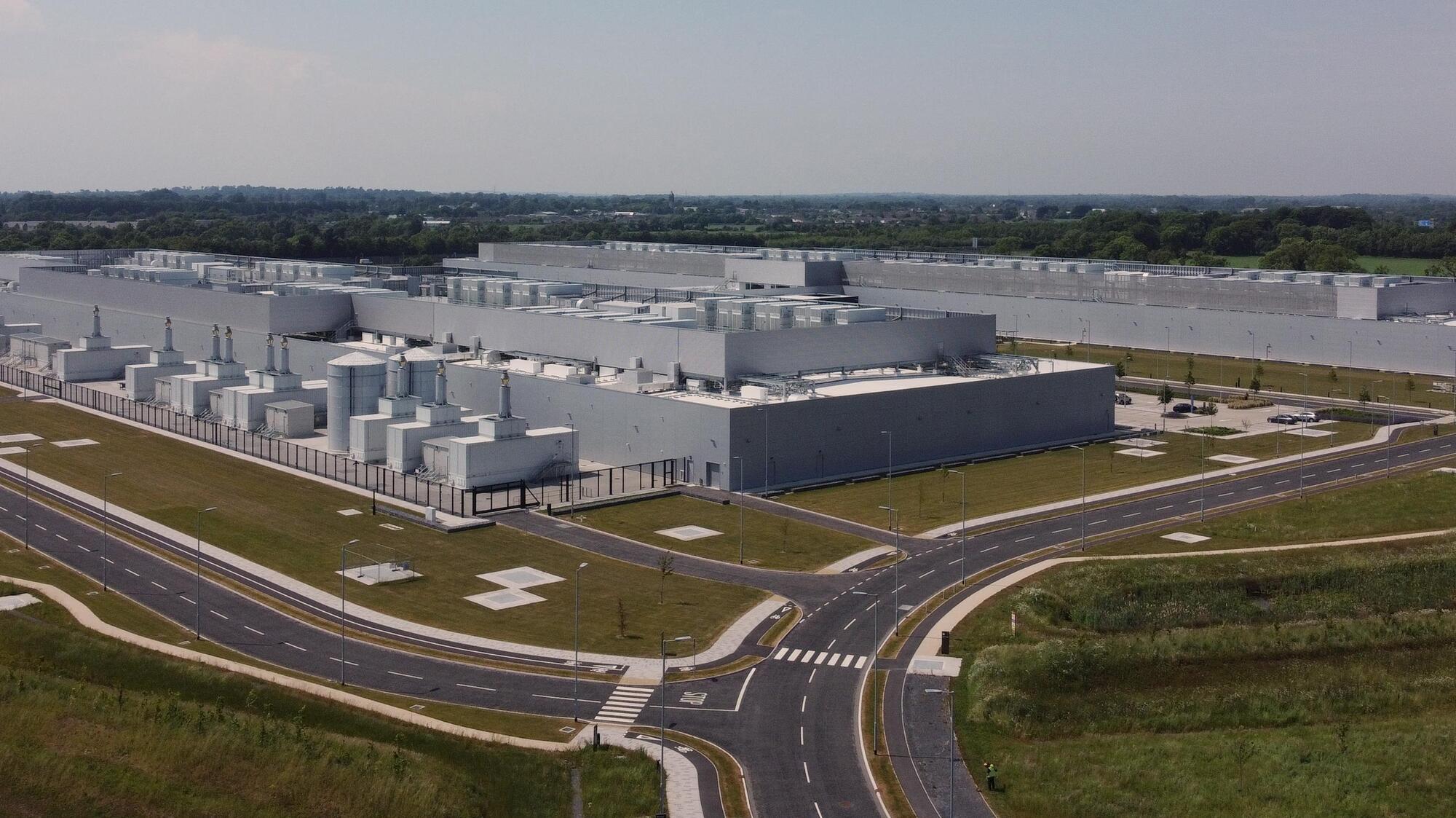
General views of Meta's Data centre in Clonee Co Meath: A data centre built in a cold climate such as Ireland requires significantly less cooling energy than one built in a hot climate such as Spain. File picture: Niall Carson/PA

Walform Ltd, a third-generation steel fabrication specialist in Gorey, Wexford, has been involved as subcontractors in the building of data centres, as well as other mainstream engineering work.
And they have also commenced the use of AI copilots to improve the competitiveness of their business.
Thomas Waldron, managing director of the company, says the quotation process alone in bidding for various new contracts, which was taking three to five hours, has now been reduced to 15 minutes using AI copilot.
Mr Waldron says the AI data processing based on prior years projects, enables the firm to more efficiently and effectively handle more quotations and grow their business.
Read More
Specialised Irish construction such as John Paul Construction, Sisk, Kirby Engineering, and subcontractors such as Walform, have enabled Ireland to become a European data centre pioneer, expanding their operations across Europe.
The sector supports nearly 19,500 jobs directly tied to construction, engineering, and upstream supply chains, contributing €280m in employment-related taxes.
However, the EU’s plan to introduce a data centre rating system may create difficulties for further expansion.
The European Commission’s plans for a common rating scheme for data centres, is expected to rate energy and water consumption, waste heat recovery, clean energy generation, and their contribution to grid flexibility.
The commission said the framework is intended to provide greater transparency over operators’ use of resources and help foster a market for more sustainable digital infrastructure.
Paradoxically, the proposal comes as the EU seeks to triple its data centre capacity over the next five to seven years.
While increased computing power is viewed as essential to strengthening Europe’s technological independence and supporting the deployment of AI and other digital technologies, beyond the hype of larger-than-life investment pledges, environmental campaigners and local communities hosting data centres are asking serious questions, not alone across the US, but increasingly across Europe.
The narrative that they consume huge amounts of power, along with water to stop servers overheating, but create relatively few direct jobs once constructed, is now commonplace.
The rating scheme will undoubtedly create significant operational, regulatory, and commercial friction for firms building data centres.
While the European Commission intends the system to increase transparency and support its goal of tripling the bloc’s computing capacity, industry bodies and engineering groups argue that the framework ignores operational realities and could hurt Europe’s competitiveness in the AI race.
Industry groups have stated that the commission’s A-to-G rating scale based on power usage effectiveness and water usage effectiveness creates a massive structural disadvantage for data centre builders depending on geography.
A data centre built in a hot climate as in Spain, requires significantly more cooling energy than one built in a cold climate such as Ireland.
Because the rating does not adjust its baseline for local weather, water, or power conditions, otherwise highly efficient facilities risk receiving poor, unrepresentative letter grades.
Then there is the risk that corporate cloud clients with strict ESG (Environmental, Social, and Governance) targets will refuse to lease space in a building with a “C” or “D” rating, even if that rating is purely a byproduct of local geography or the intensive workloads required by AI computing.
Under the framework’s strict rules, operators must also meet precise 15-minute temporal matching and strict geographic boundaries for green energy sourcing.
For developers in countries with highly congested power grids, such as Ireland, which requires new data centres to cover 80% of their power via new renewable sources, matching this strict tracking criteria on a granular 15-minute basis adds significant technological complexity and cost to power procurement.
The rating system also looks beyond internal efficiency to evaluate how a facility integrates into the local community.
Firms must report on waste heat recovery readiness and grid balancing flexibility.
Building data centres to export waste heat requires expensive heat exchangers and proximity to local district heating networks — infrastructure that often does not exist, leaving the builder penalised for local municipal planning shortcomings.
The biggest problem for firms planning multi-year builds is regulatory uncertainty. The EU has explicitly stated that this 2027 rating label is a precursor to mandatory binding minimum performance standards.
The European Commission launched a public consultation on these binding thresholds, with legislative proposals expected in the second quarter of next year.
Firms building facilities right now are effectively designing in the dark, unsure if their current efficiency blueprints will even be legal to operate by the turn of the decade.