Letters to the Editor: Ireland's subjugation should inform us about reality of Palestine
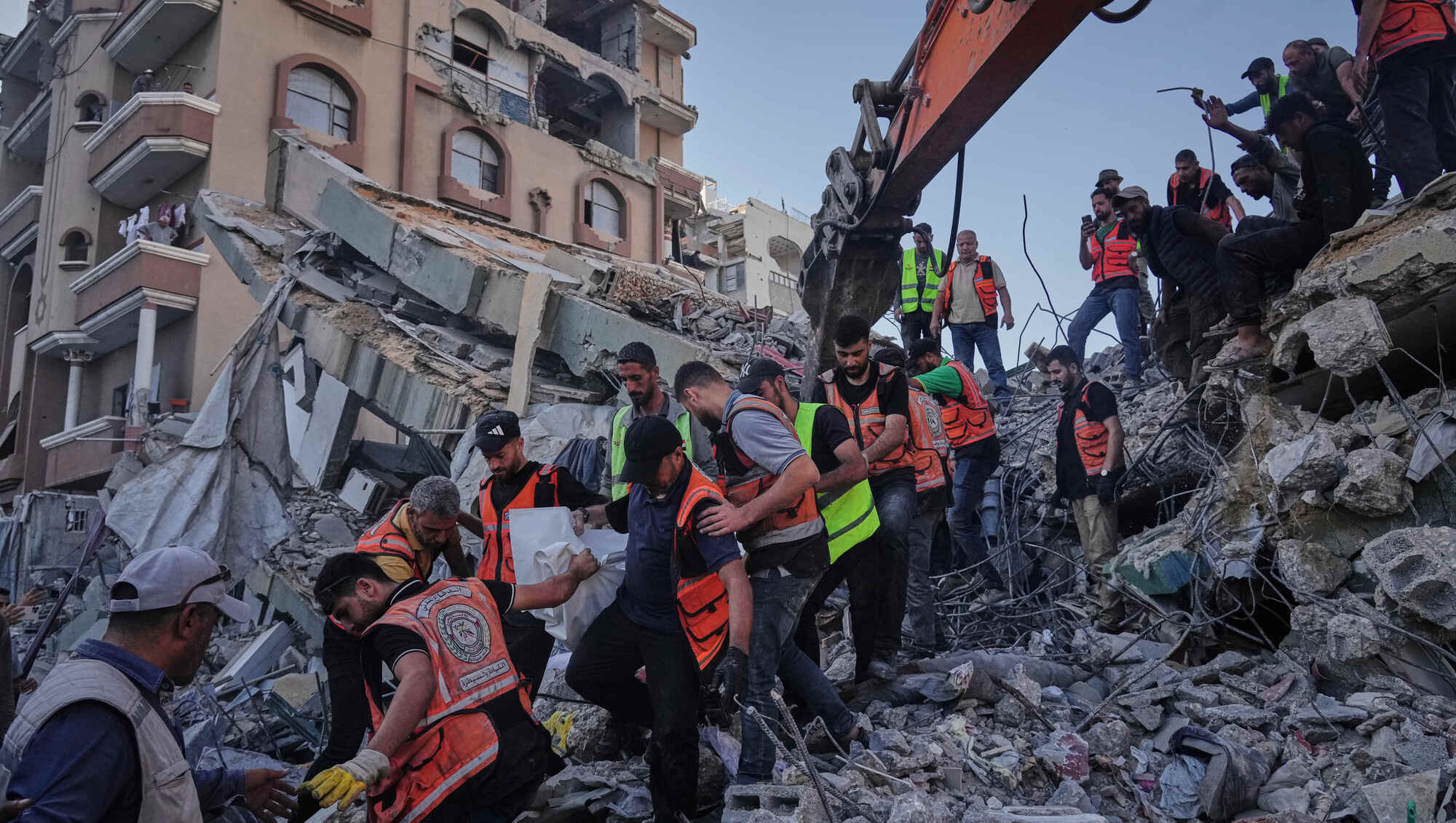
Palestinian civil defence crews carrying a body from the rubble of a collapsed building in Gaza last Wednesday. It had housed displaced Palestinians but was damaged by recent Israeli missile attacks. Picture: Jehad Alshrafi/AP
There is something rotten in the state of Ireland’s democracy. The Government’s handling of the Occupied Territories Bill, between 2020 and 2026, has had critical consequences. Analysis of how and why this happened is essential. It may also cast light, on other shortcomings in political delivery.
Senator Frances Black’s grouping aimed to end the relapsing, killings, in uneven wars between Israel Defence Forces and Palestinian militants. Her bill innovatively focused on illegal actions by Israelis in Palestine, not on blameless citizens in Israel. Its power came from penalising, not only goods like fruit, but also gainful services.
By 2019 the bill had gained parliamentary support in both houses. In the 2020 general election a large majority voted for candidates, committed to the bill in their manifestos. However in the Dáil, government delay was protracted. Justifications varied, prominent was concern, about whether Ireland’s EU membership, precluded the bill from becoming law. Circular debate persisted and the bill remained unenacted at the next election, despite heinous massacres in Gaza and Southern Israel.
Before the election, Simon Harris promised that Fine Gael, long an opponent of the bill, would now support it, to “produce near unanimity in the Dail”. The bill’s electoral mandate did increase, to over 80% of elected deputies. Nonetheless, the Government would go on to drop the bill. In July 2026, under parliamentary whip, a renamed and inadequate substitute was passed. Ireland’s democratic trust was broken.
Any country, whose economy is dependent on foreign investment, risks erosion of its sovereignty. Capital comes with a price. Jobs and economic growth are welcome. However, unless monitored and governed, real power can be diverted from democratic control. The requests of investing corporations can override a country’s values and societal priorities. Whether such factors were at play in the failure to enact the bill, deserves formal scrutiny. As it happened, independent scrutiny had already begun.
In December 2023 at the International Court of Justice (ICJ), a case was brought regarding Israel’s conduct of war in Gaza, associated with mass killings and humanitarian crisis. The ICJ advised it had no jurisdiction over Hamas or other groups, not state parties to the Geneva Convention or UN statute.
On July 19, 2024, the court handed down its initial advisory opinions. Its directives, issued to all UN member states, advocated cessation of trade and munition supplies to Israel, supportive of war on Palestine.
In its category, Ireland’s Occupied Territories Bill seemed appropriate and compliant. The Dáil had just started its summer recess, with two months remaining. It was not recalled. The formal government response came on October 22. It read as supportive of the ICJ advice and emphasised the situation’s urgency. Days later the, November 2024 election was called.
The new Dáil convened on December 18.
For months, Gaza was given no priority. Parliamentary space centred on the coalition’s negotiations with independent deputies, seeking their support for the new government.
In January 2025, Gaza suffered a particularly harsh winter. Bombardment continued to rain down on the meagre tents. Incipient famine, combined with diseases, added to the 60.000 violent deaths.
At government level, the innocents of Palestine and the massive Irish majority who advocated for them, appeared not to count.
Late in 2025, the likely cause for the bill’s saga of delay, began to emerge. Taoiseach Micheál Martin cautioned that the bill could cause loss of jobs in Ireland, “more than anybody else in terms of potential impacts, on US multinationals based here”. Justice minister Jim O’Callaghan, once the strong Fianna Fáil seconder of the bill’s introduction in the Dáil, advised “that the Occupied Territories Bill is complicated ... we must take into account Ireland’s interest, when considering the legislation”.
From January 2026, the Taoiseach repeated that the bill was ”unimplementable”.
He also “stopped short of closing the door” on an invitation to join Donald Trump’s Board of Peace, to make plans for conquered Gaza.
This phase coincided with forceful US representations. A US Department of State spokesman criticised the bill, saying “it could adversely affect American businesses operating in Ireland”. A published letter to the Taoiseach, from 23 members of congress, warned “Ireland would risk causing significant damage to its own economic credibility and partnerships”.
Even after the Government’s withdrawal of the bill, the US Embassy advised it of the “real unintended consequences” from pushing initiatives, like the bill at European level. In the US communications, no reservations were evident about issuing strictures to an independent nation.
Ireland was never subject to the Roman Empire. The fifth century Gaels and their tribal groupings shared a common language and Brehon Law. Their newly adopted Christianity provided an international framework. Gaelic culture served as a beacon of artistry, culture, and science for Europe in its Dark Ages.
The following centuries of invasion, subjugation, and displacement, embedded a strongly independent, practical altruism.
Unregulated venture capital can impinge, not just on foreign policy, but on housing, health, and more. New thinking on its governance is overdue.
Recently I read a 78-page jam-packed book published in recent years by local historian, Barry Sullivan, on Sean T O’Sullivan aka Jack Shandon: Family History and Guerrilla Years in Beara. He was a member of the Irish Volunteers before 1916 and a local battalion engineer in the War of Independence.
I learned of the strong existence of the Irish Volunteers in the Beara peninsula before 1916 and in the War of Independence and of the IRA or as they are sometimes named the Old IRA too.
The story of Albert and Rose Thomas appointed as caretakers of Dunboy Castle in 1921 is also told. The book reprints Albert’s detailed and warm-hearted essay on their experience. He was new to the peninsula and loved it. He got on well with both sides as they called on him or told him to put his hands up as they went through the castle grounds. He and his wife had to leave when advised by the authorities they feared the burning of the castle was imminent. The beautifully furnished castle was set on fire in May 1921 by the IRA as they in turn feared it could be taken over by the British army as a security base, making movement of the IRA and Volunteers in the area more difficult.
Sean T O’Sullivan did not know the castle was to be burned as he was away at the time. He would not have agreed to it.
In 1966 he led a parade through Castletownbere on the 50th anniversary of the 1916 Rising. The book is a gem on the Beara peninsula in the War of Independence.
The cost of Metrolink in Dublin is already reaching dizzying heights before a sod is even turned.
While it goes out to tender, the escalating costs to taxpayers, no matter the assurances from the transport minister, given the daily escalating costs for construction and materials, could double.
While the estimated cost is now at €15bn, it could, when finished, cost €17.5bn.
This is not the first time government has assured us that costs will be tightly managed. Remember the original estimate for the Childrens Hospital of €700m, now at €2.2bn.
The original price tag for Metrolink in 2000 was €2bn, and the same again in 2015.
In 2022, after the government applied for planning permission, the cost of the project jumped to €9.5bn.
A large sum of money has already been spent on engineers reports.
Yet here we are in Donegal unable to get, or obtain, a train link to any another part of the country all because the original rail systems were ripped up in the 1950s and ’60s, even along the Western corridor.
Monorail trains would be a better alternative to the modern ground based rail system. It relies on thin support pillars, requiring a much smaller carbon footprint.
Monorails draw electricity directly from the track structure. No overhead wires, and a safer system of travel with much lower costs.
While the TII supports the Metrolink they, and the Government, need to look at other areas of the country and provide them with the same level of investment and support.
While former taoiseach Leo Varadkar believes “that urban areas pay the bills while rural Ireland and the agriculture sector receive more in subsidies and benefits”, we certainly have not seen the benefits in the North-West.
Every major infrastructural project has been based around Dublin and its satellite counties, and we in the North-West have seen little or no investment in any similar major infrastructure.
This two-tier system of investment, in what should be available to all, is typical of Dublin 4. Nothing “beyond the Pale” it seems.