Government urged to deliver cost-of-disability payment in budget
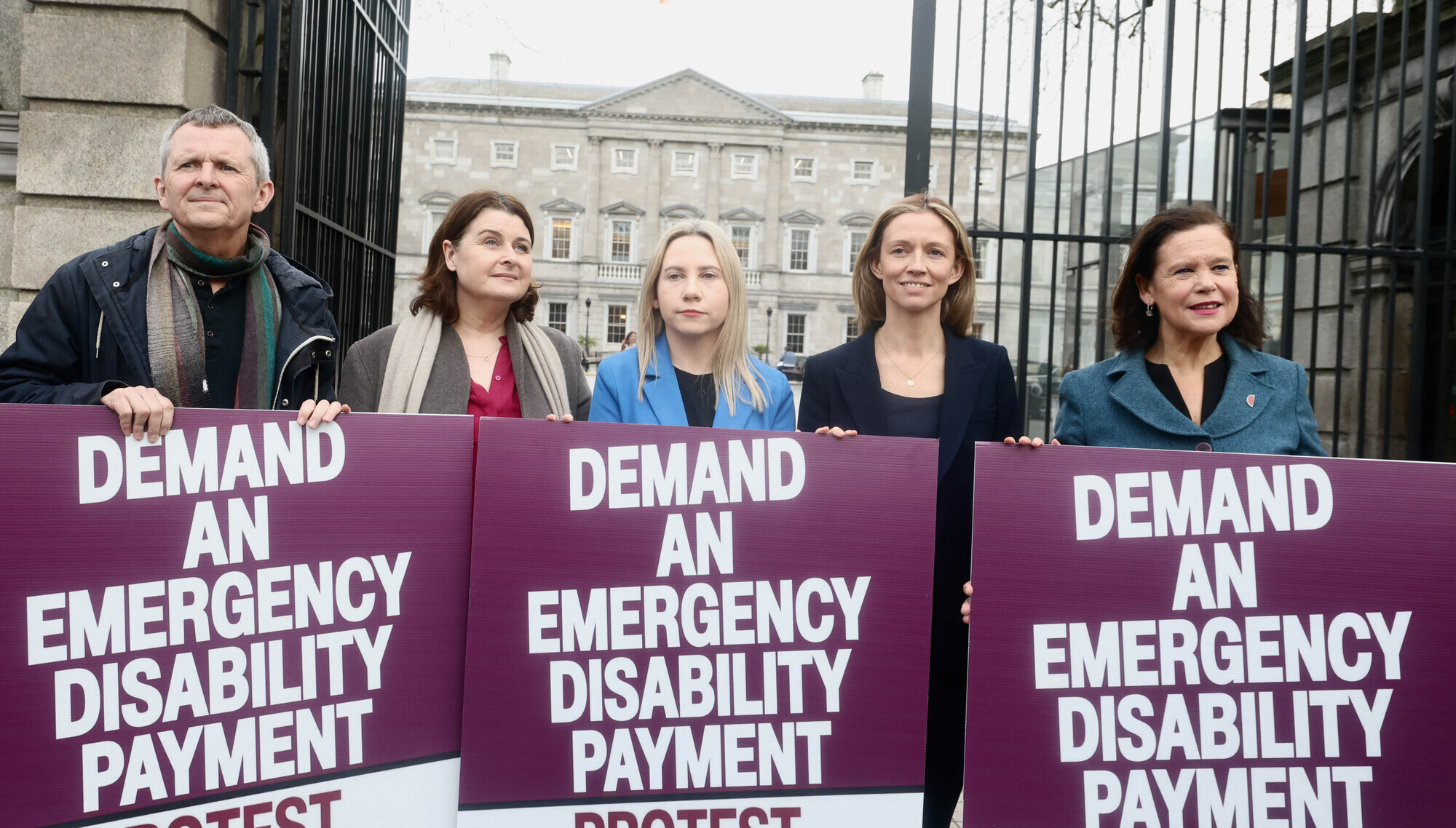
Green Party leader Roderic O’Gorman, People Before Profit–Solidarity leader Richard Boyd Barrett, Social Democrats TD Jennifer Whitmore, Labour Senator Laura Harmon, Social Democrats leader Holly Cairns, and Sinn Féin leader Mary Lou McDonald in February backing a national protest calling for an emergency payment for disabled people and carers. Picture: Leah Farrell
The Disability Federation of Ireland (DFI) has urged the Government to deliver a cost-of-disability payment, warning it must become a reality rather than remain a political promise.
The organisation said uncertainty was growing over the long-promised measure ahead of next month's budget.
DFI and other members of the Affordable Ireland campaign marched in Dublin on Saturday to highlight the issue, along with a range of other cost-of-living concerns.
A coalition of trade unions urged the public to support the march.
DFI on Friday highlighted the growing uncertainty around a Government pledge to bring in a cost-of-disability payment.
The current weekly disability allowance comes to €254 a week. DFI has estimated the extra costs of living with disabilities can amount to between €488 and €555 a week.
It said: “A commitment only becomes real when it's delivered.”
DFI director of advocacy Emer Begley said on Friday: “There is still uncertainty as to whether this payment will be at an adequate level and as to when it will be introduced.”
Read More
Referring to comments by Cabinet ministers, she said: “There is language like ‘economic responsibility’ being used. It’s implied that if the cost-of-disability payment is introduced, it will be modest.”
DFI is calling for certainty ahead of the winter months, she added.
“We want to see a permanent recurring payment, one that is based on people’s need and that is targeted to people who need it the most,” said Ms Begley.
DFI said people with disabilities were disproportionately affected by rising energy costs.
Many face higher-than-average electricity and heating bills because they rely on equipment such as electric wheelchairs and adapted beds, while some also need to keep their homes heated for longer periods.
“Some people are in arrears since last winter,” warned Ms Begley.
DFI data shows a steady increase in the number of people in energy arrears between 2023 and 2024.
Ms Begley said she feared the figure could be even higher this year.
She said the group had met public expenditure minister Jack Chambers and finance minister Simon Harris, describing the meetings as a welcome opportunity to raise the concerns of people with disabilities.
The recently reported that while the payment is on track to be introduced in Budget 2027, it is likely to be phased in on a gradual basis.
The payment is understood to be a priority for Taoiseach Micheál Martin and social protection minister Dara Calleary, with work ongoing across several Government departments.
Speaking to RTÉ this week, Mr Martin said the Government is “pushing very strongly” to include it in the budget, but did not share any figures or give a timeline.

CONNECT WITH US TODAY



Be the first to know the latest news and updates