Gaza student misses start of UCC course amid visa appeal delays
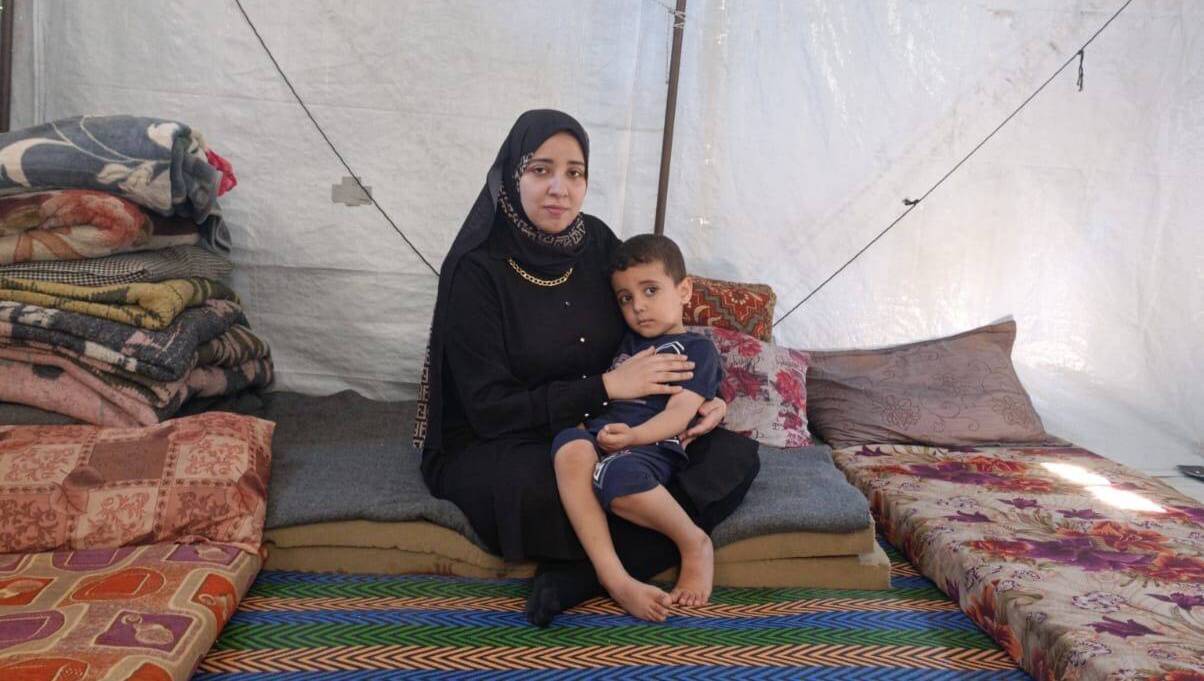
Zainab Eid and her four-year-old son Karim in the tent with is their home in Gaza.
A Gazan student who had been due to start in University College Cork last week has described as “deeply upsetting” a statement from the Department of Justice that it will not prioritise visa appeals by Palestinian students granted scholarships in Ireland.
The department’s refusal came despite an 11-month appeal process and dozens of fully funded scholarship students now being late to begin their courses in third-level institutions across Ireland.
Zainab Eid, a 30-year-old physiotherapist who previously worked for Médecins Sans Frontieres, currently lives in a tent in the ruins of Gaza with her husband Mohammed and their four-year-old son Karim.
Ms Eid had been granted a fully funded scholarship to study for a master’s degree in public health at UCC under the Irish Government-backed Ireland-Palestine Scholarship Programme (IPSP) and was due to begin her course on September 7.
Read More
She is one of 58 Gazan students granted fully funded scholarships to study in third-level institutions in Ireland but refused visas to travel.
Several of the students, including Ms Eid, whose scholarship is backed by the Irish Government, have appealed the refusal of their visas.
That appeal process takes an average of 11 months to complete, and with the autumn semester already under way, the students are already late for their courses.
The Department of Justice told the that “while the concerns expressed by the students involved are understood, visa appeals are processed in a manner that is fair to all applicants”.
A spokesperson said appeals were being progressed “as quickly as possible” and decisions would be issued as soon as full consideration had been given to each case.
“Visa appeals are dealt with in chronological order to ensure fairness to all applicants.
“(They) cannot generally be prioritised ahead of others that are awaiting consideration.”
Last month, in common with other Gazan students, Ms Eid was told by the Irish embassy in Israel that her application for a visa had been refused.
Among the reasons listed by the embassy for refusing Ms Eid’s application was a finding that documentation of her employment and educational history was insufficient.
Her lawyer, Douglas-based solicitor Susan Doyle, noted that much of Gaza has been reduced to rubble, meaning it is often impossible to access documentation.
Ms Eid said her mental health had been badly affected by the visa refusal and the appeal delay.
“Since the refusal, I haven’t had a single proper night of sleep. I have cried almost every night, and my eyes are swollen from how much I’ve been crying and staying awake,” she said.
“I worked and waited for this opportunity for so long. I studied, applied, and went through so much just to finally receive this scholarship. And then, when it finally happened, the door was suddenly closed because of the visa refusal.
“I’m trying to stay strong and keep fighting, but honestly, this has taken a huge emotional toll on me.”
The next expected evacuations of scholarship students from Gaza will be on September 28 and October 5.
“If we miss these dates, we may lose our scholarships and university places, especially as the evacuation process takes time,” Ms Eid said.
“After that, the Jewish holidays begin, and the student evacuations are expected to end.”

CONNECT WITH US TODAY



Be the first to know the latest news and updates