Irish Examiner view: Education is key when it comes to wildfires
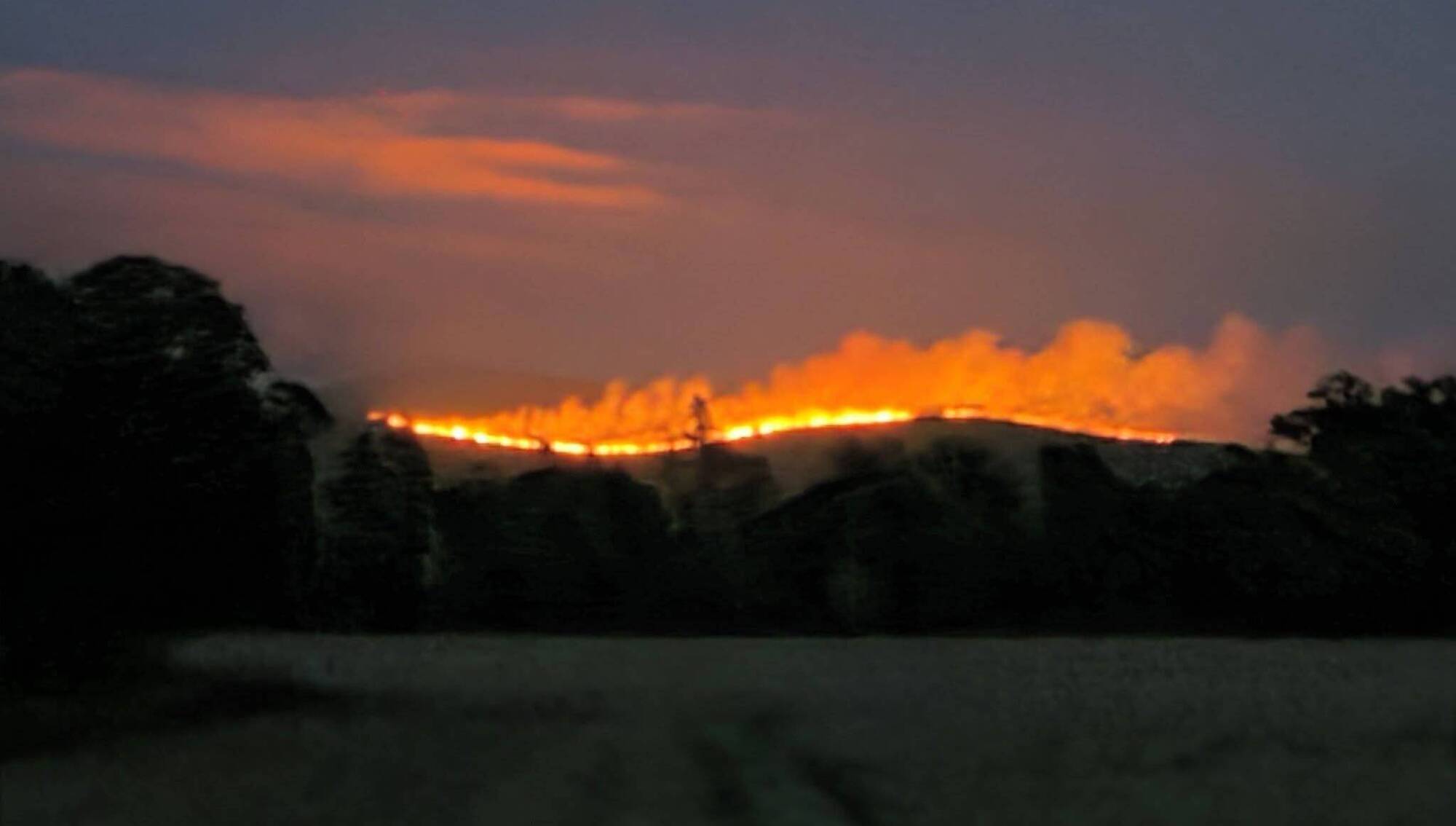
Emergency services remain at the scene of a fire on Slievenamon in County Tipperary this morning as efforts continue to battle what was described as a “very large” blaze. Picture credit: Cllr Michael Brennan Facebook
The wildfire raging across Slievenamon in Tipperary has made its presence felt all across the south of the country, literally.
The blaze was widely blamed for the odour of smoke detected in Cork City this week, which is approximately 112km away — one could hardly have a starker illustration of the ferocity of the fire.
Slievenamon is not the only place to burn during the current heatwave.
Roads in Killarney National Park had to be closed earlier this week as a fire raged through 20 hectares of the park.
Earlier this month, in Crosshaven, Cork, a wildfire described by the emergency services as an “absolute monster” came within feet of homes in the area before being brought under control.
These are hugely challenging events — firefighters, air corps crews, and local volunteers are working in Tipperary to bring the Slievenamon blaze under control, and it is hugely disappointing to learn that some of these fires could have been prevented.
The fire in Killarney, for instance, is suspected to have been started by a disposable barbecue.
Read More
It was unsurprising, then, to hear minister of state for nature, heritage and biodiversity Christopher O’Sullivan propose legislation which would empower park rangers to issue on-the-spot fines of up to €1,000 for reckless behaviour such as using a disposable barbecue.
Such announcements lead to an inevitable question: Who will enforce those regulations?
Stating that park rangers will have powers to issue fines is not the same as resourcing them to do so, and there is little clarity on how these new measures will be put into practice.
When it comes to fire safety and awareness in our national parks and wild areas, there is clearly a need for greater education and awareness.
The fact that people believe they are entitled to use disposable barbecues in the tinderbox conditions generated by the recent heatwave proves that.
However, knee-jerk reactions and measures that cannot be enforced cannot help the situation.
The Government on Friday announced that nine significant infrastructure projects had been designated as being of critical national importance under the Critical Infrastructure Act, which gives them priority status.
Those projects are the MetroLink, the Cork commuter rail programme, the Galway City ring road, the Midlands and Eastern water supply project, the Greater Dublin drainage project, the Limerick wastewater plant upgrade, the North-South interconnector, the Moneypoint capacitor project, and the Letterkenny 110 kV redevelopment project.
It is worth acknowledging the geographical spread of those projects, which should contribute to balanced national development as well as improvements in regional services.
As outlined by public expenditure minister Jack Chambers, such projects will now “effectively go to the top of the queue for faster processing and decision making by public bodies”.
Encouraging though this is, significant caveats should also be noted.
The Metrolink project, for instance, has been delayed not so much by issues with slow processing and decision-making by public bodies as much as legal challenges brought by residents on its proposed route.
Read More
It would be impractical to imagine that the judicial process can be side-stepped, no matter how pressing the need for infrastructural projects such as those mentioned above.
A separate complication may have arisen this week when health minister Jennifer Carroll McNeill appeared to suggest that developers BAM should not tender for the new National Maternity Hospital planned for Elm Park in Dublin.
When she spoke to RTÉ about issues with BAM providing fire certificates at the National Children’s Hospital project, she was asked if the developers would be allowed to tender for the Elm Park project.
“I wouldn’t,” said the minister and then added: “I think, you know, anybody is allowed to tender... ” while nodding, though she did not elaborate any further.
The minister has been highly critical of BAM in the past and comments such as this will hardly be welcomed by the developer.
They underline the well-established impression that while agreeing on major projects is a positive step, seeing those projects through to completion is far more challenging.
A newspaper report on passport mobility has revealed some surprises about international travel — and about the restrictions on such travel.
Using a scoring system which tots up points for the number of destinations the holder of a particular passport can access without a visa, with a visa on arrival, with a fast-track e-visa, and similar requirements, the strengths and weakness of various national passports are evaluated.
For instance, a person with an Afghan passport can only travel visa-free to three other countries and will have to apply for a visa at a consulate before travelling to 113 countries.
In comparison, a UK passport holder can travel to 114 countries without a visa, with another 33 accessible once the traveller takes out a visa on arrival.
Various anomalies can be identified by comparing countries.
Read More
The US, Canada, Australia, and New Zealand have ‘strong’ passports which enable holders to travel widely, but they keep their own borders comparatively tight.
Passport holders from South Sudan, Nigeria, Ethiopia, and the Democratic Republic of the Congo need visas to travel to most other countries, but their governments admit most foreign visitors easily.
Irish passports are in joint third place on the rankings with several other countries, which means ours are among the strongest passports in the world.
Welcome news for anyone planning to jet off on their holidays in the coming weeks.

CONNECT WITH US TODAY



Be the first to know the latest news and updates