Irish Examiner view: EU presidency focus must remain at home
Ireland assumes the presidency at one of the most challenging moments in the EU’s history
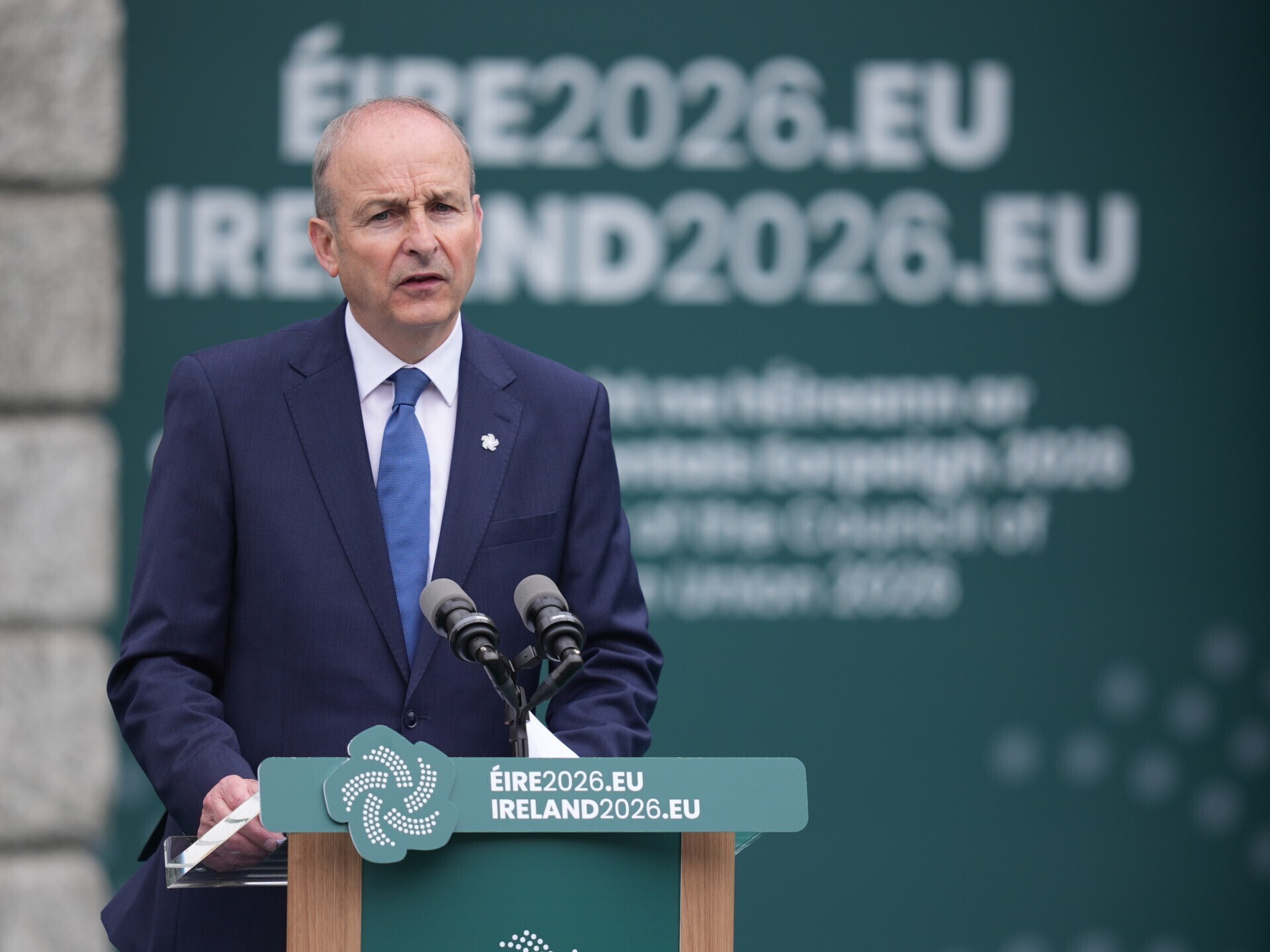
Taoiseach Micheál Martin delivering a speech at Dublin Castle during the opening ceremony of Ireland's EU presidency. Picture: Niall Carson

Taoiseach Micheál Martin delivering a speech at Dublin Castle during the opening ceremony of Ireland's EU presidency. Picture: Niall Carson

A poll showing the public remains firmly committed to the EU is unlikely to make the Government’s daunting task of steering Ireland’s presidency of the Council of the EU any easier over the coming months.

Some 61% of Irish people regard EU membership as a good thing, while only 16% see it as bad. 

More than two thirds (67%) say they would vote to remain in the bloc if an exit referendum were ever held, compared with just 17% who would follow the Brexit path. 

Those figures reflect a settled public consensus that Ireland’s future lies firmly at the heart of Europe.

Strong public support, however, does not make the job any less demanding. 

Ireland assumes the presidency at one of the most challenging moments in the EU’s history. 

With war continuing on Europe’s eastern border, trade tensions with the US, and growing geopolitical instability, there is an urgent need for the EU to strengthen its security, resilience, and competitiveness while remaining true to the democratic values that underpin the European project.

These are major challenges on which the Government will have to try to build consensus.

Economic competitiveness is set to dominate the presidency. 

The EU is facing slower growth, along with increasing competition from the US and China, but at the same time will have to balance growth with climate commitments and social protections that are not a priority elsewhere.

The most immediate challenge is negotiating the EU’s next long-term budget at a time when members remain divided over how much should be spent and on what priorities. 

Some want greater investment in defence, others see competitiveness and innovation as the priority, and still others want to protect traditional spending on agriculture and regional development.

Maintaining European unity on Ukraine and wider security issues is also likely to test Ireland’s diplomatic skills. 

Ireland supports Ukraine’s EU accession process, and will oversee discussions on enlargement, sanctions against Russia, and continued military and financial assistance, but a number of countries — including France, the Netherlands, and Poland — have less enthusiasm for hurrying the process by which Ukraine joins the EU.

Already, the Government’s role in EU plans to renegotiate its AI and tech rulebook is being called into question with the Irish Council for Civil Liberties saying that, because of our economic dependence and close relationship with big tech, Ireland should recuse itself from negotiations.

While the Government has all of this to manage, as well as a huge body of European legislation and the logistics of ensuring the scores of meetings hosted here at home run smoothly and securely, it cannot afford to lose focus on the day-to-day concerns of the electorate. 

No matter how successful — or otherwise — the presidency turns out to be, it will count for nothing if people cannot afford homes, access health services, get their children into school, or keep up with the cost of living.

Energy bills: Subsidies are not the solution 

This week’s price increases by two major energy suppliers, Electric Ireland and Yuno Energy, will add between €250-€300 a year to the household bills of more than 1m customers. 

They will also deepen the financial strain on thousands of families who were already struggling to pay for basic necessities long before these latest hikes.

Figures published earlier this year by the Commission for the Regulation of Utilities painted a stark picture of the scale of the problem. 

At the end of last winter, almost one in seven households — around 319,000 electricity customers — were in arrears on their bills, an 11% increase on the previous year. 

At the end of last winter, almost one in seven households were in arrears on their bills. File picture

A further 183,000 households owed money on their gas accounts. 

While some will reduce arrears during the warmer, brighter months, many will inevitably fall behind again once winter returns unless the Government acts.

Targeted short-term supports, such as the fuel allowance or emergency assistance for low-income households, are justified. 

No family should be forced to choose between heating their home and putting food on the table. 

But the Government should resist the temptation to rely on broad, expensive subsidies that, though popular, provide the same benefit to those who need help least.

The real priority should be sustained investment in measures that permanently reduce household energy costs. 

Expanding grants for insulation, heat pumps, and solar panels, alongside reforms that improve competition and transparency in energy pricing, will require greater upfront spending. 

Over the medium and long term, however, these investments will reduce energy consumption, shield households from volatile international markets, and advance Ireland’s climate goals.

Trump’s income: Out of touch 

It is small wonder that Donald Trump struggles to understand ordinary Americans’ concerns about rising prices when it has emerged that his own income topped an eye-watering $2bn last year.

The scale of the US president’s wealth is laid bare in almost 1,000 pages of financial disclosures relating to 2025, the first year of his second term. 

They show earnings of $2.2bn last year, almost four times his income in 2024. 

His declared assets stood at $2.4bn — almost certainly an understatement given disclosure rules require only assets worth more than $50m be reported.

President Donald Trump's income topped an eye-watering $2bn last year. Picture: Jacquelyn Martin/AP

Such extraordinary wealth helps explain Trump’s repeated indifference to the financial pressures facing millions of Americans. 

After his tariffs pushed prices up, he suggested families could make do with fewer imported goods, quipping that children needed fewer “dolls and pencils”. 

When challenged about affordability, he dismissed the issue as a “Democratic hoax”.

When journalists asked him about the economic impact of the war with Iran on struggling households, he replied: “I don’t think about Americans’ financial situation.” 

A remark that, perhaps, revealed more than intended.

x

More in this section

Revoiced

Newsletter

Had a busy week? Sign up for some of the best reads from the week gone by. Selected just for you.

Cookie Policy Privacy Policy Brand Safety FAQ Help Contact Us Terms and Conditions

© Examiner Echo Group Limited