Irish Examiner view: Home insurance falls victim to Storm Chandra and climate change 
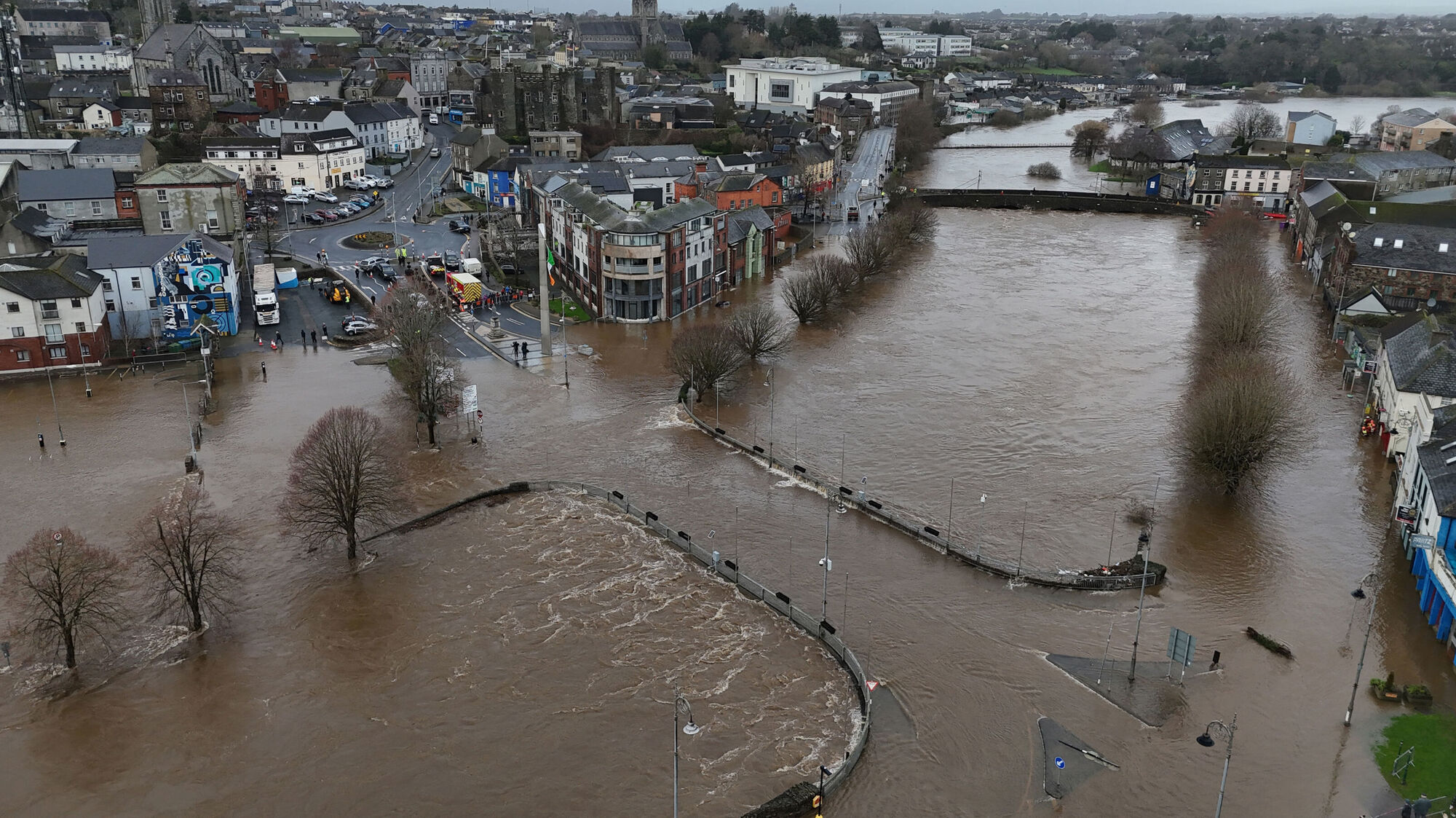
People in Cork still dealing with the fallout from Storm Babet look on with sympathy as residents in the east are battered by Storm Chandra
Irish Examiner view: Home insurance falls victim to Storm Chandra and climate change 

Storm Chandra wreaked havoc in Enniscorthy, Co Wexford, this week as the River Slaney bursts its banks. Hundreds of schools were closed, and tens of thousands of people were left without power during the storm. Picture: Niall Carson/PA

Much of the coverage of Ireland’s rough weather has, rightly, concentrated on the here and now of Storm Chandra, a tempest whose gentle Sanskrit name has belied its severe consequences.

Residents of Wexford, Wicklow, and Dublin, already saturated from Tuesday’s deluge, were preparing for more yesterday, while Louth, Carlow, Kilkenny, and Waterford were added to the rainfall warning.

As discussions rage about early warning systems and the quality of our flood protection measures — a hot topic since Storm Babet some 28 months ago — we must also keep constantly in mind the evil twin of the roiling climate crisis. 

The issue of insurance, and its bearing on a housing market which continues to be the most contentious political issue of the age.

While prevention remains the most desirable and essential of objectives, the reality of attempting to gain insurance for homes which are deemed to be at risk of flooding, and/or subsidence, is something with which owners and potential purchasers will be grappling for the foreseeable future.

With some mitigation measures unlikely to be ever completed, according to transport and climate minister Darragh O’Brien, cover will come at a premium. It is the, as yet unaudited, local cost of global warming. And once the bills start to come in, or transactions are thwarted, it will also become a political issue.

Surge in rainfall 

Met Éireann’s head of climate services said this week that the changing weather patterns we are experiencing has caused our rainfall to increase by 7%. This, in an era where estates have been developed on flood plains and inadequate drainage has ensured that deluges rapidly produce standing surface water.

The other threat to domestic peace of mind is the accelerating risk of subsidence, the downward movement of the ground beneath a building, which can cause a structure’s foundations to sink.

Late last year, the Cork-based consulting engineers BCE observed that not one of Ireland’s five major insurance firms will provide subsidence cover for homes deemed to be in high-risk areas. 

Effect on property

Parts of Cork, Galway, Clare, and Roscommon fall within that category, which means that purchasers may struggle to obtain the insurance that mortgage providers require. At the very least, it’s another potential source of stress in what can be an already taxing — emotionally as well as financially — transaction. At worst it might render an existing property unmortgageable, with a dire impact on its sales value.

For now, nobody is keeping the scores on the doors in Ireland when it comes to the impact of subsidence. The Central Bank collects detailed data for motor, employers’, and public liability insurance, but nothing on home or household claims. 

Insurance Ireland does not publish specific details on the volume, trend, or value of this problem.

This is surely unsatisfactory if we are to get a proper handle on the overall impact of global warming and the true cost of our sluggish progress towards our carbon goals.

Anecdotal evidence and commentary from analysts and construction experts point to more extreme wet and dry weather cycles increasing changes in soil moisture ratios, a significant cause of subsidence issues in clay-rich regions.

With flooding, the costs in the Republic are clearer. 

The Irish Insurance Federation calculated that combined costs and claims from severe winter weather reached over €540m.

It is now common in the industry for brokers to use climate and geospatial data for risk assessments and pricing. These treat such weather events as regular rather than rare, which in turn generates a “computer says no” response to inquiries from potential customers.

It’s less than two decades since mandatory energy efficiency ratings were introduced for homes in Ireland. 

Can we be far away from the day when each dwelling will require its own “weather logbook” to ensure that the property can be insured at competitive rates and, if it cannot, that the reasons for any excess are founded on human logic and judgement, and not the aggregated verdict of an algorithm?

Please, St Brigid, let the sun shine

It may not seem likely, as the weather pays tribute to King Lear and the “cataracts and hurricanoes”, but this weekend is usually one where we can draw breath and think that the worst of winter is behind us.

A traditional St Brigid's Cross woven from reeds. Stock picture

At least that’s what our second-most venerated saint, St Brigid, would have us believe. 

In folklore, she is said to have promised that every second day would be fine from her day onwards. 

Fingers [St Brigid's] crossed 

That’s tomorrow, so let us hope she is right this year. It’s been wet enough of late.

St Brigid, said to have been the founder of the Abbey of Kildare, is the patroness of many things which are important, including poetry, learning, healing, protection, blacksmithing, livestock, and dairy production. 

She is thought to have died in 525AD when winters were much colder, often with prolonged spells of snow.

She is a spiritual leader whose fame has spread across the world, and whose name inspired the famous St Bride’s off Fleet St in London. 

One of the striking stamps issued by An Post in 2024 commemorating both St Brigid and the pagan festival of Imbolc — both celebrated on the first day of spring in Ireland, February 1. Picture: An Post

Whether it was her reputed skill as a brewer and her ability to change water into ale that first commanded the support of the journalists who used it as their local church it is impossible to say, other than it can have done no damage to her attraction to them.

All over Ireland, people will be celebrating St Brigid’s weekend, and hoping her weather forecast proves sound. 

If you are tempted out, just keep an umbrella to hand.

x

Check out the Irish Examiner's WEATHER CENTRE for regularly updated short and long range forecasts wherever you are.

More in this section

Revoiced

Newsletter

Sign up to the best reads of the week from irishexaminer.com selected just for you.

Cookie Policy Privacy Policy Brand Safety FAQ Help Contact Us Terms and Conditions

© Examiner Echo Group Limited