Irish Examiner view: Dublin landmarks back in the news
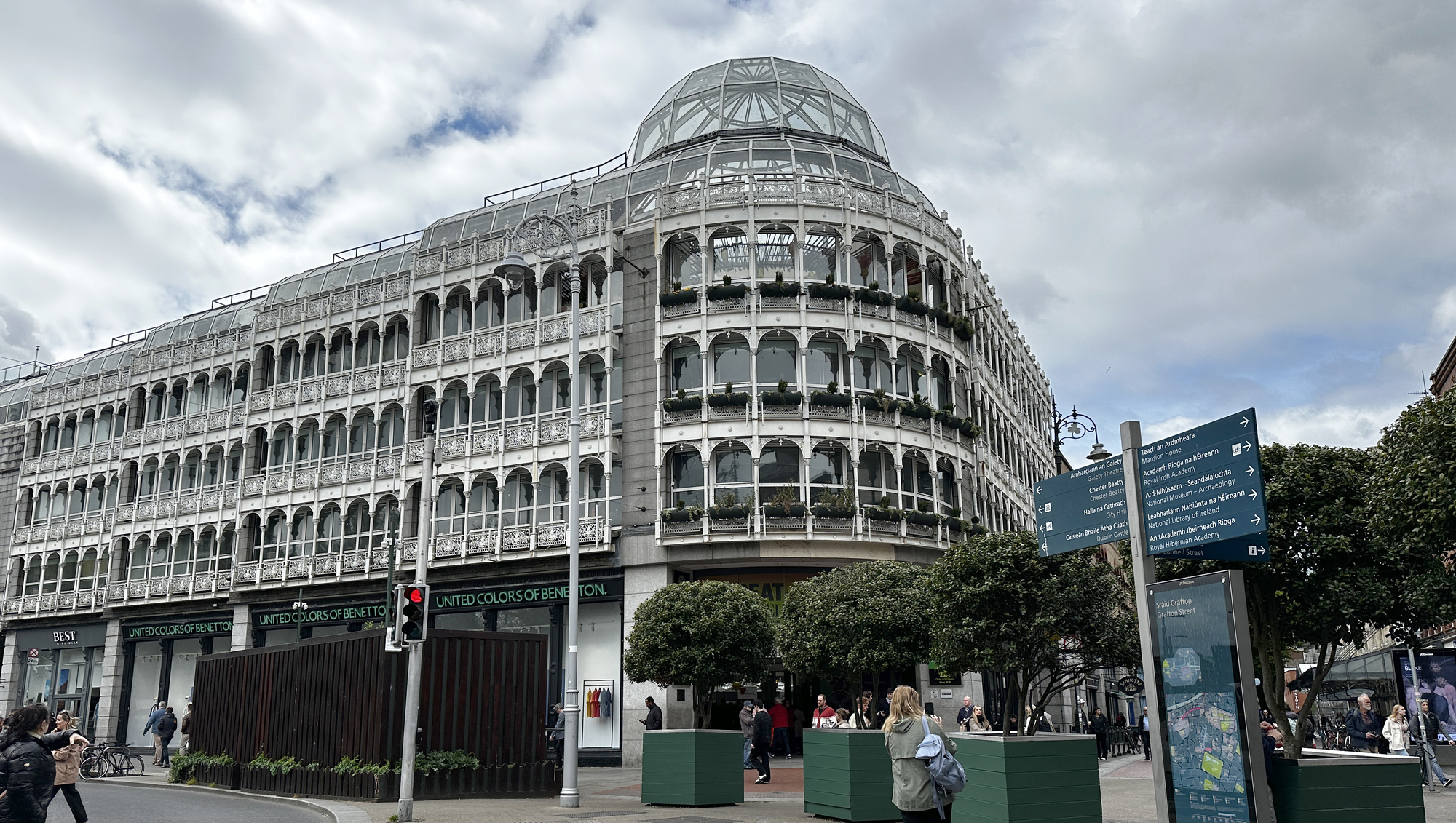
The St Stephen’s Green Shopping Centre, which occupies a prime location at the junction between Grafton St and the Green in Dublin city centre, is set for a major rebuild. Picture: Eamonn Farrell/RollingNews
Two public buildings in Dublin, born in controversy, are back in the news, and again surrounded by controversy. Dublin City Council’s headquarters at Wood Quay was constructed in the 1980s, after a long and bitter battle by those seeking to protect an important historic site. Now the city council proposes to move from Wood Quay and either demolish the much-maligned offices or “repurpose” them for housing.
A little over a kilometre away, the St Stephen’s Green Shopping Centre, which occupies a prime location at the junction between Grafton St and the Green, is set for a major rebuild. The distinctive glass structure was not universally popular when construction began in the mid 1980s.
Many lamented the loss of the Dandelion Market, the cinema, and the elegant — though somewhat shabby — buildings nearby. When it opened, some dismissed it as a garish intrusion on the surrounding Georgian streetscape.
The buildings differ dramatically in style, function, and ownership — the Civic Offices were publicly funded, the shopping centre remains a commercial endeavour — but share one striking trait: Their remarkably short lifespan. Both are less than 40 years old.
The first Wood Quay blocks opened in 1986, and the shopping centre followed in 1988. Yet both are no longer considered fit for purpose already. The cost of moving the Civic Offices could reach hundreds of millions of euro, but retrofitting the existing offices to bring them up to current environmental standards would cost €450m-€500m, and still represent poor value according to city council chief executive Richard Shakespeare. While the financial cost of the shopping centre need not concern the taxpayer, there is an environmental cost to both projects.
The building and construction sector is by far the largest emitter of greenhouse gases, accounting for 37% of global emissions, according to a 2023 report by the UN environment programme, which says that the production and use of materials such as cement, steel, and aluminium have a significant carbon footprint.
Neither Dublin City Council nor the owners of the St Stephen’s Green shopping centre will have entered lightly into the costly construction they are now planning, or have been unaware of the environmental impact. Indeed, in the case of the former, the need to bring energy-inefficient public buildings up to current standards is a key driver of the project, along with the need to provide badly-needed housing.
It is necessary to bring our homes and other buildings up to modern, more sustainable standards, and efforts to do this are welcome. However, if sustainability is to be achieved, buildings must be designed not just to meet today’s needs and standards, but to endure. Let us hope that the future-proofing of all new buildings envisages a future longer than 40 years.
A proposal by the Australian government to make tech giants such as Meta, Google, and TikTok pay for online news — from which they profit — looks set to spark an interesting battle.
Prime minister Anthony Albanese is to “encourage” tech companies to make deals with news publishers, TV stations, and newspapers, to pay for the online content that the tech firms currently use for free. News drives traffic on these platforms, boosting the already healthy profits of Mark Zuckerberg and co. Meanwhile, the publishers that directly pay journalists to produce news are fighting ever-dwindling revenues. If the tech companies do not reach agreement, the Australian government plans to impose a 2.25% levy.
Predictably, the tech companies are outraged at this interference in their ability to profit from the work of others. Equally predictably, their good friend in the White House is backing them. A spokesperson for the Trump administration told the Australian financial review that Donald Trump was committed to defending America’s tech sector from digital services taxes and other forms of “foreign extortion”.
The tech companies are not alone in expecting to get, for free, what costs others money and effort to produce. Not too long ago, when we wanted the news, we handed over money for a newspaper. If we wanted to see the latest film, we paid at the cinema or at Xtravision or Blockbusters. And if we wanted to enjoy music, we bought an LP or CD.
Advances in technology have changed the way news, films, music, and other intellectual products are delivered to us, but they have also broken the financial relationship between consumers and the people who make that intellectual property. Many of us now expect to get news for free, music for a pittance through streaming services, and our movies and television series for a fraction of what we used to pay. The recent controversy about dodgy boxes, which allow people to enjoy the latest films and television series without paying subscriptions, says a lot about our expectations.
Technology has opened up access to news and culture to a previously unimaginable degree. But the people who produce, still need to be paid. It will be interesting to see if Australia can reset the model, and force the biggest financial beneficiaries — the tech giants — to begin paying their way.
Many of us will return to work today having used the bank holiday weekend as a chance to get out for a walk — along the coast or riverbank, through our parks, or on quiet country roads. Chances are that we will feel refreshed by our brief immersion in nature and fortunate to have such easy access to it. But nature, as we experience it, is under threat.
Writing in these pages last week, Aoibhinn Ní Shúilleabháin said that declining biodiversity now poses a major threat to our economy through diminished crop yields and fish catches, and increased susceptibility to flooding, wildfires, and invasive species.
Ms Ní Shúilleabháin was writing as chair of the independent advisory committee on nature restoration, which has just issued its report on how Ireland might meet its EU nature restoration regulation obligations.
The report says that the Irish public expects the State to meet its legal obligations and to ensure that nature is protected and paid for. Because there is a cost for restoring and preserving our natural environment.
The Europe-wide cost of restoring degraded ecosystems is put at €150bn, but the benefits are estimated at 10 times that, based on improved public health, strengthened food and water security, reduced disaster losses, and increased climate resilience.
At home, the cost of implementing the EU regulation is estimated at €450m to €700m per year. The cost of not implementing it is considerably more.
Apart from the fines we will pay, we will miss out on all the public health benefits, face crises in food production, and endure serious harms by failing to mitigate “natural” disasters such as floods.
Nature has been good to us; it’s time we began paying back.