They loved JFK, Reagan and Obama. Now Middle Ireland is asking what happened to America

Ahead of Donald Trump’s Irish visit, a room of traditionally pro-American voters reveals growing unease about America’s direction
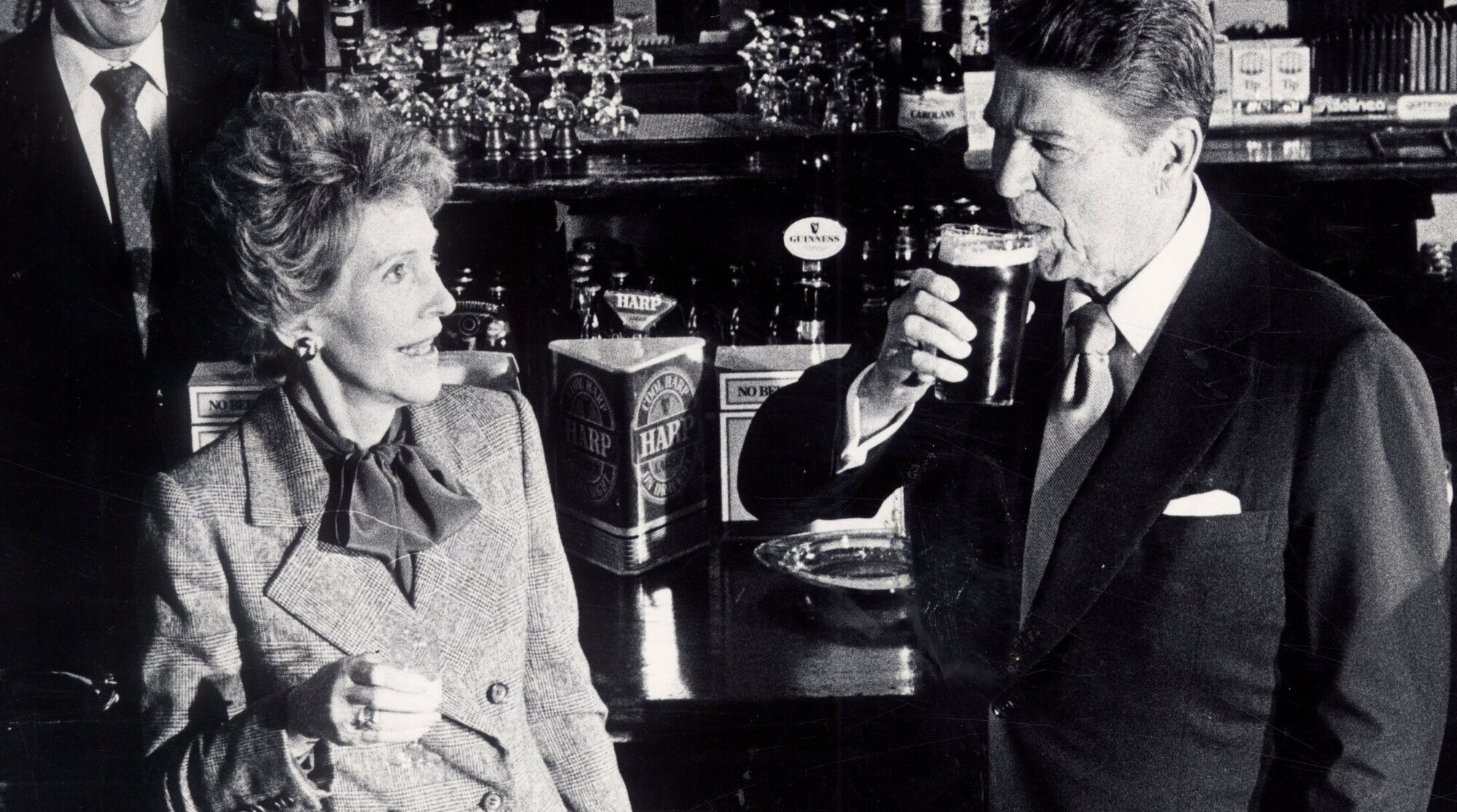
SOFT POWER: Ronald and Nancy Reagan in Ballyporeen, Tipperary, in 1984. Middle-class Ireland has long looked up to the US but Áine Lawlor detects a shift in mood in the Trump era. Picture: Irish Examiner Archive

SOFT POWER: Ronald and Nancy Reagan in Ballyporeen, Tipperary, in 1984. Middle-class Ireland has long looked up to the US but Áine Lawlor detects a shift in mood in the Trump era. Picture: Irish Examiner Archive

We all know that Donald Trump loves golf. He spends most of his weekends playing on one or other of his 14 golf courses, and he’s coming to Ireland next weekend not because he loves us but because of the Irish Open.

Golf is a passion that as many as one in 10 Irish people share with the 47th president of the USA. Just one of ties that bind the American eagle and the shamrock.

Trump also has a soft spot for Irish-American voters. 

Traditionally Democrat, they’ve trended Republican as they’ve prospered. The Pew Research Center found churchgoing white Catholics voted two to one for him at the last election. Steve Bannon calls the Scots-Irish and the Irish-American vote the backbone of America.

And there are the economic ties we hear so much about: Without the bonus of corporation taxes, we’d be at least €11bn in deficit — and Budget 2027 would be a radically harsher proposition. 

The US is our largest trading partner, we’re the fifth-largest FDI [foreign direct investment] investor in the States.

Which is the backdrop to being a guest at a recent golf club lunch and talk on US politics from the UCD Clinton Institute’s Professor Scott Lucas.

It was a room full of nice people, many retired, from a business and/or professional background. Most had travelled to the States many times in their lives.

Middle Ireland looked up to America

They’d seen the Empire State Building and the Statue of Liberty, they’d sampled New York’s fancy restaurants and diners.

They’d played golf in gated resorts in Florida, seen San Francisco and Alcatraz. They’d grown up on the myth of JFK, they remembered the red carpet being rolled out for Ronald Reagan in Ballyporeen, they’d heard Bill Clinton and Barack Obama praise Ireland as a beacon for peace and economic development on the world stage. 

And they had heard Joe Biden say Mayo was part of his soul, and cheer ‘Mayo for Sam’ before the curse was ever beaten.

When American FDI began pouring into Ireland, it had profited many of them and given their children well-paid jobs.

So, they had lived through the American dream here in Ireland, the Irish middle and business class dream, of doing well, and your kids doing better.

Living the American dream in Ireland

As they’d prospered, they’d bought American-style fridges, watched American TV and movies, cried at Hamilton the musical. Their children went on J1 and postgraduate trips to the US, some even married there, so more than a few now had American grandchildren.

Like their counterparts in the States, they were the boomer generation for whom life had basically turned out well. Between Boston and Berlin, Boston was where they’d felt at home.

Prof Lucas began by speaking about his own background, a family divided between Trump diehards and never-Trumpers, a family from the South, his father a preacher. 

It was a fascinating talk — covering the midterms, governorship races, the state of the parties, the economy — and the packed dining room listened closely.

Questions reveal middle Ireland's concerns

Then came their questions, and they were striking. 

• How does America repair the damage? It’s not just one man; it’s a system failure…. 

• How badly damaged is the American democratic system? What about the failure of the courts and the judiciary, the checks and balances of Congress, the partisanship of the American media — how can that all be repaired? 

• Will the midterm elections really be free and fair elections? Is a third party the answer to the failure of both parties, Democrat and Republican?

These were questions from people you won’t see marching against the US president’s visit. People who’ll be glued to the Open, just like Trump, but who don’t share Maga’s American dream.

Questions about the US and Israel 

• Questions about the USA and Israel — where did that allegiance come from? Why was it so enduring, even after everything that’s happened in Gaza? Could that change?

American opposition to the Occupied Territories Bill also came up.

It was all very calm, but it also exhibited concern that something had changed in this second term, that a line had been crossed.

An Israeli strike on Maghazi, Gaza, on August 23 killed three people including a child, according to first responders. Middle-class Irish people who would never have protested a US president’s visit now ask questions about US support for Israel. Picture: Eyad Baba/AFP/Getty

Towards the end, there was another question from one woman that got a murmur of assent from the rest of the room: What about the record-breaking $40tn US national debt, she asked. 

Fear of another crash 

What about the bond markets? There was a note of real worry in her voice. 

An equally worried man wondered would an AI bubble bring it all crashing down. Could the Middle East war do the same?

Because this group remembered the banking crash, the wipeout of bank shares and pension pots, the redundancies, and pay cuts. They had learned, through bitter experience, that whatever dream you’re dreaming, nobody beats the bond markets.

So they’re worried about the price to be paid if this ends badly for the world economy, and Treasury secretary Scott Bessent hasn’t reassured them so far.

As lunch broke up, one woman spoke about her daughter, who works on Wall Street, for a boss who’s a multi-millionaire.

It’s a great job, with her own AI agent to do all her drudge work for her. She’s doing well, although she worries the AI agent they’ve given her will end up costing her own job.

Her boss is doing better. He sees AI as an investment, not a threat. And, under Trump, he’s getting richer all the time, thanks to that booming stock market, and the administration’s cuts to taxes and regulations.

When you’re looking at the glossy brochure for your second yacht, fuel at four dollars a gallon isn’t much of a problem. And how you cast your vote in the mid-terms, a no-brainer.

Worries about America's values

But this woman wondered and worried. And not just about her daughter’s job, or AI, or the chances of a recession.

She worried about values — the values she used to feel were shared on both sides of the Atlantic.

Whatever the midterms bring, there are two more years of those golfers, and others, who’d looked up to the American ideal around the world, wondering whether there’s a way back. Whether that dream can be shared in the same way again, on both sides of the Atlantic.

More in this section

Revoiced

Newsletter

Had a busy week? Sign up for some of the best reads from the week gone by. Selected just for you.

Cookie Policy Privacy Policy Brand Safety FAQ Help Contact Us Terms and Conditions

© Examiner Echo Group Limited