John O'Brennan: Ireland could be crucial to Montenegro's EU accession chances
Like Ireland in 1973, Montenegro is small, peripheral and insecure, in a world of increasingly volatile international relations and a multilateral order in retreat
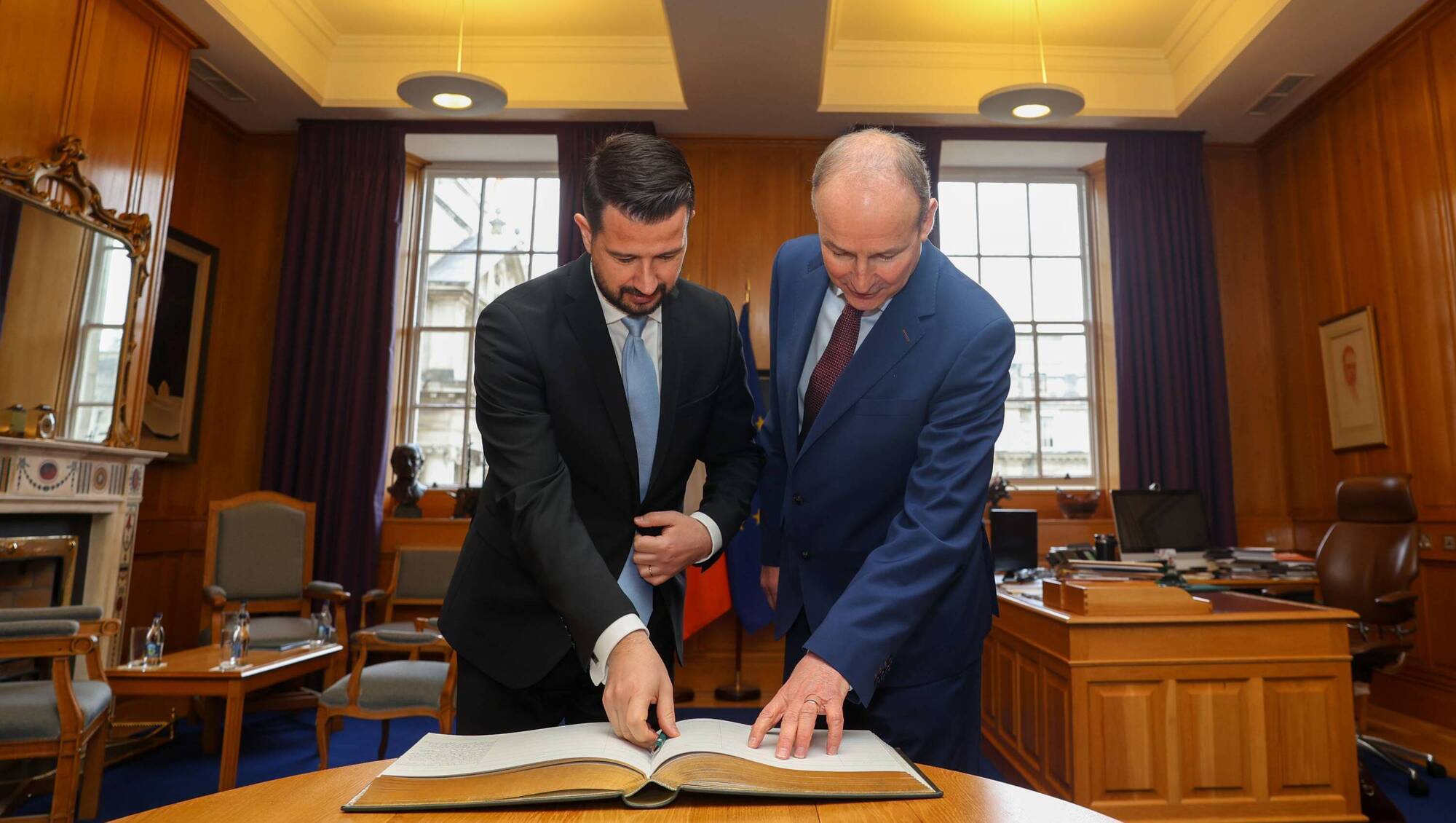
Taoiseach Micheál Martin (left) meeting the president of Montenegro, Jakov Milatović, at Government Buildings in February. Montenegro’s current struggle for international recognition is one that Ireland fought at an earlier stage of its existence.Photo: Government Information Service

Taoiseach Micheál Martin (left) meeting the president of Montenegro, Jakov Milatović, at Government Buildings in February. Montenegro’s current struggle for international recognition is one that Ireland fought at an earlier stage of its existence.
Photo: Government Information Service

The Irish writer Hubert Butler spent a great deal of time in the Balkans in the 1920s and 1930s. 

He wrote beautifully about Montenegro, in particular, introducing Irish readers to a part of the continent that seemed both geographically obscure and faintly mythical. Butler emphasised the proud traditions of the Montenegrins and how its mountainous landscape helped mould the character of the people of the region.

Almost a century later, amongst the items on the packed agenda of the current Irish presidency of the EU Council is how to progress the EU enlargement process, and, in particular, whether negotiations with Montenegro might be closed before the end of this year.

Ukraine and Moldova have both recently opened negotiations for membership which are likely to drag on for many years.

In the western Balkans there are six candidate states — Albania, Bosnia Herzegovina, Kosovo, Montenegro, North Macedonia and Serbia. Of these six states, Montenegro is by far and away the best prepared and the most likely to successfully cross the threshold of EU membership within the next few years.

On a recent visit to Montenegro I met leading academics, officials, civil society representatives and think tank researchers. I wanted to get a better sense of how membership of the EU is perceived in Montenegro, and the challenges associated with persuading the European Council to admit a small state of just over 620,000 people.

Ireland is widely viewed as the paramount success story of the 50 years-plus of enlargement and how membership can help transform a country. Like Ireland in 1973, Montenegro is small, peripheral and insecure, in a world of increasingly volatile international relations and a multilateral order in retreat.

Chapters to accession

Montenegro has made definite and measurable progress in its path to become the next member of the European Union. The EU divides the negotiations into six thematic "clusters", consisting of 33 specific "chapters", each of which is subject to intense negotiation with the candidate states. 

To date, Montenegro has opened all 33 chapters and successfully closed 18 of these. The stated ambition of Montenegro is for "28 by 28", i.e. to become the 28th member state of the EU by the end of 2028. 

Officials talk about the possibility of closing the remaining chapters by the end of the year, with the Irish presidency potentially playing a crucial brokerage role.

By far the most important of these chapters are those found in the first thematic cluster — Chapter 23 and 24 deal with rule of law, the criminal justice system and the fight against corruption. 

To describe progress made by candidate states, the European Commission uses the following scale: "backsliding", "no progress", "limited progress", "some progress", "good progress", and "very good progress".

In its latest analysis of Montenegro’s convergence with EU rules, the commission argues that Montenegro is only "moderately prepared" in the fight against corruption and, similarly, only "moderately prepared" in the fight against serious and organised crime. 

On judiciary and fundamental rights, Montenegro is "between a moderate and a good level of preparation" and has made some progress overall. Montenegro’s judicial system is "between a moderate and a good level of preparation" and has made some progress on the implementation of key judicial reforms.

Montenegro has made "some progress and is between a moderate and a good level of preparation" in developing a functioning market economy and has made "some progress and is between a moderate and a good level of preparation to cope with competitive pressure and market forces in the EU’" 

Montenegro has a "good level of preparation" in the area of public financial control and external audit, but is only "moderately prepared" in the free movement of goods.

On the positive side, both civil society and the media operate in a pluralist and very open environment in Montenegro. Indeed Montenegro has risen dramatically in the press freedom index (41st out of 180 countries in 2026) and ranks significantly above many current EU member states. 

It already uses the euro as its currency and will join the EU mobile phone roaming scheme later this year.

The gap between insiders and outsiders

The enlargement process is a long and protracted one and presents multiple hurdles which candidate states have to clear.

There has always been a tension within the process, between insiders and outsiders, between existing member states who may seek to protect their interests in accession talks, and the outsiders who are endeavouring to gain access to the club.

Ireland’s task over the period of the presidency is to try and bridge the gap between insiders and outsiders while maintaining the integrity and merit-driven nature of the process.

The EU has, in the past, been accused of publishing unrealistically upbeat assessments of candidate state preparations. 

Nobody can claim that of the current talks with Montenegro.

Montenegro’s progress

So, how to interpret the commission’s analysis of Montenegro’s progress? The general consensus is that although Montenegro has made significant progress in a range of important chapters, the road to the finishing line will be tough. 

The difference between the relatively straightforward early chapters and the more difficult later chapters is akin to that between a flat stage of the Tour de France and the agonising climb to Alpe d’Huez. Chapters 23 and 24 constitute the enlargement equivalent of that great climb.

Montenegro cannot count on just meeting the criteria for membership. It will also have to contend with some member states that are sceptical about accepting any new members. 

Recently France, Germany and the Benelux countries published a "non-paper" on enlargement which caused consternation in candidate countries.

By far the most controversial of these proposals was that to potentially restrict the voting rights of acceding states in the European Council and Council of Ministers, particularly in areas which currently require EU unanimity, for a period of up to five years. 

In addition, a range of other rule of law "safeguards" have been put forward to guard against "democratic backsliding" of the kind we saw in Hungary, for example, during the Orban years.

For all of the potential obstacles Montenegro faces in completing its march towards EU membership, it should be acknowledged that it has been a reliable and trusted partner of both the EU and Nato for many years. 

It is located in an important part of Europe where the EU needs a presence and geopolitical impact to match that of China and Russia.

Most importantly, it is a small European state seeking to anchor itself in the safer and more prosperous harbour that the European Union provides. 

Hubert Butler would recognise Montenegro’s current struggle for international recognition as one that Ireland fought at an earlier stage of its existence. Ireland may yet play an important part in helping Montenegro achieve its ambition of joining the European family.

  • John O’Brennan is professor of European Politics in the Department of Sociology at Maynooth University and director of the Maynooth Centre for European and Eurasian Studies. He has written a number of books on EU enlargement policy.
x

More in this section

Revoiced

Newsletter

Had a busy week? Sign up for some of the best reads from the week gone by. Selected just for you.

Cookie Policy Privacy Policy Brand Safety FAQ Help Contact Us Terms and Conditions

© Examiner Echo Group Limited