ieExplains: How will Ireland's presidency of the EU work and what events will take place?
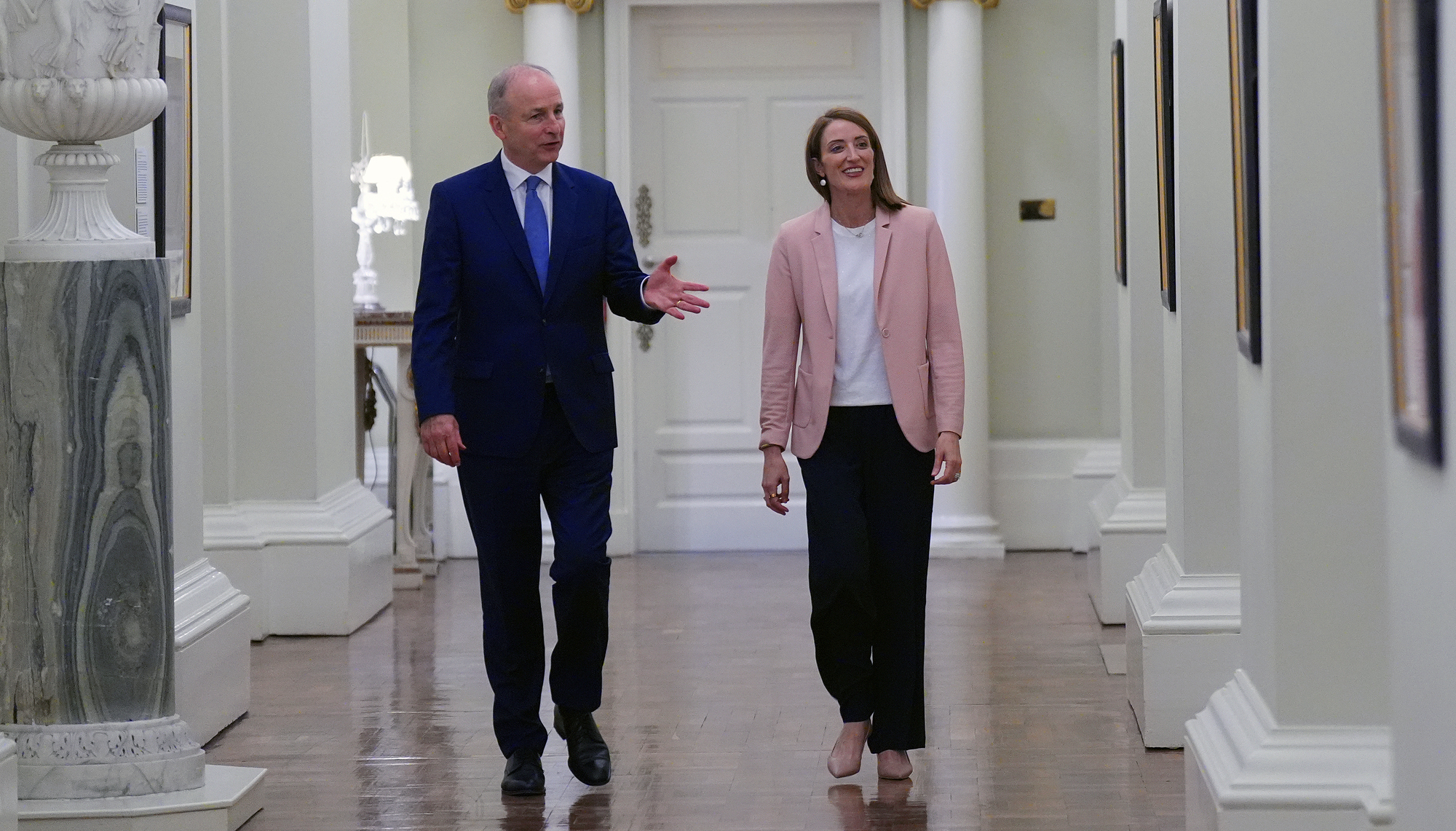
Taoiseach Micheál Martin with the president of the European Parliament Roberta Metsola at Dublin Castle for a meeting this week ahead of Ireland assuming the EU presidency. Picture: Niall Carson/Pool/RollingNews.ie
Over the next six months, Ireland will receive a conveyor belt of Europe's top politicians: from commissioners, to Government heads, to senior officials as we take over the rotating EU presidency.
Ireland will be at the centre of EU decision‑making, steering complex negotiations that shape laws and policy for about 450 million people.
This comes at a challenging time for the EU as Russia’s war in Ukraine continues, migration remains politically sensitive, competitiveness is under pressure, and the demand to meet climate targets is intensifying.
Overall, more than 270 events will take place across the country as Ireland chairs most meetings of the EU Council, sets its work programme and acts as its representative.
This will be the eighth time Ireland has led the EU Council since 1973, last holding the presidency in 2013.
Read More
A massive amount of preparation has gone into holding key meetings and hosting European leaders, with extra staff taken on, security measures put in place, facilities upgraded and diplomatic relations strengthened.
During its presidency, which runs from the beginning of July until the end of December, Ireland will host 22 informal ministerial meetings and two ministerial conferences.
More than 250 other important meetings and conferences will take place in venues across the country.
The most high-profile event of the calendar is expected to be the informal meeting of heads of state, or government of the EU, which will take place in November.
The Irish Government has set a number of priority areas it wants to focus on as it chairs meetings over the coming six months — this includes strengthening protections for children online.
Taoiseach Micheál Martin has promised social media age verification will be "a key factor" in the work that is carried out around online safety for young people.
EU enlargement is also an area that will gain a significant amount of focus. A number of countries, including Ukraine, are at different points along the road to entering the union.

Mr Martin has already suggested one of those countries, Montenegro, could be “very close to the end line by the end of the year”.
Ireland will inherit ongoing policy discussions and legislative negotiations from the soon-to-end Cypriot presidency, while responding to any emerging challenges during its six-month term.
Beyond formal policymaking, the presidency will also be used to showcase Ireland internationally.
The Government plans include cultural initiatives, youth engagement programmes, and partnerships linking Irish counties with EU member states.
More than 300 additional civil servants across 16 Government departments have been hired to support the extra work relating to taking on numerous sensitive legislative dossiers, chairing meetings and steering the EU agenda.
These extra staff have been taken on in both Dublin and abroad and are on contracts of between six months and 18 months duration.
The Department of Foreign Affairs, for example, has recruited 130 additional staff — 79 in Iveagh House in central Dublin, 45 across the "mission network”, and six new translators.
In Brussels and Luxembourg, Irish ministers and officials will chair about 180 council preparatory bodies and lead negotiations with the European Parliament across a broad range of legislative files.
As a result, public sector unions have been pressing for one–off payments for civil servants of varying amounts, depending on the extent of their involvement in presidency-related duties.
This involves cases where members take significant travel, or carry primary responsibility for the chairing, negotiation, or coordination of presidency business, requiring sustained additional attendance over the course of its duration.
The gardaí have been preparing for the security requirements of Ireland hosting the EU presidency since January 2024, with deputy commissioner, Policing Operations, Shawna Coxon, tasked with coordinating what will be a significant operation and will be tied in with the Defence Forces.
Gardaí have visited countries that recently held the presidency to learn from their experiences, and policing and security colleagues have also visited Ireland.

A fleet of 78 cars to transport dignitaries and officials has been procured, along with 75 motorcycles for escort duties; 12 mini-buses for transporting gardaí, and a tactical truck for use by specialist firearm Garda units, including Emergency Response Unit, and Armed Support Units.
With drone attacks also now a real threat, there has also been significant investment in counter-drone capability over the last 18 months, as well as upgrades to ICT systems and support.
Gardaí have received extra training in close protection; strategic, tactical and operational command; public order; and motorcycle escort.
Meanwhile, Garda managers have been engaged in a series of table-top exercises on potential scenarios for policing the EU presidency.
Dublin Castle will be the primary State venue, however, other gatherings will take place in Cork, Mayo, Wicklow, Limerick, and Kerry.
The opening event will take place on Wednesday in Dublin Castle, which is closed to the public in its entirety, including the Chester Beatty Library and Dubh Linn Gardens. This means Castle Street, Ship Street Little and Ship Street Great will be closed to both traffic and pedestrians.
The Office of Public Works expects to spend about €10m on event catering and hospitality services for State dinners and high-level lunches over the course of the presidency.
Issuing a tender late last year, it outlined how hospitality would be required across several venues, including Dublin Castle, the North Range of the Royal Hospital Kilmainham, the Botanic Gardens, Áras an Uachtaráin, Iveagh House, and Farmleigh. This contract will continue for two years.
The tender document stated some dining events would require five-course meals with wine pairings, a bespoke-designed menu, serving high-quality, seasonal, organic food with geographical indications, according to tender documents.
Other hospitality options will include wine and canapés, selections of sandwiches, tea, coffee, pastries, and buffet-style lunches, involving formal service styles and beverage lists to accompany menus.
All of this comes at a price and this time around, the cost is expected to exceed €293m, with some estimates suggesting the final figure could approach €400m once Garda security operations, infrastructure works, and other associated costs are included.
This represents a significant jump in comparison to the €50m spend the last time we hosted it.
The OPW has spent €12.55m renovating Dublin Castle ahead of the presidency.
This includes to the Hibernia Conference Centre, which the OPW said had “not undergone a significant refurbishment in over 40 years” and has now been “comprehensively upgraded to meet modern international standards”.
This included a full upgrade of mechanical and electrical systems across the complex, modernisation of the auditorium and translation booths, acoustic improvements to key conference and dining spaces, upgraded kitchen facilities to support State functions, refurbished reception, seminar, and bathroom facilities, and “decorative upgrades”, including a “Green Corridor,” which will “provide high-quality office accommodation for EU delegations”.

University College Cork (UCC) will host most of the events across the two days. Europe’s 27 commissioners, including Michael McGrath, will be welcomed.