Irish people's lack of concern over climate action due to mixed messaging from politicians
While more than seven in 10 respondents described themselves as either very or somewhat environmentally conscious, just one in seven reported this had altered their behaviour in any significant way.
Of the many findings to emerge from the new Irish Examiner Sustainability Poll, perhaps the most striking is the chasm that still exists in the Irish public mind between being environmentally conscious and actually doing anything concrete about it.
While more than seven in 10 respondents described themselves as either very or somewhat environmentally conscious, just one in seven reported this had altered their behaviour in any significant way. One in four who self-identified as environmentally conscious were candid in stating it had no effect whatsoever on their behaviour.
This is described by the Ipsos B&A researchers as the consciousness-action gap, with economic factors most widely cited as the reason for inaction despite being concerned about the environment.
Belief in the reality of climate change is widespread in Ireland, with only 13% of respondents expressing serious doubt, yet when translated into personal concerns, it ranks only seventh in a list dominated by more personally salient financial and economic issues.
While many of the findings in the new poll are broadly in line with previous research, there were a number that were genuinely surprising. More than one in three respondents said who they vote for is "heavily influenced" by their environmental concerns, yet the 2025 election results, with just 3% voting for the Green Party, would suggest many are being somewhat economical with the truth about what really wins their vote.
Another conclusion in this research that is likely to raise some eyebrows is that farmers, by their own description, emerge as far more environmentally engaged than the population as a whole, with nine in 10 self-reporting as environmentally conscious, and one in three saying they have made significant behavioural changes — this is more than double the rate for the population as a whole.
Read More
While this ecological interest is extremely welcome news, especially for those wishing to paint climate action as only of interest to urban elites, when you drill a little further into the data, a more nuanced picture emerges. When asked about the causes of climate change, only one in seven farmers identifies agriculture, despite it accounting for almost 40% of Irish national carbon emissions.
Nearly three times more farmers — incorrectly — believe "natural change in the environment" is driving climate change rather than human actions, while most farmers blame transport, which in reality accounts for less than half the agri sector’s emissions.
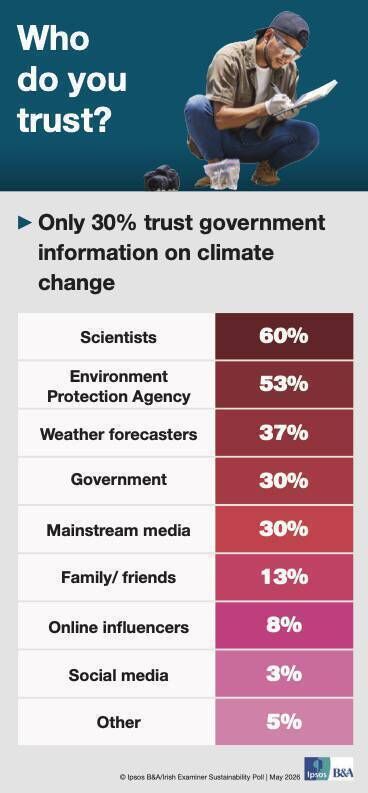
Worryingly, while two-thirds of the Irish public see the Environmental Protection Agency (EPA) as a trusted source on climate, only 38% of farmers concur. This is likely to be related to the EPA’s role in reporting on emissions as well as water-quality issues.
Astonishingly, only one in eight farmers reports trusting the Government on climate change, far lower than the national average.
Among the wider public, misconceptions as to what constitutes effective climate behaviour are widespread. While seven in 10 believe recycling is the most effective personal climate action, only one in five identify a vegetarian/vegan diet. In reality, mainly plant-based diets are vastly more impactful in terms of reducing emissions.
Just one in five identified cutting down on flying as the most effective way to reduce climate impact, a hugely significant contributor to personal carbon emissions. The Government’s efforts to remove passenger caps at Dublin Airport will undoubtedly have contributed to public scepticism over the true impacts of flying.
The research delivers a sharp rebuke to the current Government on its climate record. This is particularly strong among women, with two in three saying it is not doing enough. Overall, more than one in four believe climate change has become less of a priority for the State. Government back-pedalling, in other words, has not gone unnoticed.
There is strong public support in Ireland for wind and solar energy, as well as increased spending on public transport.
Where this rapidly tails off is when the public is faced with options, such as banning cars in city centres, they perceive as limiting their freedom. Similarly, only one in 10 supports higher petrol and diesel taxes or higher carbon taxes, and just 15% support reducing the size of the national herd.
While in other countries, trust in expertise is collapsing, it is encouraging from this research to see scientists and the EPA are widely considered to be trustworthy, while sensibly, only 3% of people in Ireland trust what they see on social media about climate.
I was surprised only 13% of respondents considered family and friends to be "trusted sources" on climate. This suggests many people are reluctant to discuss climate issues in their social groups.
The mainstream media is rated as trustworthy on climate by only 30% of respondents. What is clear from the new poll is that the gap between the intensifying global climate crisis and public concern is still very wide, with little sign of closing, due in no small part, I would suggest, to mixed and confused messaging from our politicians.
- John Gibbons is an environmental journalist and author of
CLIMATE & SUSTAINABILITY HUB
CONNECT WITH US TODAY



Be the first to know the latest news and updates