Irish people believe in climate change — we just don’t want to pay more for it
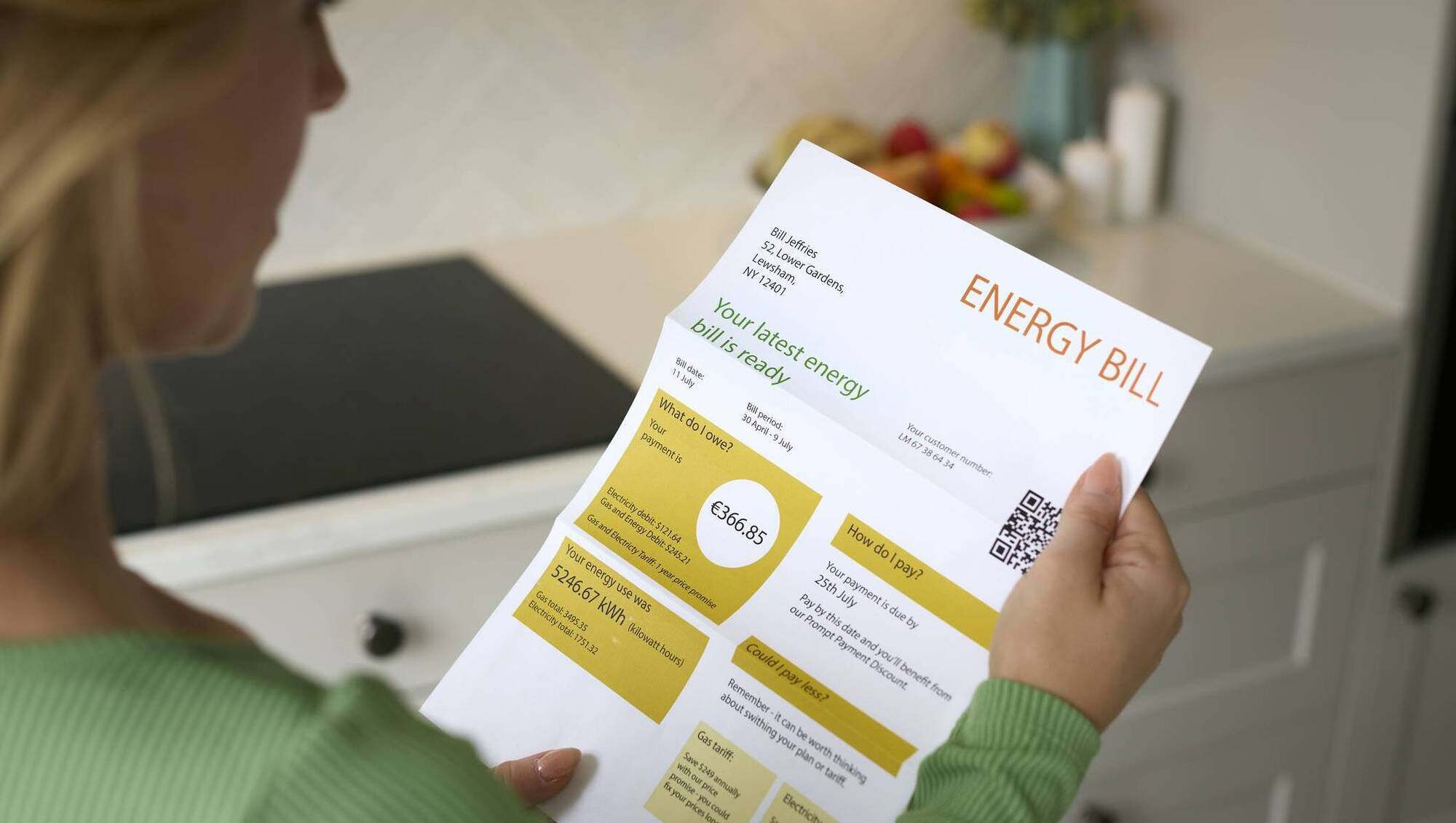
The Irish Examiner Ipsos B&A poll found that most people believe climate change is real — but favour investment over higher carbon or fuel taxes. Picture: iStock
Most Irish people do not believe the country is prepared for the impacts of climate change, but favour greater investment in public transport and EV grants over higher carbon taxes or fuel costs.
Experts have warned that the cost-of-living pressures on households mean they cannot or are unwilling to shoulder the burden alone and need policymakers to urgently step in.
A poll of 1,056 adults for the by found that 80% of adults believe that climate change is real but may be more pre-occupied with more immediate economic pressures. A similar proportion believe that the global economy will worsen in the short term.
The results suggest many Irish people see themselves as environmentally conscious, but are not making significant changes to their own behaviour.
CLIMATE & SUSTAINABILITY HUB
Today, Monday June 1, the 'Irish Examiner' publishes an in-depth analysis — in print and online here — of its new Ipsos B&A poll on Irish people's attitudes to issues including climate change
Read More
"Similar patterns are consistently observed across international research, where awareness does not always translate into meaningful behavioural change,” said Marica Cassarino, environmental psychologist at UCC and member of the Psychological Society of Ireland’s special interest group for addressing the climate and environmental emergency.
Ms Cassarino said that supporting climate adaptation measures such as flood preparedness and mitigation such as shifting to more sustainable forms of transport needs systems that make these options more accessible and attractive while at the same time gradually discouraging the unsustainable practices.
For this to happen, there needs to be a strong structural and policy environment in which these choices are made.
“The strong preference expressed in the poll for incentives over punitive measures, such as carbon taxes, can also be interpreted through the lens of the current cost-of-living crisis,” she said.
“For many households, particularly those reliant on fossil fuels for transport or home heating, policies perceived to impose immediate financial costs and efforts may feel difficult to accept, even where long-term benefits are recognised.”
The poll was conducted in late April and early May, after the fuel protests which brought Ireland to a standstill several weeks prior and amid the ongoing price surge that followed the US and Israeli war in Iran.
It found that 59% of people think the Government isn’t doing enough with the available resources it has on climate change, with less than one in five (18%) deeming their current efforts adequate.
The poll identifies a perception gap, with 34% of people saying climate action has become more personally important to them while at the same only 27% say that the Government has made it more of a priority.
Breffní Lennon, a research fellow in the School of Engineering and Architecture and the Sustainability Institute at UCC, said that historically the Government has reneged on its responsibilites through underinvestment in sectors such as public transport.
“We are supposed to be living in a ‘climate emergency’ but it feels more like we are living through a slow-motion car crash, when we step back and look at Government performance,” he said.
“And the gap between personal and state prioritisation is very telling. If Government does not start to take the climate emergency more seriously, we are still going to hit the wall.”
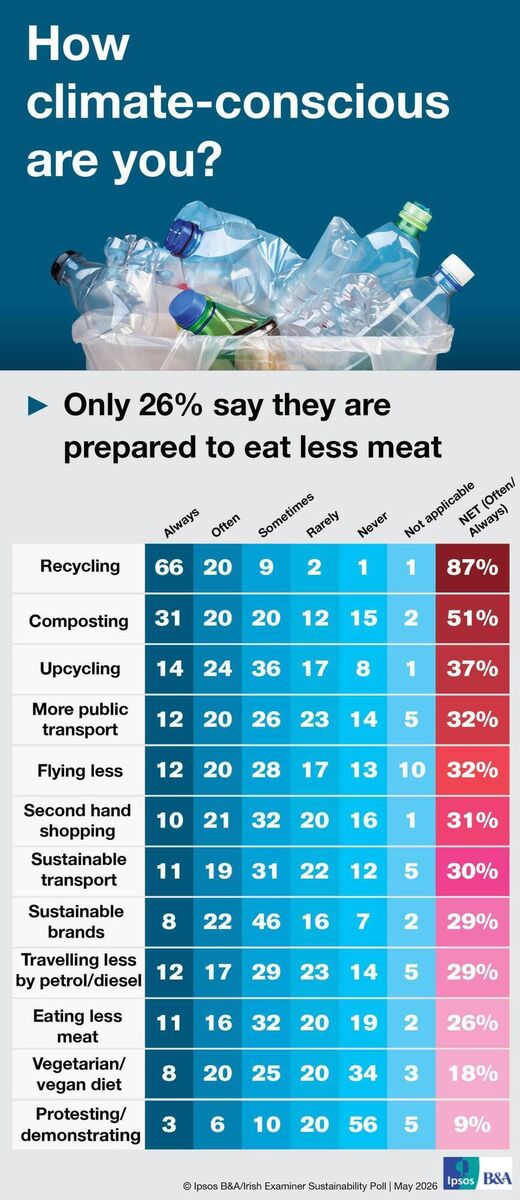
While people feel aware of the issues around climate change, a significant proportion aren’t doing anything about it.
The poll found that 71% of adults identify as environmentally conscious, but only 14% make significant behavioural changes.
Around 26% of people say they consider themselves environmentally friendly yet don’t modify their behavior at all.
There were significant differences by age and gender, with 11% of women describing themselves as environmentally conscious and that it alters their behaviour significantly compared to 18% of men.
Furthermore, 34% of 18-24-year-olds described themselves as environmentally conscious but said it doesn’t really alter their behaviour compared to 17% of people aged 65 and over.
The reasons given as to why people don’t take action is the financial freedom to do so (cited by 59% of people), followed by a lack of Government supports (37%) and infrastructure gaps (31%).
This suggests that environmental intent is not translating into action, with economic constraints a significant issue.
Sinéad Sheehan, who researches climate action and eco-emotions based in Ryan Institute and School of Psychology, University of Galway, highlighted the impact of these constraints as holding back people’s ability to make their own personal contribution to being more sustainable.
“The results of the report suggest that people are concerned about climate change and around 70% of people wish to change their behaviour accordingly,” she said.
“However, it is clear that there are significant structural constraints to behaviour change, in relation to financial barriers or perhaps access, if we consider rural public transport as an example.”
Mr Lennon said it was "very telling" that only 14% make behavioural changes.
“It indicates, despite the positive spin put out there about ‘consumer agency’ — the power of one, etc — people are actually locked-in to economic and social systems that are difficult to change through individual actions alone,” he said.
When it comes to actions they want to see taken, there is a clear preference among the public for investment over taxation.
Support is highest for greater investment in public transport (65%), wind energy (58%), solar (54%), and higher EV grants (44%).
At the other end, there is least support for higher carbon taxes (11%), higher petrol/diesel taxes (11%), and reducing the national herd.
The results suggest a clear preference for incentive-driven and infrastructure-focused measures rather than taxation measures that hit households’ pockets.
James Green, a health psychologist specialising in behavioural science at the University of Limerick, said the findings point to a significant opportunity for more ambitious structural change, rather than continuing to place the burden primarily on individuals.
“The apparent lack of public appetite for punitive measures is unsurprising; behavioural evidence consistently shows that people are more receptive to change when environments and systems support it, rather than when they feel constrained or penalised,” he said.
“What is striking, however, is the broad consensus across demographic groups that climate change is real. The relative consistency of this belief across respondent groups indicates that the issue is not one of awareness or denial, but of translating concern into meaningful action.”
The Environmental Protection Agency conducts its own research into public perceptions around climate change with a recent study breaking the population into “the Four Irelands” when it comes to climate change: The alarmed, the concerned, the cautious and the doubtful.
“Successfully addressing the challenge of climate change requires a diversity of messages, messengers, and methods that reach each of these audiences, and must be tailored to meet their particular needs, and [our studies] provides a useful framework to help climate communicators identify and understand their target audiences to engage the public more effectively about climate change and solutions,” a spokesperson said.
In terms of preparedness for climate change, 17% of people said they agreed that they personally were ready for the impacts of climate change compared to 47% who said they weren’t.
This pessimism deepened when asked about the country as a whole. A majority of people think both that Ireland is not prepared for the impacts of climate change (61%) and that society has not done enough to be prepared for the effects of climate change (63%).
Mr Lennon added: “I think a notable impression to take away from this survey is that people are far more engaged and knowledgeable than they are sometimes given credit for — which is encouraging — but the systemic and institutional inequalities that we are experiencing are being translated into individual experiences in real-time and hindering our individual (and collective) agency to effect the changes that are needed.
“Individuals cannot instigate change unless the system is built to facilitate it. We are still missing those levers.”
On a regular basis, another climate report lands in the inbox — from the Climate Change Advisory Council, the Environmental Protection Agency, the EU’s Copernicus service, or academic researchers.
Each focuses on a different facet, but the message is much the same: Man-made climate change is accelerating, emissions are not falling fast enough, and targets are being missed.
The longer this goes on, the planet gets hotter, the storms get stormier, and the risk to businesses and livelihoods from floods only heighten.
Experts in the field could be forgiven for being blue in the face sending us the same messages time and time again.
In the past month alone, data has shown Europe is warming faster than any other continent. Just weeks later, Ireland was among the countries to record its hottest May day on record.
Professor Peter Thorne from Maynooth University remarked that “to break the all-time May record by more than 2 degrees is hard to comprehend”.
After a miserable and rainy start to the year in Ireland, people could be forgiven for making the most of a few hot days. But it doesn’t take from the fact that such heatwaves are becoming more normalised and bring with them a host of problems as they pose a risk to the nation’s health.
This poll commissioned by the in recent weeks delves into how people are feeling about it all.
Several experts believe governments and policymakers need to be upfront with the public, emphasising that action on climate change does not have to come at the expense of the cost of living.
As Marica Cassarino from UCC told us: “Issues such as cost of living, migration, and resource pressures are closely tied to global environmental and geopolitical dynamics, yet this complexity can be difficult for individuals to fully engage with.
“This highlights the need for clear, trusted communication that helps people make sense of these interconnections, fostering more systemic thinking, and, ultimately, supporting more sustained climate-positive behaviours.”
Tiny little Ireland of course can’t turn the tide alone, of course.
But we can take measures that will mitigate as best we can the very real and devastating effects of climate change that will happen — and in some cases already are happening — to our citizens.
These findings suggest Irish people are more than willing to be onboard. They just need the right support and guidance to make it happen, and it is something the Government simply cannot ignore.
Read More
CLIMATE & SUSTAINABILITY HUB
CONNECT WITH US TODAY



Be the first to know the latest news and updates